

A new University of Southampton research study is asking prosthetists, orthotists and technicians to share first-hand evidence of how transtibial prosthetic sockets actually fail in clinical use, with the aim of improving the way socket strength is assessed in the laboratory.
The study, titled “Understanding real-world structural failures of transtibial prosthetic sockets,” focuses on the gap between laboratory structural testing and the failures clinicians observe in everyday practice. It specifically aims to compare real-world failures with existing test approaches, including those described in ISO 10328, and to contribute to ongoing efforts to develop more appropriate structural testing methods for sockets.
The project has received University of Southampton ethics approval and is being conducted by Siqi Liu, Laurence Russell and Alex Dickinson.
For the P&O profession, the study addresses an important issue: sockets are one of the most patient-specific and clinically critical parts of a prosthesis, yet information about where, when and why they fail is rarely captured systematically.
Clinicians hold evidence that laboratory tests may miss
The researchers are inviting professionals who design, fit or repair prosthetic legs because they are likely to have direct experience of structural damage and socket failure.
The study notes that these observations are rarely captured in published literature or in a central register, which makes clinicians an important source of real-world evidence. The research team is aiming to collect approximately 50 to 100 responses.
That distinction is important.
Laboratory testing can provide controlled and repeatable loading conditions, but patients use prostheses in far less controlled environments. Sockets experience repeated loading, impact, twisting, heat, moisture, changes in body weight and activity, different terrains and occasional unexpected events.
How those combined factors translate into structural failure may not always be reproduced by a standardised test.
The Southampton project is therefore trying to understand whether the failure mechanisms clinicians see in practice correspond with the locations and loading conditions currently represented in structural testing.
What types of failure is the study looking for?
The questionnaire asks clinicians to describe the transtibial socket failures they encounter most frequently.
It separates failures into broad categories including damage to the socket itself, detachment of a distal connector or other hardware, and other forms of structural failure.
Importantly, the researchers are also interested in where failures begin.
The survey identifies a number of possible initiation points, including the anterior, posterior, medial and lateral distal socket, the area below the patellar tendon, and the posterior-medial and posterior-lateral brim lines.
That location-specific information could be particularly valuable when comparing clinical failures against laboratory loading configurations.
If real-world cracks or delamination consistently initiate in particular regions that are not adequately stressed during current testing, that could help inform the design of future test methods.
All major socket fabrication methods are included
The study is not restricted to one socket technology.
Clinicians can report failures involving composite or laminated sockets, plastic sockets and other materials, while fabrication methods can include thermoforming, vacuum or bubble forming, lamination and 3D printing/additive manufacturing.
That is particularly timely as prosthetic socket manufacturing becomes more diverse.
Traditional laminated and thermoformed sockets remain widely used, but additive manufacturing is becoming increasingly important in both research and clinical services.
As new materials and fabrication techniques enter practice, the P&O profession needs confidence that structural testing methods remain relevant across different manufacturing approaches rather than reflecting only traditional socket construction.
Patient and prosthesis context matters
One of the strengths of the survey is that it does not look at a damaged socket in isolation.
Where clinicians have the information available, the researchers ask about the socket type, suspension system, materials, fabrication method, time in use, patient weight, activity level, residual-limb shape and whether failure followed a particular event or developed through accumulated damage.
The survey also distinguishes between Patellar Tendon Bearing and Total Contact/Total Surface Bearing sockets and asks about suspension systems including self-suspension, suction or vacuum, pin lock and lanyard systems.
These variables may help reveal whether certain combinations of patient characteristics and fabrication approaches are associated with particular types of failure.
For example, a high-activity K4 user with a particular socket construction may expose the device to very different loading conditions from a lower-activity user.
The study asks clinicians to record activity using the K1 to K4 classification, as well as approximate user weight.
Photographs of failed sockets could be especially valuable
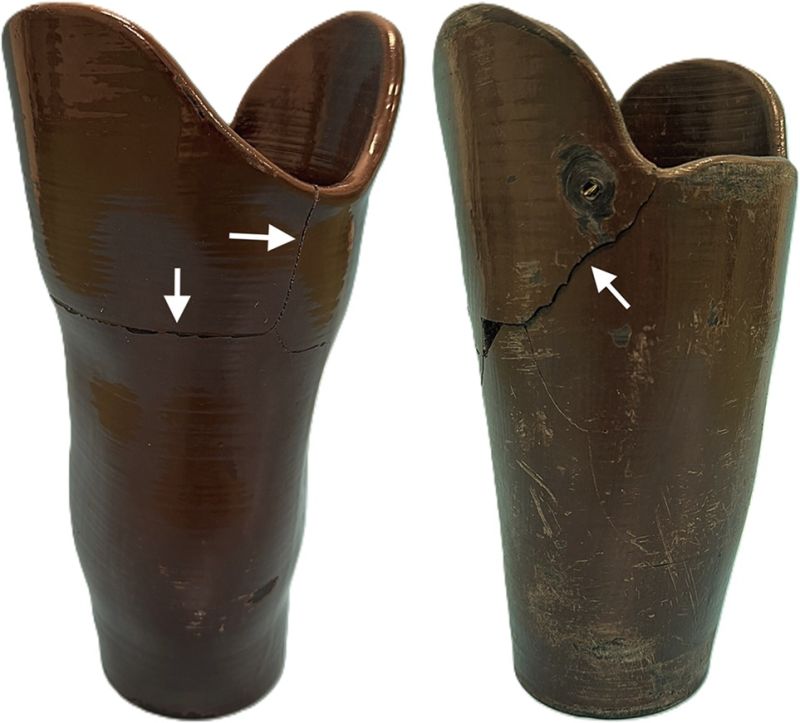
Participants can also submit photographs of damaged sockets.
The researchers encourage clinicians to upload up to three images showing the overall socket and close-up views of the failure, while removing or obscuring any identifying markings such as decorative artwork.
Photographic evidence could become particularly useful because the physical appearance of a failure can provide information that a written description alone may not capture.
Crack direction, delamination, local deformation, connector separation or brim damage can all potentially provide clues about the loading conditions that led to failure.
The study also asks whether submitted photographs may be used as examples in future publications.
The aim is better socket testing, not assigning blame
The researchers are explicit that the purpose of the work is not to assign responsibility for failures.
The survey is designed so that data are processed anonymously, and the participant information states that no liability for socket failures can be implied, specifically to reassure prosthetists and technicians who may otherwise be concerned about legal implications.
Instead, the objective is to build a better understanding of how sockets behave outside the laboratory.
The information collected will contribute to the researcher’s MSc dissertation and is intended to support academic presentations and future research. The study may also inform ongoing work by the AOPA Socket Guidance Work Group to improve structural testing standards.
Why this research matters for IMEA CPOs
The study is particularly relevant for clinicians across the IMEA region because socket fabrication methods and operating environments can vary considerably.
P&O services may be working with laminated composites, polypropylene, thermoplastics, central fabrication, locally fabricated components or increasingly 3D-printed sockets.
Patient environments can also range from urban clinics to humanitarian programmes and rural areas where prostheses may be exposed to demanding terrain, high temperatures and limited access to maintenance.
Collecting failure evidence from a broad geographical range could therefore help ensure that future structural testing guidance reflects real clinical diversity rather than a narrow set of laboratory conditions.
The survey specifically invites responses from professionals across North America, Central and South America, Europe, Asia, Africa and Australia/Oceania, giving IMEA clinicians a clear opportunity to contribute to the dataset.
An opportunity for CPOs to influence future standards
Prosthetic socket design is becoming increasingly sophisticated, but ultimately every socket has to survive thousands of loading cycles while safely transferring forces between the residual limb and the rest of the prosthesis.
Understanding how sockets actually fail is therefore fundamental to improving safety.
The Southampton study provides an opportunity for clinicians to turn everyday workshop and clinic experience into evidence that could influence future testing methods.
A cracked socket returned for repair may normally be replaced, documented briefly and forgotten.
Under this project, the same failure could become part of a much larger dataset identifying patterns across materials, fabrication methods, socket designs and patient groups.
For CPOs, that represents an unusually direct opportunity to contribute practical clinical knowledge to the development of future prosthetic socket standards.
- University of Southampton
- International Organization for Standardization – ISO 10328
- American Orthotic and Prosthetic Association
- International Society for Prosthetics and Orthotics