

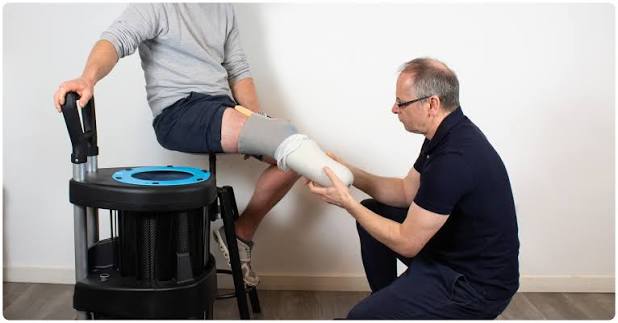
For prosthetists and orthotists across the Middle East, Africa and South Asia, the economics of introducing a new socket technology are usually straightforward: the clinical benefit has to be clear, the investment has to be recoverable, and the system has to fit into existing workflows.
The AMPARO Prosthetic Starter Pack performs strongly against all three criteria.
For a clinic investment of approximately US$20,000, the package can establish a complete direct-fit transtibial socket pathway while also providing a reusable Majicast system that can remain in service for years.
The starter configuration considered in the IMEA CPO ROI model includes:
- 1 × AMPARO Majicast
- 10 × AMPARO Trust check/interim sockets
- 10 × AMPARO Resilience definitive sockets
AMPARO’s own materials describe Majicast as a system for capturing residual-limb shape and volume under full weight-bearing conditions using hydrostatic pressure, while integrating directly with its socket products.
That combination creates both an immediate clinical pathway for 10 transtibial patients and a long-term capital asset for the clinic.
The commercial case is unusually simple
Using an illustrative UAE reimbursement value of AED 35,000 per completed below-knee prosthetic case, the first 10 patients could represent:
AED 350,000 in gross case revenue
against an initial investment of approximately:
AED 73,450
That means the initial starter-pack investment is recovered from gross case revenue during the third reimbursed patient.
The first 10 cases therefore represent a gross revenue multiple of approximately 4.77 times the original investment.
The economics become even more compelling because the US$20,000 is not simply being spent on consumables.
The Majicast is reusable capital equipment.
AMPARO’s distributor materials show the Mixed Starter Pack configuration with one Majicast, 10 Trust sockets and 10 Resilience sockets, alongside training and clinic tools.
Once the first 10 sockets have been used, the Majicast remains in the clinic.
That means subsequent patients require replenishment of socket inventory rather than another major equipment purchase.
For a CPO with a regular transtibial caseload, the cost of Majicast can therefore be spread over dozens or potentially hundreds of patients.
At 100 patients, an US$18,000 capital-equipment value works out at only US$180 per patient.
Clinically, the value may be even greater
The strongest argument for AMPARO is not purely financial.
The system is designed around one of the most difficult areas of prosthetic practice: socket fit.
AMPARO describes its approach as a modular fitting system that allows clinics to introduce direct fitting, weight-bearing shape capture and adaptive socket care without replacing their entire existing workflow.
That matters because many clinics across IMEA still rely heavily on conventional casting, plaster modification, check-socket fabrication and laminated definitive sockets.
These methods remain clinically valid, but they are labour intensive.
The AMPARO model potentially compresses parts of that pathway.
According to the company’s clinical materials, fittings can move from multiple visits and weeks of processing to around one hour in appropriate cases, while allowing real-time patient feedback and adaptation to residual-limb volume change.
For the CPO, that creates the possibility of seeing more patients without simply adding more workshop capacity.
Trust and Resilience create a logical clinical pathway
The Trust Socket is intended as an affordable, remouldable check socket for transtibial patients.
AMPARO states that the Trust Socket can be remoulded up to five times before additional components are attached and can support different suspension choices depending on clinician preference.
That makes it particularly useful during the early stages of rehabilitation when limb volume and fit may still be changing.
The Resilience Socket provides the definitive stage.
AMPARO describes it as a transtibial socket constructed from low-temperature thermoplastic reinforced with Kevlar fibres and an aerospace-grade aluminium mounting plate. It can also be remoulded up to five times and supports pin, passive vacuum and active vacuum options.
This means the CPO has the ability to move from an initial check/interim stage into a definitive socket while remaining within the same broader clinical system.
This is particularly relevant for IMEA clinics
The opportunity becomes even more significant when viewed across the IMEA region.
Many clinics face one or more of the following constraints:
- limited technician availability
- long fabrication lead times
- high workshop overhead
- difficult access to lamination infrastructure
- patients travelling significant distances for fittings
- growing insurance-driven demand for faster turnaround
- humanitarian or outreach environments where conventional workshops are impractical
Majicast is specifically designed for use in both clinical and mobile prosthetic environments, according to AMPARO’s technical documentation.
That makes the model relevant not just for premium Gulf clinics, but also for rehabilitation centres, humanitarian organisations and mobile services across Africa and parts of South Asia.
A productivity investment, not just a socket purchase
For CPOs, this distinction is critical.
The US$20,000 investment should not be evaluated as the cost of 20 sockets.
It should be evaluated as the cost of establishing a new clinical capability.
The clinic receives the equipment required for weight-bearing shape capture, an initial supply of check and definitive sockets, and a pathway that can continue operating after the initial stock has been consumed.
Commercially, that means recurring revenue potential.
Clinically, it means faster fittings, potentially fewer patient visits and the ability to adapt sockets as patients change.
Operationally, it can reduce dependence on some of the most labour-intensive parts of conventional socket fabrication.
Why it is a compelling proposition for CPOs
For an established prosthetic clinic already treating below-knee amputees, the business case is difficult to ignore.
The clinic is not being asked to build a completely new service from scratch.
AMPARO has deliberately positioned the system to work alongside existing prosthetic workflows, including plaster-based and digital processes.
That lowers the barrier to adoption.
A clinic can continue using the techniques that work while introducing direct-fit and weight-bearing methods where they make clinical sense.
The result is a technology that potentially improves socket workflow while also creating a measurable return on investment.
For CPOs across IMEA, that combination of clinical flexibility, faster fitting and recurring commercial value is what makes the AMPARO starter model particularly attractive.
It is not simply a new socket.
It is a way for a prosthetic clinic to turn one relatively modest capital investment into a long-term, scalable transtibial service line.