

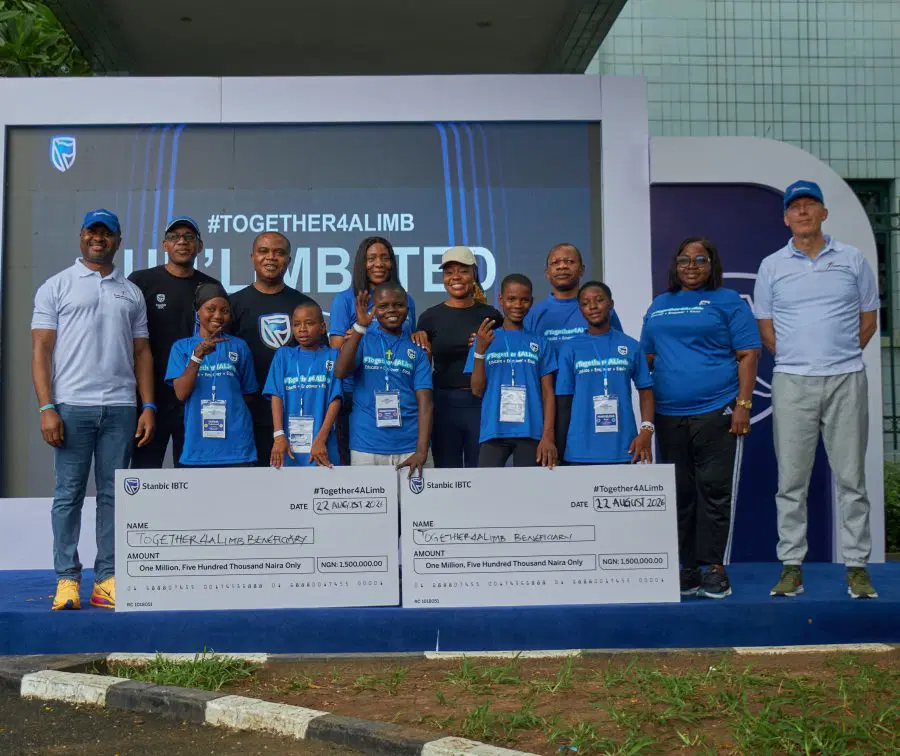
IfeanHealth and Stanbic IBTC Holdings have marked 12 years of collaboration through the Together4ALimb programme, with the Nigerian initiative now having supported 250 children living with limb loss.
The milestone was celebrated during the programme’s 12th annual awareness walk in Lagos in August 2026. The event brought together beneficiaries, families, clinicians, corporate leaders and public representatives to highlight the importance of mobility, education and social inclusion.
According to Vanguard News, IfeanHealth has served as the programme’s prosthetic rehabilitation and clinical-support partner since its inception, while Stanbic IBTC owns and sponsors the initiative.
The partnership illustrates how sustained corporate investment can move beyond a one-time prosthetic donation and support children throughout growth, education and the transition towards adult life.
Fifty new beneficiaries join the programme
The 2026 edition introduced another 50 children to Together4ALimb. Each beneficiary is expected to receive a customised prosthetic limb alongside a Stanbic IBTC Education Trust Fund valued at ₦1.5 million.
A separate Vanguard report said the programme has delivered benefits worth more than ₦800 million since its launch, including over ₦300 million in scholarship funding.
Its reach now extends across different stages of education. Reported beneficiaries include:
- 23 children in nursery education
- 97 children attending primary school
- 55 children in junior secondary school
- 38 children in senior secondary school
- Eight beneficiaries studying at university
- Two children receiving specialist educational support
- Seven beneficiaries who have completed secondary education
These figures demonstrate that the programme’s objectives extend beyond fitting a device. By combining prosthetic rehabilitation with educational support, Together4ALimb aims to address two closely connected barriers: physical access and the financial ability to remain in education.
Rehabilitation measured by what comes next
At the event, IfeanHealth Managing Director and CEO Ejike Anih described the programme’s development through three stages: the circumstances surrounding limb loss, the rehabilitation taking place in the present and the futures beneficiaries are beginning to build.
His central message was that a prosthesis restores a pathway, but the more meaningful outcome is what the person can accomplish once that pathway becomes accessible.
Some beneficiaries who entered the programme as children are now progressing through tertiary education, approaching national service or developing businesses. One recent secondary-school graduate reportedly achieved a score exceeding 300 in Nigeria’s 2026 Unified Tertiary Matriculation Examination.
These outcomes place education, employment and entrepreneurship alongside clinical measures of mobility.
For prosthetists and orthotists, this is an important distinction. Alignment, socket comfort, suspension and gait remain essential, but their value is ultimately demonstrated through participation: attending school, building relationships, entering employment and making independent choices.
Why paediatric prosthetic care requires continuity
Children with limb loss cannot normally be served through a single prosthetic fitting. Growth, changes in body weight, activity and physical development can alter socket fit, component requirements and alignment.
A device that was appropriate at one stage may become short, tight or functionally unsuitable as the child grows. Continuing care may involve:
- Regular clinical reviews
- Socket adjustments and replacements
- Changes to component size
- Alignment reassessment
- Skin and residual-limb monitoring
- Gait training and physiotherapy
- Repair and maintenance
- Support when activity or educational needs change
Poorly fitting or outgrown devices may cause discomfort, skin problems, altered gait or reduced use. Long-term programmes therefore require reliable clinical infrastructure and planned funding for replacement prostheses—not only resources for the first device.
IfeanHealth says its role has included continuing assessment and rehabilitation as beneficiaries progress through different stages of development.
The company describes itself as a health-technology organisation specialising in prosthetics, orthotics and technology-supported rehabilitation. It reports a growing Nigerian network encompassing Lagos, Enugu, Kano, Delta, Sokoto and Abuja.
Supporting children and their families
The effect of paediatric rehabilitation frequently reaches beyond the individual child.
When a child lacks mobility, a parent or family member may need to leave employment, reduce working hours or remain continuously available to provide support. Restoring safe mobility and access to school can therefore affect the economic and social participation of the wider household.
Stanbic IBTC’s earlier account of the programme noted this family dimension. At its tenth edition in 2024, Together4ALimb had supported 136 children, demonstrating substantial expansion to the current total of 250. Stanbic IBTC’s 2024 programme report also described the combination of prosthetic provision, education funding and social acceptance as central to the initiative.
At the 2026 walk, Stanbic IBTC Holdings Chief Executive Chuma Nwokocha emphasised that limb loss should not prevent children from pursuing their ambitions. Representatives of the Lagos State Government similarly described the event as promoting hope, inclusion and opportunity.
A model for corporate rehabilitation partnerships
The programme offers several lessons for corporate social responsibility initiatives involving prosthetics and assistive technology.
Effective programmes should:
- Work with qualified prosthetic and rehabilitation providers
- Provide individually assessed and customised devices
- Budget for growth, repairs and replacement
- Include rehabilitation and functional training
- Track long-term educational and participation outcomes
- Avoid treating the number of devices distributed as the only measure of success
- Build referral pathways for complications or changing clinical needs
- Listen to children and families when shaping future support
Professor Rufai Ahmed, Registrar and CEO of Nigeria’s Medical Rehabilitation Therapists Board, connected the programme with the country’s wider development of assistive-technology and rehabilitation policy. He argued that collaboration between corporate organisations and healthcare providers can help identify needs and demonstrate approaches that later inform national policy.
Corporate programmes cannot replace publicly funded rehabilitation systems. They can, however, provide credible models, strengthen clinical capacity and show the value of investing in long-term outcomes.
After 12 years, Together4ALimb is entering a stage in which its earliest beneficiaries can demonstrate what sustained support has enabled. Its next measure of success will not simply be the number of prostheses fitted, but the education completed, careers established and independent lives built by the children it has supported.
- Vanguard: IfeanHealth Marks 12 Years as T4AL Reaches 250 Beneficiaries
- Vanguard: Together4ALimb Supports 250 Children and Provides Education Funding
- Stanbic IBTC: Together4ALimb Programme
- IfeanHealth