

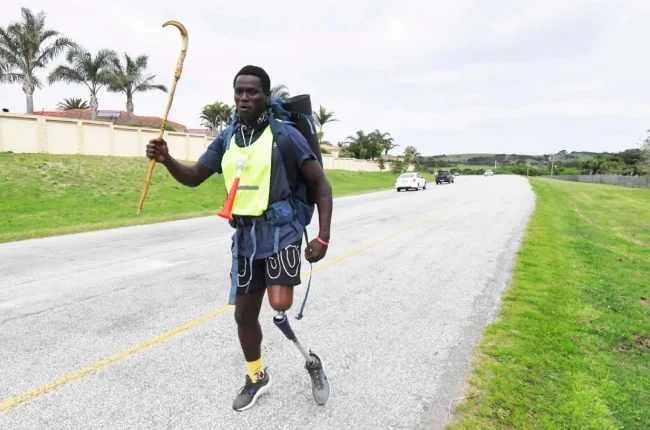
South African amputee Mqondisi Ntshangase is attempting an extraordinary 5,000km journey across the country on a prosthetic leg, using every step to call for greater inclusion of people with disabilities.
Known publicly as King Nipho, the 37-year-old from Krugersdorp began his self-funded #OneLegWalk in Pretoria on May 27, 2026. His route has taken him south to Cape Town, through the Eastern Cape and towards Durban.
By the time he reached Gqeberha in August, Ntshangase had covered more than 2,000km. Walking through the streets of Mount Pleasant with a vuvuzela, he repeatedly called out: “We’re making history.”
His journey, recently profiled by News24’s YOU magazine, is not simply an endurance challenge. Ntshangase says it is intended to encourage support for people with disabilities while promoting national unity and the South African principle of Ubuntu.
Walking for inclusion and social cohesion
Ntshangase’s central message is that people should act when they see exclusion or division within their communities.
“My main mandate is to do something to include people living with disabilities,” he explained during his visit to Gqeberha. He also described the walk as a positive response to disorder and division, choosing to promote unity instead of hate.
The scale of the challenge gives that message visibility. Five thousand kilometres is approximately the distance of 120 consecutive marathons. Completing such a journey on a prosthetic limb adds significant considerations around socket comfort, residual-limb health, component durability, fatigue and overuse of the contralateral limb.
Yet Ntshangase began without a major sponsor or extensive support infrastructure. Carrying a backpack and tent, he has spent some nights sleeping at petrol stations before returning to the road the following morning.
Public support has gradually grown as communities have learned about the journey through social media. Guesthouses have offered accommodation, while individuals and local organisations have provided food, supplies and encouragement.
A warm welcome in Gqeberha
Ntshangase’s arrival in Nelson Mandela Bay brought him into contact with the local Association for the Physically Disabled.
The organisation only learned that he was approaching shortly before his arrival, but quickly assembled a welcoming group. APD chairperson Garth van Niekerk hosted Ntshangase at his home, while the organisation contacted its longstanding partner, SPAR Eastern Cape, to request practical support.
SPAR provided food and other supplies from its Mount Pleasant store, together with a digital shopping voucher that Ntshangase could use at stores along the remaining route.
His arrival also coincided with preparations for APD’s Wheelchair Wednesday campaign, an annual initiative through which the organisation and SPAR Eastern Cape raise funds to provide wheelchairs to people in underserved communities.
The convergence placed Ntshangase’s individual journey within a much wider discussion about access to mobility products and the participation of people with disabilities in South African society.
What the walk demonstrates about prosthetic mobility
For the prosthetic and orthotic community, the #OneLegWalk is a striking example of what may be possible when an individual has access to a functional prosthesis and develops the physical capacity and confidence to pursue an ambitious goal.
Long-distance walking places repeated forces through the residual limb and socket interface. Changes in limb volume, perspiration, friction and alignment can become increasingly important as daily mileage accumulates. Liners, suspension systems, feet and structural components must also tolerate sustained use across different road surfaces and environmental conditions.
Skin inspection, socket adjustment, suitable footwear, hydration and recovery are therefore essential parts of endurance activity for a person using a lower-limb prosthesis.
At the same time, Ntshangase’s achievement should not become an expectation against which other people with limb loss are measured. Every person has a different amputation level, health status, living environment and rehabilitation goal. Inclusion does not depend on performing an extraordinary physical feat.
The stronger message is that people with disabilities should have the equipment, rehabilitation, infrastructure and social support needed to decide for themselves what participation means.
Beyond an individual story of determination
Ntshangase’s reliance on community support also exposes the practical realities behind the inspiring images.
An individual walking thousands of kilometres should not have to depend on petrol stations for overnight shelter. The attention generated by his campaign creates an opportunity for businesses, disability organisations, healthcare providers and local authorities to offer organised support and help carry his message further.
It can also open a broader conversation about affordable prosthetic services, repairs and replacement components in South Africa. Receiving a prosthesis is not a one-time intervention. Long-term mobility requires continuing access to qualified professionals, rehabilitation, maintenance and new sockets as physical needs change.
Ntshangase’s walk is making disability visible in towns and communities across the country. He is meeting people where they live, inviting them to reconsider assumptions about physical disability and demonstrating that inclusion is built through action rather than slogans.
Whether measured in kilometres, conversations or communities reached, the #OneLegWalk has already become something larger than an endurance challenge. It is a moving campaign for dignity, participation and Ubuntu—carried forward one step at a time.
- News24 YOU: Gauteng man’s epic 5,000km trek on a prosthetic leg
- African News Agency: King Nipho’s journey for disability rights
- Full Stop Communications: One-legged King walks across South Africa
- SPAR South Africa: King Nipho’s OneLegWalk
- Association for the Physically Disabled Nelson Mandela Bay