

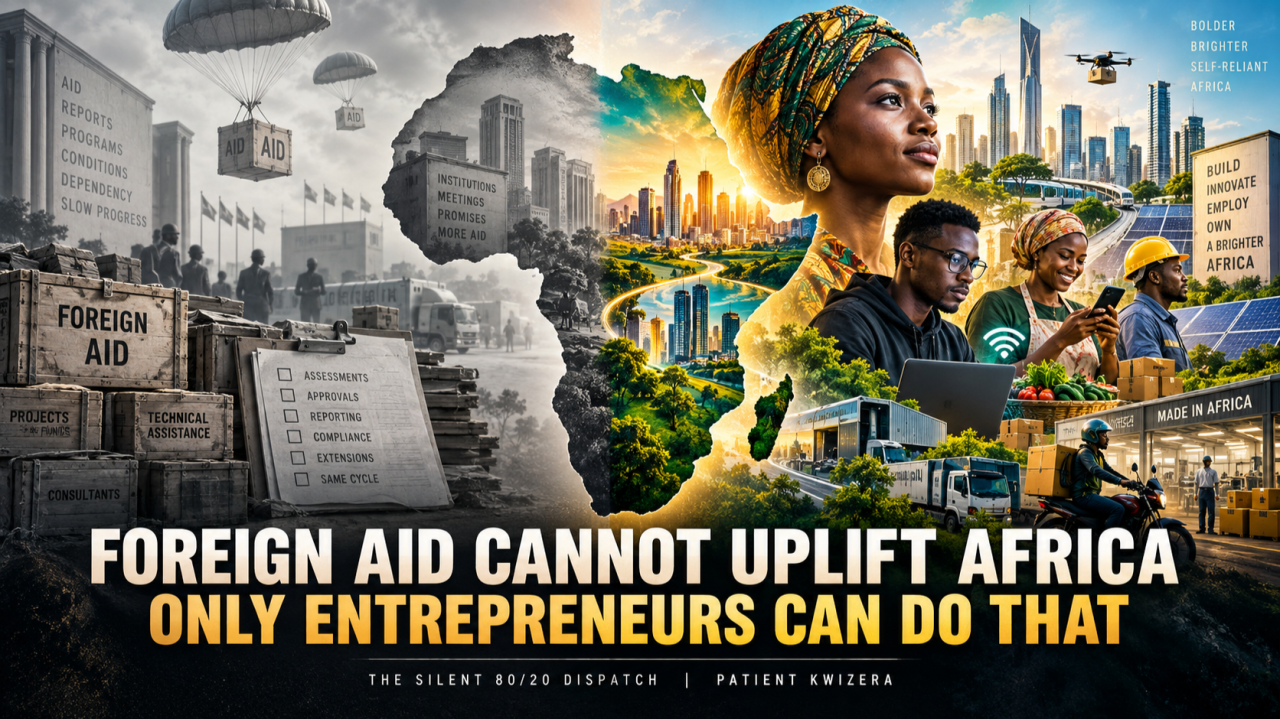
For decades, international aid has funded prosthetic camps, donated equipment, supplied imported components and deployed foreign specialists across Africa. These initiatives have restored mobility and changed lives—but they have rarely created rehabilitation systems capable of continuing without the next grant.
In his LinkedIn article, “Foreign Aid Cannot Uplift Africa. Only Entrepreneurs Can Do That,” Rwandan writer Patient Kwizera argues that Africa’s long-term development will come from founders who build sustainable solutions around local problems rather than projects controlled by external donors.
His argument is particularly relevant to prosthetics, orthotics and assistive technology.
Africa does not need another decade of disconnected pilot programmes that end when donor funding expires. It needs locally owned clinics, component manufacturers, digital production centres, repair networks, training institutions and distribution businesses that can earn revenue, employ professionals and remain accountable to the people using their services.
However, entrepreneurship cannot replace public responsibility or humanitarian assistance. The real opportunity is to use development funding, government procurement and private capital to create functioning local markets—not permanent dependence.
From beneficiaries to customers with choices
Kwizera challenges the language of aid, in which people are described as beneficiaries, target populations or recipients of an intervention.
That language matters.
A beneficiary often receives whatever a project has selected, during the period in which the project is funded. A customer has greater power to compare options, reject poor service, return for repairs and expect a supplier to remain available.
In prosthetics and orthotics, many people do not have the income to become conventional private customers. Governments, insurers, employers, compensation systems and humanitarian agencies will therefore continue to finance care.
But the person using the device should still be treated as the customer around whom the system is designed.
Funding should follow successful clinical provision rather than simply count devices distributed. Providers should be assessed on socket comfort, device use, mobility, repair access, user satisfaction and long-term outcomes—not only on the number of people photographed at a handover event.
This change would create stronger incentives for local providers to improve their services.
The problem with the permanent pilot
Africa’s rehabilitation sector contains many examples of well-intentioned projects that provided short-term activity but limited institutional continuity.
A digital scanner may be donated without funding for software renewal. A 3D printer may arrive without an engineer capable of repairing it. Imported prosthetic components may be fitted without establishing a local replacement supply. Clinicians may receive several days of training without the supervision required to convert that introduction into safe clinical practice.
When funding ends, the equipment can remain unused while patients are told to wait for the next phase.
This is not an argument against digital technology or international partnerships. It is an argument for examining who will own, maintain and finance a service after the initial project.
A local enterprise has to answer practical questions that a temporary programme can postpone:
- What will the patient pay, and who will subsidise those who cannot pay?
- How will components and raw materials be replenished?
- Who will repair equipment?
- How will qualified staff be retained?
- How will clinical records be protected?
- Where will users return when a socket becomes painful?
- What revenue will finance follow-up and replacement?
These questions can be uncomfortable, but they are the foundation of sustainability.
Africa’s assistive-technology gap is also a market failure
The scale of unmet need is enormous. A World Health Organization progress report estimated that between 90% and 97% of people requiring assistive technology in the African Region do not have access.
The barriers include out-of-pocket costs, shortages of services and qualified personnel, low awareness, inadequate domestic funding and weak supply chains.
These are health-system problems, but they are also market-design problems.
Demand clearly exists. What is often missing is a reliable mechanism that converts need into funded demand. A person may require an ankle-foot orthosis, prosthesis or wheelchair but lack the money to purchase it. A local provider may have the clinical ability to deliver it but no access to working capital. A government may have a disability policy without a defined reimbursement rate or procurement pathway.
Entrepreneurs cannot solve this alone. Governments must create predictable purchasing systems, establish appropriate product and clinical standards, recognise qualified professionals and include prosthetic, orthotic and rehabilitation services within universal health coverage.
When public financing becomes dependable, local companies can invest with greater confidence in people, facilities, inventory and technology.
African companies are already building alternatives
Nigeria’s DynaLimb Technologies offers one example of a locally developed mobility-care model.
The company combines clinical prosthetic and orthotic services with 3D scanning, digital design and additive manufacturing. DynaLimb told Disrupt Africa that its average prosthetic device costs approximately ₦800,000 and can be delivered in around seven days, depending on clinical requirements. It compared this with conventional devices costing upwards of ₦1.6 million and taking four to six weeks.
DynaLimb has also developed DynaX, a platform intended to connect patient assessment, digital measurement, device design, manufacturing, rehabilitation and follow-up.
The importance of this model is not simply that it uses 3D printing. Its greater significance is that African clinicians are designing a workflow around the limitations and opportunities of their own market.
The company says it has served more than 1,000 patients and is building relationships with hospitals. It plans to strengthen its Nigerian operations before entering markets such as Ghana, Kenya and Rwanda through local partnerships.
This is the type of expansion African O&P needs: clinical knowledge, technology and local ownership combined in a business that must demonstrate value to users and institutional customers.
Investment must understand clinical reality
Assistive-technology companies do not scale like payment apps.
A fintech platform can add customers with limited additional physical infrastructure. A prosthetic provider must assess a person, manufacture or assemble an individual device, manage clinical risk, conduct fittings and remain available for adjustment.
This makes O&P businesses capital-intensive and operationally complex. They need equipment, inventory, qualified professionals, quality systems and clinical premises. Their customers may also have limited ability to pay.
Traditional venture capital can struggle with this model because investors frequently seek rapid, technology-led growth. Yet treating every healthcare startup as a software company creates pressure to expand before clinical and service systems are ready.
Africa needs patient forms of capital suited to rehabilitation:
- Grants for early research and clinical validation
- Low-interest finance for workshop equipment
- Working-capital facilities linked to hospital contracts
- Outcome-based government purchasing
- Corporate social responsibility partnerships
- Social-impact investment with realistic return periods
- Insurance and reimbursement for essential devices
- Guarantees that reduce risk for local lenders
- Procurement commitments for validated local products
The Innovate Now Accelerator and the wider AT2030 programme have demonstrated how assistive-technology ventures can be supported through mentorship, product development, ecosystem building and connections to investors.
The next step is converting accelerator participation into recurring contracts and sustainable revenue.
Aid should build markets, not compete with them
Foreign assistance remains essential in emergencies and conflict settings. It can finance care where no viable market exists, support people who cannot pay and help governments build rehabilitation systems.
The problem arises when donated products displace emerging local providers or when short-term procurement rewards the cheapest device without financing assessment, fitting, rehabilitation and follow-up.
Aid can be redesigned to strengthen entrepreneurship by:
- Purchasing from qualified African manufacturers and service providers
- Funding local clinical training and supervision
- Requiring maintenance and replacement plans
- Supporting shared testing and quality-assurance facilities
- Financing national assistive-products lists and reimbursement systems
- Providing local companies with transparent procurement forecasts
- Including users with disabilities in product design and purchasing decisions
- Measuring continued device use rather than distribution alone
International manufacturers also have a role. Instead of treating Africa only as an export market, they can license production, transfer technical knowledge, establish regional component assembly, train local clinicians and develop products that can be repaired within the countries where they are used.
Ownership is the missing measure of sustainability
A project is not sustainable because its final report contains the word sustainability. It is sustainable when local people possess the knowledge, assets, revenue and authority required to continue it.
For African O&P, this means more than manufacturing everything domestically. Some specialised components will continue to be imported, and international collaboration will remain valuable.
The objective should be local control of the service pathway: assessment, prescription, procurement, fabrication, fitting, rehabilitation, repair and outcome measurement.
Kwizera’s central argument is that Africans must be able to build and own the systems shaping their future. In prosthetics and orthotics, ownership can determine whether a person receives a device once or gains access to a lifetime of care.
Africa’s rehabilitation future will still need public funding, philanthropy and international expertise. But those resources should help build enterprises and institutions that remain after the visiting experts, funding cycle and project banners have gone.
The future should not be another donated workshop waiting for Phase Two. It should be an African clinician, technician or founder opening the doors each morning because patients value the service, staff are paid, components are available and the organisation has a reason to keep improving.
- Patient Kwizera: Foreign Aid Cannot Uplift Africa—Only Entrepreneurs Can
- WHO Africa: Progress on Access to Assistive Technology
- WHO: African Regional Workshop on Assistive Technology
- AT2030: Assistive-Technology Innovation in Africa
- Innovate Now Accelerator
- DynaLimb Technologies
- Disrupt Africa: DynaLimb’s 3D Mobility-Care Model