

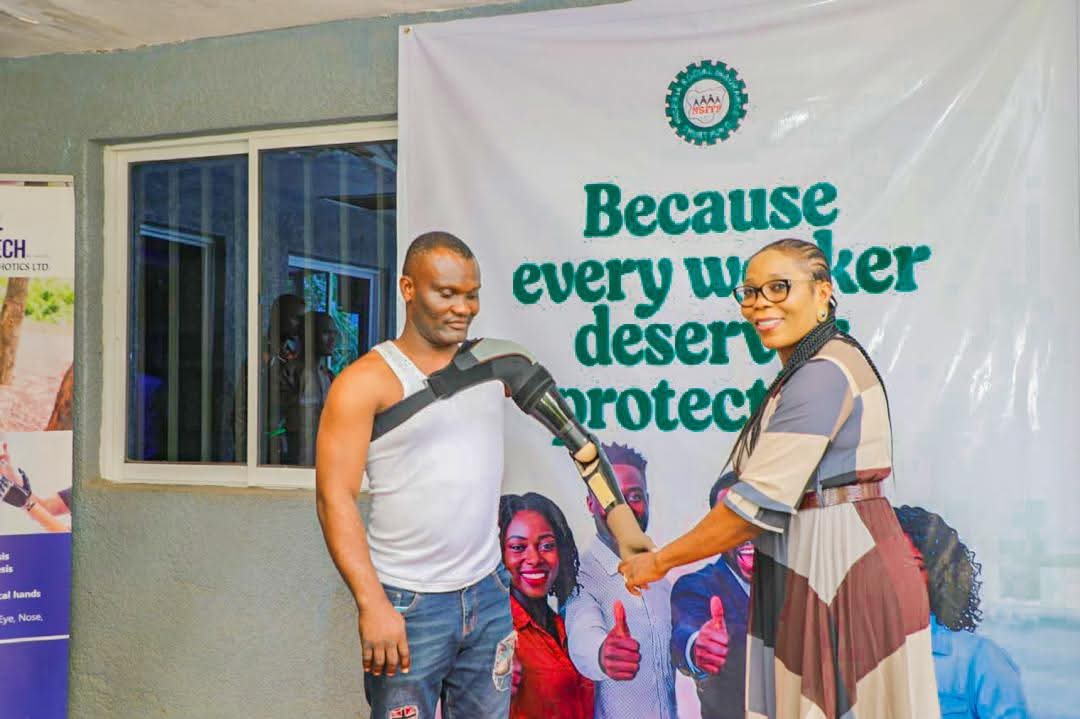
The Nigeria Social Insurance Trust Fund has completed a prosthesis provision programme for 78 employees who sustained disabling injuries in the course of their work.
The initiative provided lower-limb, upper-limb and partial-hand prostheses through the Fund’s Employees’ Compensation Scheme. According to the NSITF, beneficiaries received clinical assessment, measurement, fabrication, fitting, training and final evaluation before discharge.
The intervention was recently highlighted by National Accord as an example of how employment-related social insurance can support people beyond the immediate medical treatment of an injury.
For Nigeria’s prosthetics and orthotics sector, the programme demonstrates the importance of treating prosthetic rehabilitation as a recognised component of workers’ compensation rather than relying exclusively on charitable donations or personal payment.
Programme began in April 2026
The current phase of the Prosthesis Provision Exercise began in April 2026 and was monitored by the NSITF Claims and Compensation Department.
Its completion was announced during the presentation of a final programme report in Abuja.
NSITF Managing Director Oluwaseun Faleye, represented by Executive Director of Operations Mojisola Alli Macaulay, credited the collaboration between beneficiaries, employers, prosthetic service providers and the Fund’s monitoring team.
The providers were also recognised for adapting to individual clinical requirements, including the provision of a prosthesis for a person with hip disarticulation.
Where an initially selected beneficiary could not be contacted, declined to attend or had died, the NSITF used a supplementary list so that the allocated programme places could still be used.
Range of amputation levels addressed
The 78 devices delivered under the programme were reported as:
- Eight above-knee prostheses
- One hip-disarticulation prosthesis
- Eleven below-knee prostheses
- Twelve below-elbow prostheses
- Five above-elbow prostheses
- One additional transhumeral prosthesis
- Forty silicone partial-hand prostheses
The range of devices illustrates the diversity of injuries that can arise from industrial, manufacturing, construction, transport and other occupational activities.
It also demonstrates why prosthetic provision cannot be handled through a single standard device. A person with partial-hand loss has different functional, occupational and psychosocial priorities from someone with transfemoral or hip-disarticulation amputation.
Each prescription should reflect the individual’s anatomy, health, work tasks, home environment, functional objectives and access to maintenance.
Rehabilitation went beyond device distribution
General Manager for Claims and Compensation Nkiru Ede-Ogunnaike said the beneficiaries passed through a process involving assessment, measurement, fabrication, fitting, gait or functional training, evaluation and final discharge.
The NSITF also recorded completed discharge letters, warranty information and beneficiary-satisfaction forms.
This structure is significant. Prosthetic rehabilitation cannot be measured only by the number of devices distributed. A component must be incorporated into a comfortable, appropriately aligned prosthesis and the user must be trained to use it safely.
Lower-limb prosthesis users may require training in balance, weight transfer, knee control, walking over different surfaces and managing work-related environments.
Upper-limb users may need functional training based on their chosen terminal device and occupational requirements. For people receiving silicone partial-hand prostheses, goals may include appearance, protection, positioning, selected functional assistance and greater confidence in social or work settings.
Successful rehabilitation should therefore be assessed through function and participation as well as successful delivery.
Worker describes intervention as life-changing
Speaking for the beneficiaries, Solomon Sunday of Zodoson Industries in Abia State described the programme as a turning point.
He said a workplace injury had left many beneficiaries facing emotional distress, loss of independence and uncertainty about their futures. Receiving a prosthesis and skills support gave him greater confidence and a renewed opportunity to earn a living.
His comments highlight the economic consequences of work-related limb loss. The impact may include hospital costs, loss of income, prolonged absence from employment, reduced career opportunities and additional demands on family members.
A prosthesis does not automatically restore a person’s previous occupation, particularly when the work involves heavy lifting, prolonged standing, machinery or hazardous environments. Nevertheless, appropriate rehabilitation, workplace accommodation and retraining can create a pathway back to employment.
NSITF mandate includes rehabilitation support
The Employees’ Compensation Act 2010 gives the NSITF responsibility for compensation and support related to employment injuries, occupational diseases and disability.
The Fund’s official compensation information states that support may include medical and surgical treatment, hospital and nursing care, transportation, medicines, crutches, apparatus and artificial limbs where reasonably necessary.
This is an important policy principle. Compensation for limb loss should not end with a cash payment or initial surgical care. It should address the practical consequences of disability and help the worker regain function, independence and economic participation.
The scheme can also protect employers by providing a structured mechanism for managing the long-term consequences of occupational injuries.
Discharge must not end clinical access
Although all 78 beneficiaries were reportedly discharged after satisfactory evaluation, prosthetic care remains a continuing process.
Residual-limb volume can change, sockets can become loose or uncomfortable and mechanical components require inspection and maintenance. Liners, straps, cables, gloves and cosmetic covers wear out. A person’s health, body weight and functional demands may also change.
Beneficiaries therefore need clear information about:
- Where to obtain socket adjustments
- Warranty terms and exclusions
- Repair procedures
- Replacement components
- Scheduled clinical reviews
- Skin and residual-limb care
- Who will pay for future maintenance
- What happens if their condition or occupation changes
This is especially important for workers who live far from the original fitting centre. A device may be abandoned if obtaining a minor repair requires extensive travel or personal expense.
NSITF could strengthen future phases by publishing defined follow-up intervals and reporting device use, comfort, work participation, repairs and replacement requirements at six and 12 months.
Return to work requires employer participation
The employer’s role should continue after the worker receives a prosthesis.
An occupational assessment may be needed to determine whether the person can resume the previous job safely, return with modifications or requires retraining for a different role.
Reasonable accommodations could include:
- Gradual return-to-work schedules
- Modified duties
- Seating or rest breaks
- Changes to workstations
- Accessible entrances and facilities
- Protective equipment compatible with the prosthesis
- Reduced lifting or climbing
- Alternative tools or controls
- Skills development and reassignment
A prosthesis should not be used to justify returning someone prematurely to a hazardous task. The objective is sustainable and safe employment, not simply physical presence at work.
A model with wider African relevance
Many people who experience occupational limb loss across Africa struggle to obtain a prosthesis because compensation systems are incomplete, employers are not registered or rehabilitation is treated as a charitable responsibility.
The NSITF programme presents a more sustainable model: employers contribute to a social insurance mechanism, and eligible workers receive rehabilitation support when an employment-related disability occurs.
Future expansion should be supported by qualified prosthetists and orthotists, transparent provider standards, functional outcome measurement and reliable funding for long-term care.
The delivery of 78 prostheses is an important achievement for the beneficiaries. Its wider significance lies in recognising that restoring mobility, function and livelihood is part of employment compensation—and that injured workers require a pathway back into society, not only a device.
- National Accord: NSITF Gives Injured Workers New Hope
- Nigeria Social Insurance Trust Fund
- NSITF Compensation and Disability Support
- Employees’ Compensation Act 2010
- The Sun: NSITF Presents Prostheses to 78 Workers
- International Labour Organization: Occupational Safety and Health