

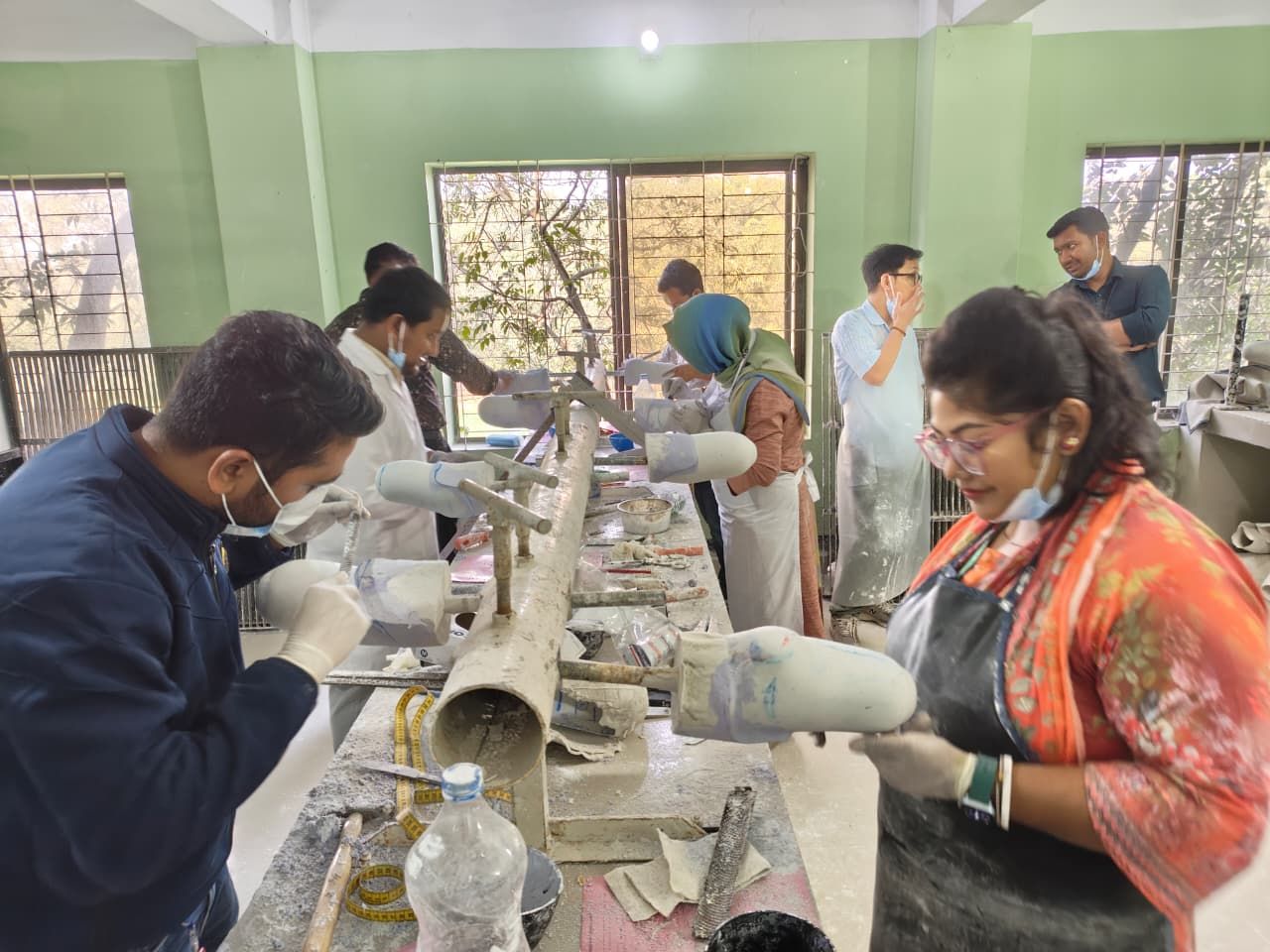
A grant from the Hanger Foundation has helped the Centre for the Rehabilitation of the Paralysed (CRP) expand access to prosthetic and orthotic services while investing in the people and infrastructure required to sustain them.
According to CRP Bangladesh, the initiative supported 102 patients, provided specialised training to 20 professionals and technicians, and enabled the installation of a lamination setup in the organisation’s Prosthetics and Orthotics Laboratory.
The programme demonstrates how philanthropic funding can create a broader and more durable impact when it combines direct patient care with workforce development and local fabrication capacity.
Prosthetic and orthotic devices for 102 patients
Through the initiative, 48 patients received prosthetic devices and 54 received orthotic devices.
For people from underserved communities, obtaining an appropriate device can influence far more than physical mobility. A well-prescribed prosthesis or orthosis may help a person return to education, employment, family responsibilities and community participation.
However, successful provision requires more than handing over a device. Each intervention should include clinical assessment, prescription, measurement or casting, fabrication, fitting, alignment, patient education and appropriate follow-up.
The distinction is important. Device numbers provide an immediate measure of reach, but long-term outcomes depend on whether each prosthesis or orthosis remains comfortable, functional and suitable for the person’s daily environment.
CRP’s multidisciplinary rehabilitation model creates an important foundation for this continuum of care. Established in 1979, the organisation provides medical care, physical rehabilitation, psychosocial support, vocational training and community reintegration services through a network of centres in Bangladesh.
Building clinical expertise in transtibial prosthetics
The grant also supported training for 11 professionals in transtibial prosthetics and Total Surface Bearing socket design.
The prosthetic socket is the interface between the patient and the remaining prosthetic components. Its design can affect comfort, stability, suspension, pressure distribution, skin integrity and the user’s ability to control the prosthesis.
Total Surface Bearing, or TSB, socket principles aim to distribute load across the residual limb rather than concentrating it only within selected pressure-tolerant areas. Applying these principles safely requires more than reproducing a socket shape.
Practitioners must consider:
- Residual-limb presentation and tissue characteristics
- Areas requiring protection or relief
- Volume management
- Suspension and liner selection
- Socket stability and rotational control
- Static and dynamic alignment
- Skin response during trial use
- The patient’s activity level and functional objectives
Training therefore strengthens clinical reasoning as well as fabrication technique. It can also help teams develop a more consistent approach to assessment, documentation, fitting and follow-up.
No socket concept is appropriate for every patient. The value of professional training lies in helping clinicians understand when a technique may be suitable, how it should be applied and when another approach is required.
Recognising the contribution of technicians
Nine technicians received training in sewing techniques intended to improve the quality of device fabrication.
Sewing may receive less attention than socket design or component selection, but it remains an important part of many P&O workshop processes. Straps, closures, suspension elements, soft interfaces, covers and textile components can all influence the comfort, durability and usability of a device.
Poorly positioned seams, weak fastening points or inappropriate materials may create pressure, reduce device life or make an orthosis more difficult to use. Strong technical skills contribute directly to the quality of the finished product.
By including technicians in the programme, CRP and the Hanger Foundation have recognised that effective P&O services depend on the entire clinical and technical team.
New lamination capacity for the P&O laboratory
The successful installation of a lamination setup represents another significant element of the project.
Lamination remains an established fabrication process for many prosthetic sockets and structural components. Bringing this capability into a local laboratory can help improve control over production, reduce dependence on external fabrication and support faster adjustments or replacements.
The equipment can also provide a practical training platform for developing local technical competence.
Its long-term value will depend on the surrounding systems, including:
- Appropriate extraction and ventilation
- Personal protective equipment
- Safe resin and chemical handling
- Material storage and traceability
- Standardised fabrication procedures
- Quality inspection
- Equipment maintenance
- Appropriate disposal of hazardous waste
Investment in equipment is most effective when accompanied by trained personnel, operating procedures and continuing quality assurance.
Part of a larger P&O service
CRP’s Prosthetics and Orthotics Department was established in 2002 with technical and financial assistance from the International Committee of the Red Cross. Its services have developed to support people affected by amputation, cerebral palsy, stroke, spinal cord injury, post-polio conditions, congenital differences and other physical impairments.
CRP’s 2024–25 annual report states that its P&O department served 1,997 patients during the reporting year and produced 2,393 devices, including 2,264 orthoses and 129 prostheses. The department also introduced pre-prosthetic management and expanded support for diabetic-foot assessment and orthotic intervention.
These figures place the Hanger Foundation-supported activities within an established national rehabilitation service rather than a standalone distribution exercise.
A three-part model for sustainable impact
The initiative is particularly notable because it addresses three connected requirements:
- Immediate access: Patients receive prosthetic and orthotic devices that may improve mobility and participation.
- Workforce development: Professionals and technicians gain clinical and fabrication skills that can benefit future patients.
- Local production capacity: New laboratory infrastructure allows more work to be undertaken and supported locally.
This creates a multiplier effect. A device directly benefits one patient, while a trained practitioner or properly equipped workshop can support many patients over time.
The Hanger Foundation reports that it has provided more than $5 million in grants and supported over 200 grassroots organisations working within prosthetics, orthotics and rehabilitation.
Measuring what happens after delivery
Future evaluation could look beyond the number of devices supplied and examine outcomes such as:
- Device use after three, six and 12 months
- Comfort and skin condition
- Functional mobility
- Participation in education or employment
- Patient satisfaction
- Repair and replacement requirements
- First-fit success and adjustment rates
- Changes in workshop turnaround time
- Continued application of newly acquired skills
These measures would help demonstrate whether the programme’s benefits remain effective after the initial fitting and training periods.
For the wider P&O sector, the partnership offers a valuable lesson: sustainable rehabilitation investment must support patients, practitioners and production systems together.
By combining device provision with clinical training, technical skills and laboratory development, CRP Bangladesh and the Hanger Foundation are helping create the conditions for stronger and more locally sustainable P&O services.