

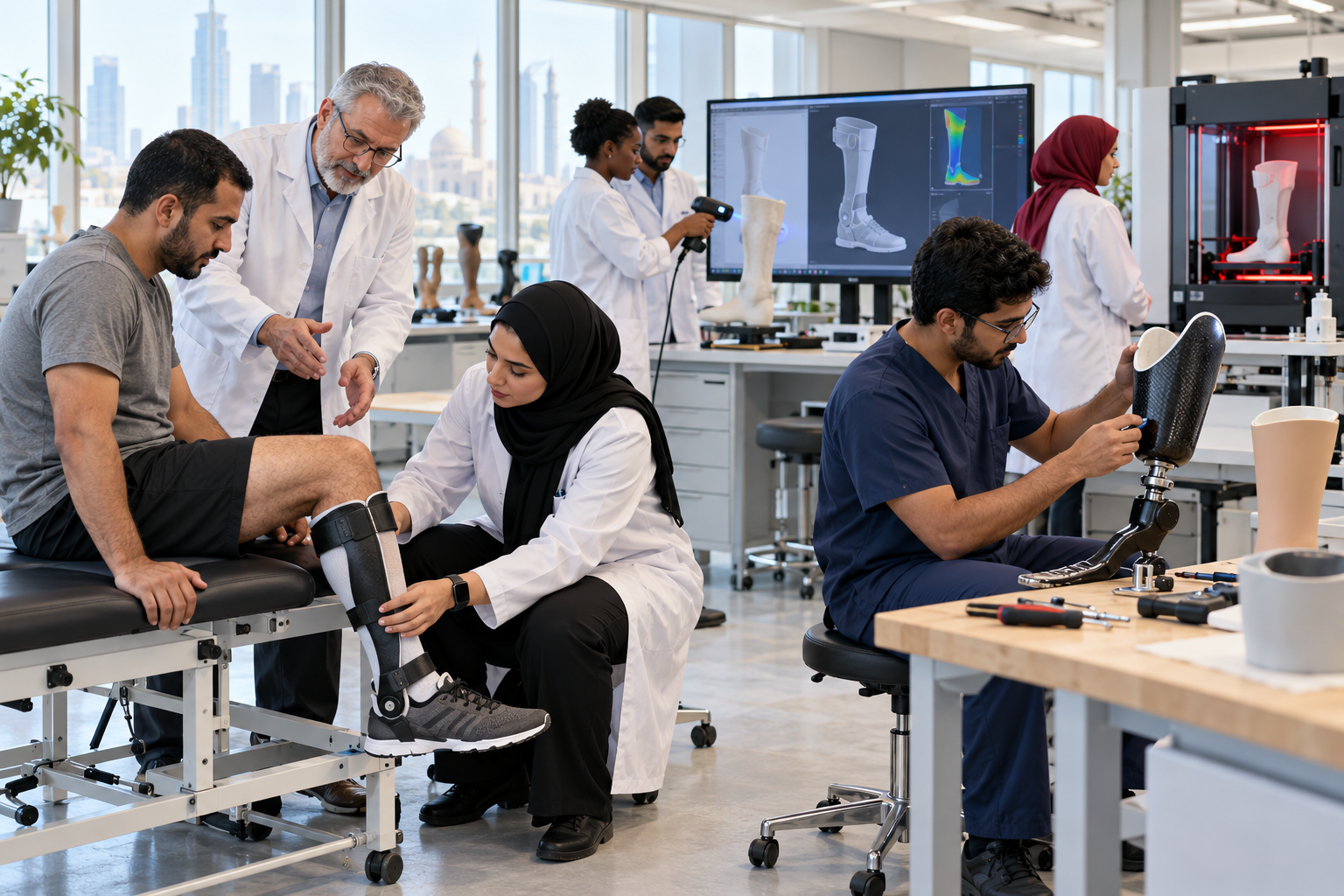
Digital shape capture, computer-aided design, additive manufacturing, data-driven clinical tools and artificial intelligence are changing prosthetics and orthotics. The more difficult question is whether education is changing quickly enough to prepare practitioners for this new clinical environment.
Professor Géza F. Kogler and Professor Christopher Hovorka addressed this wider challenge in their position paper, Academia’s Role to Drive Change in the Orthotics and Prosthetics Profession.
Their central argument remains highly relevant: P&O education should not wait for technology and market pressures to redefine professional practice. Academic institutions must help lead that transformation.
The paper argues that new technologies and data-driven processes can streamline workflows, reduce errors and support new methods of clinical care and device manufacturing. It calls for curricula to incorporate digital shape capture, digital modelling, rectification and additive manufacturing while placing greater emphasis on clinical reasoning, evidence-based practice and measurable patient outcomes.
Technology is already changing the practitioner’s role
Traditional P&O education has often required students to spend a substantial proportion of their time learning labour-intensive fabrication processes.
Those skills remain important. Practitioners need to understand materials, biomechanics, trim lines, alignment, pressure distribution and how modifying a shape affects the patient.
However, the daily workflow is changing.
A contemporary practitioner may now be expected to:
- Capture anatomy using a three-dimensional scanner
- Modify a digital model
- Select an appropriate design from a software platform
- Review an automatically generated orthosis or socket
- Prepare a file for milling or additive manufacturing
- Assess the quality of an externally manufactured device
- Interpret pressure, gait or activity data
- Use digital records to repeat, adjust or compare designs
- Communicate remotely with fabrication and clinical teams
The educational response cannot simply be to add one isolated lecture on 3D printing. Digital practice must be connected to clinical assessment, prescription, design approval, fitting, risk management and outcome measurement.
What should students learn about AI?
Artificial intelligence could support several areas of future P&O practice, including image analysis, shape modification, component selection, documentation, outcome prediction and manufacturing quality control.
It may also help students access personalised learning, simulated clinical cases and immediate feedback.
But AI literacy is not the same as accepting an algorithm’s recommendation.
P&O students will need to understand:
- What information an AI system uses
- Whether its training data represents the relevant population
- How a recommendation was produced
- Which clinical factors may have been omitted
- When the output conflicts with the physical examination
- Who remains responsible for the prescription
- How patient data are stored and protected
- How potential bias or unsafe recommendations are identified
A future practitioner must be able to challenge an automated output rather than simply operate the software.
The most important educational outcome is therefore not software proficiency alone. It is the ability to combine digital information with clinical examination, biomechanics, patient goals and professional judgement.
Digital efficiency should create more time for clinical education
Kogler and Hovorka make an important distinction: reducing time spent on repetitive manual fabrication should allow programmes to strengthen clinical education.
Digital fabrication should not reduce the prosthetist or orthotist to a scanner operator. It should create more time for the work that requires human expertise.
This includes:
- Listening to the patient
- Understanding functional priorities
- Conducting a complete physical assessment
- Selecting an appropriate treatment strategy
- Managing expectations
- Evaluating device performance
- Recognising complications
- Coordinating care with the wider rehabilitation team
- Measuring outcomes and adjusting treatment
The future value of the profession will increasingly depend on these capabilities. A machine may manufacture an orthosis, but it cannot independently understand how pain, family circumstances, skin condition, cognition, motivation, environment and personal goals should influence the care plan.
Online learning can expand access—but cannot replace practice
Digital education creates important opportunities for the IMEA region.
Live online teaching, recorded demonstrations, virtual cases and remote mentoring can connect students with educators and specialists who may be located in another country. This is particularly valuable where travel costs, shortages of specialist faculty or disruption to physical education restrict access to conventional teaching.
Virtual and augmented reality could also allow students to rehearse processes such as rectification, alignment, casting or component assembly within a controlled learning environment.
However, P&O remains a hands-on clinical profession.
Students must still develop the ability to:
- Examine a patient safely
- Palpate anatomy
- Evaluate muscle strength and joint range
- Handle materials and equipment
- Recognise tissue response
- Fit and align a device
- Observe movement
- Communicate effectively with patients
- Respond to unexpected clinical findings
Online learning can strengthen theoretical knowledge and prepare students for practical sessions. It cannot entirely reproduce contact with patients, materials, workshop processes and experienced clinical supervision.
The most realistic model is therefore blended education: digital learning for knowledge and simulation, combined with protected practical training and supervised clinical exposure.
New evidence reinforces the education gap
A 2026 Canadian research initiative involving practitioners, technicians, researchers, engineers and people using prostheses and orthoses identified five priorities for digital P&O.
These included stronger evidence on device quality, economic and reimbursement models, better digital education, standardised practice guidance and greater involvement of technology users. The researchers found that adoption remains inconsistent despite the recognised potential of digital workflows.
This matters because purchasing equipment does not create a digital service.
Successful implementation requires:
- Trained educators
- Competency-based curricula
- Access to hardware and software
- Suitable clinical cases
- Technical support
- Quality-control processes
- Evidence-based design parameters
- Secure data management
- Continuing professional development
Educational institutions must also avoid becoming dependent on a single commercial platform. Students should learn transferable principles that allow them to evaluate different systems critically.
Implications for P&O education across IMEA
Training institutions across India, the Middle East and Africa operate within very different resource environments. A single curriculum model will not suit every country.
Nevertheless, several shared priorities are emerging:
- Protect core clinical and workshop competence.
Students must understand traditional processes even when production becomes digital. - Integrate digital workflows throughout the curriculum.
Scanning, CAD, milling and printing should be taught within complete patient-care pathways. - Build AI and data literacy.
Graduates must understand validation, bias, privacy, accountability and the limitations of automated systems. - Strengthen evidence-based practice.
Students should learn to measure mobility, comfort, participation, device use and patient-reported outcomes. - Invest in faculty development.
Educators need protected opportunities to learn new technologies and revise teaching methods. - Create regional teaching networks.
Institutions could share specialist lectures, digital cases, simulation resources and faculty expertise. - Include patients in curriculum development.
Technology users should help define what competent, respectful and effective care looks like.
Should education lead or follow technological change?
P&O education must do both—but it should lead wherever patient safety, professional standards and clinical value are concerned.
Academic programmes cannot teach every new scanner, printer or AI application immediately. Technology will always move faster than formal curriculum approval.
They can, however, prepare adaptable practitioners who understand first principles, assess evidence, question automated recommendations and learn new systems without losing sight of the patient.
The future of P&O education is not a choice between craftsmanship and technology. It is an opportunity to combine practical knowledge, digital capability and stronger clinical reasoning.
If educational institutions only react after technologies become established, commercial platforms may end up defining professional practice. If academia leads the conversation, technology can instead be shaped around the needs of patients, practitioners and sustainable rehabilitation systems.
- Academia’s Role to Drive Change in the Orthotics and Prosthetics Profession
- Original Article DOI
- Canadian Prosthetics & Orthotics Journal
- Developing a Research Agenda in Digital Workflows for Prostheses and Orthoses