

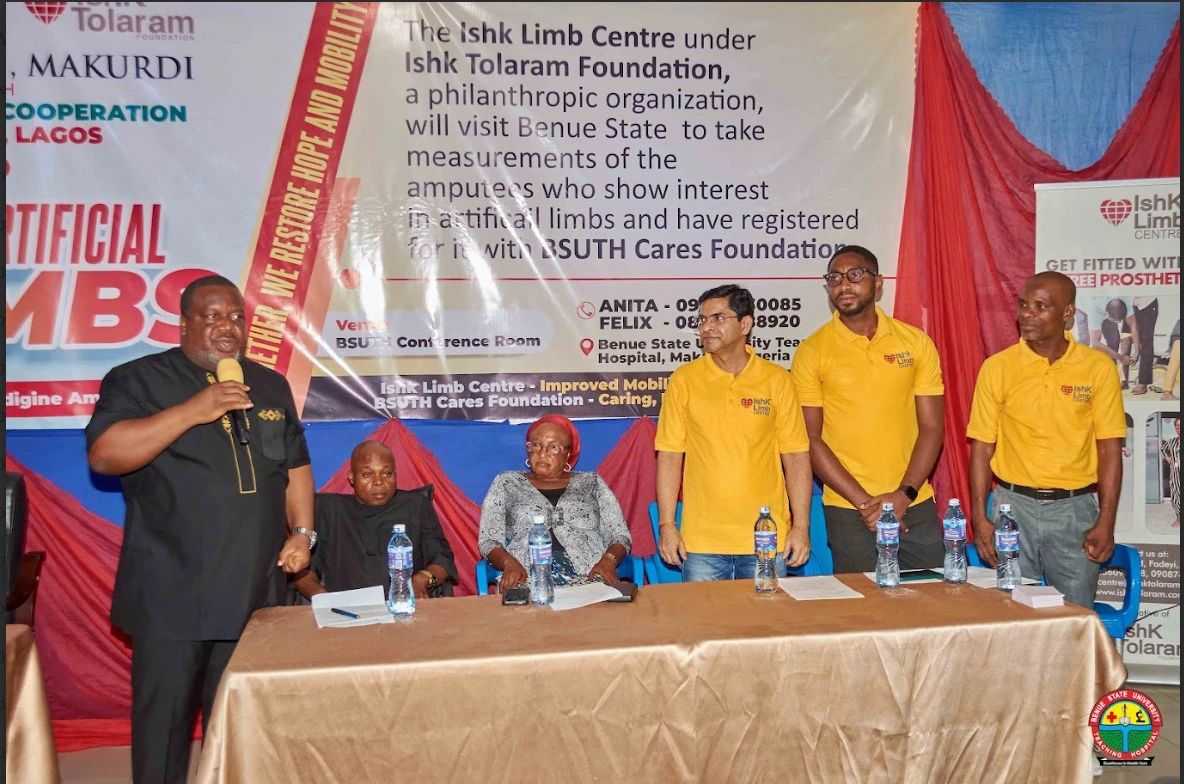
A Makurdi prosthetics outreach in Benue State, Nigeria, has seen a multidisciplinary team take casts, fabricate, fit and gait-train amputees, according to a clinician who took part. Prosthetist and orthotist Stanley Maduneme said he worked with the Ishk Limb Centre, part of the Ishk Tolaram Foundation, in partnership with the Benue State University Teaching Hospital (BSUTH) Care Foundation. His account was shared in a LinkedIn post.
What did the Makurdi prosthetics outreach involve?
Maduneme describes the work as covering the full prosthetic pathway: casting, fabrication, custom fitting and gait training for amputees from across the state. He writes that hundreds of people “walked out with renewed hope”, but he does not give a precise number of people fitted, the dates of the outreach or the types of devices provided. Those figures should be treated as unconfirmed until the organisers publish them.
The clinical moment he highlights
Maduneme says the point at which a patient stands and takes first steps on a new prosthesis is the part of the work that stays with him, describing disbelief turning to smiles and uncertainty to confidence. He thanked the leadership of Ishk Tolaram Foundation and BSUTH Care Foundation for what he called an enabling environment for access to assistive technology.
What is the wider context in Benue State?
Separate Nigerian press reports describe a BSUTH initiative to provide free artificial limbs to registered indigent amputees in Benue State. Leadership reported a target of 400 limbs, with the hospital’s chief medical director saying the programme would become annual. An earlier Benue Today article reported a plan for 300 free limbs, with registration open to Benue amputees and the Bureau for International Cooperation and Development and Ishk Tolaram named as partners. The dates on these reports differ, and neither describes the outreach Maduneme mentions, so IMEA CPO cannot say that they refer to the same programme. The Leadership article does not name Ishk Tolaram.
Why does multidisciplinary outreach matter for CPOs?
Nigeria is building prosthetic capacity on several fronts. IMEA CPO has recently covered the federal 3D-printed prosthetics initiative, the University of Lagos plans for prosthetics and orthotics education and the Nigerian bionic arm named in TIME’s Best Inventions of 2026. Outreach programmes such as the one in Makurdi sit alongside these developments by bringing fitting and gait training to patients who may live far from a specialist centre. For a clinician, an outreach deployment combines assessment, fabrication and training in a short time, with follow-up the main continuing challenge.
IMEA CPO Perspective
The source for the clinical detail here is a single first-hand LinkedIn post, not an organiser release or independent news report, and IMEA CPO has not verified the numbers or dates. What can be said is that a qualified prosthetist and orthotist is reported to have worked within a charity-hospital partnership in Benue State, with gait training included. For the CPO profession, the opportunity is in the details the post does not give: how patients are followed up after the team leaves, how repairs and replacements are handled, and whether local clinicians are involved so that care continues. Programme organisers and clinicians who can share those details are welcome to contact IMEA CPO.
Frequently asked questions
Who took part in the Makurdi prosthetics outreach? Stanley Maduneme, a clinical prosthetist and orthotist, says he served with the Ishk Limb Centre (Ishk Tolaram Foundation) team in partnership with the BSUTH Care Foundation.
What services were provided? Casting, fabrication, custom fitting and gait training for amputees, according to his post.
How many people were fitted? The post says hundreds but gives no exact figure.
Suggested hyperlinks / sources
- Stanley Maduneme on LinkedIn (source post)
- Leadership: BSUTH to offer free artificial limbs to 400 amputees in Benue
- Benue Today: BSUTHCares initiative launches 300 free artificial limbs
- Ishk Tolaram Foundation
- International Society for Prosthetics and Orthotics (ISPO)