

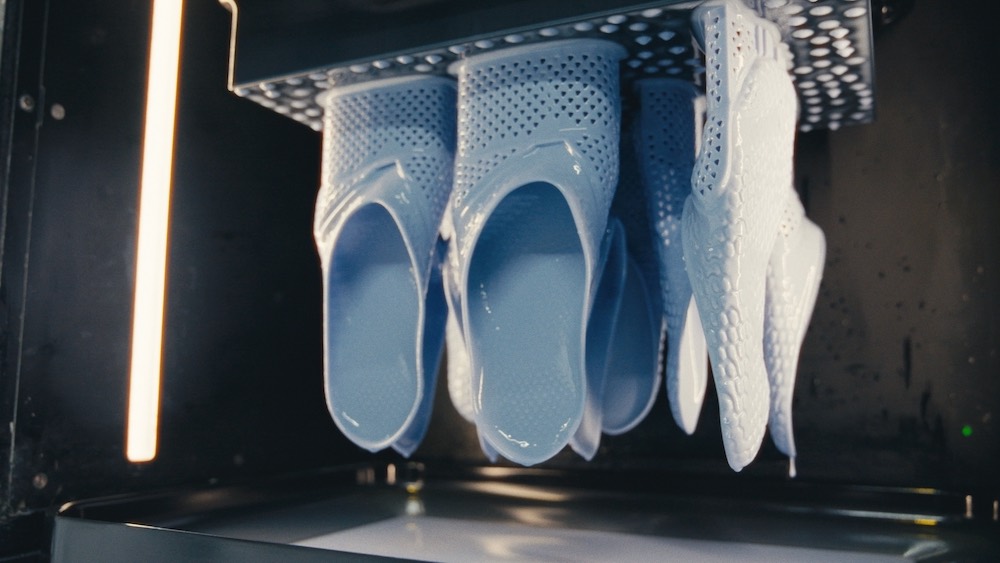
Chemical company Arkema and 3D printer maker Carbon have expanded a collaboration that spans more than 13 years, according to a report by 3D Printing Industry. The two companies are positioning their combined materials and production expertise as a route for brands to bring 3D printed footwear, sporting goods and other consumer products to market.
What the collaboration covers
Carbon develops high-performance elastomeric resins for its Digital Light Synthesis (DLS) platform, with Arkema’s specialty UV-curable materials as the chemical base. The focus is complex lattice structures, which Carbon’s customers can tune for cushioning, support and energy return. The article says these suit midsoles, protective padding and other performance parts.
The companies divide the work clearly. Arkema supplies material science and industrial capacity for scaling production, while Carbon formulates the elastomers its DLS printers run. Jason Rolland, Carbon’s Chief Technology Officer, said this lets his team concentrate on performance rather than raw chemistry: “Great resins start with great materials.”
Julie Haevermans, Vice President of Marketing at Arkema Coating Solutions, said brands want more performance and personalization while producing less waste, and that Arkema plans to keep building on its work with Carbon, prioritizing performance and sustainability.
The Vivobarefoot sandal example
The companies point to Vivobarefoot’s custom 3D printed sandal, which uses individual foot scans to make footwear to order. The report says this model reduces inventory and material waste compared with stock-based manufacturing. The product is the Tabi Gen 02, the second version of Vivobarefoot’s scan-to-print barefoot sandal, developed with Carbon and manufactured by Oechsler. Switching to DLS made the sandal lighter, at roughly 91 grams per sandal, with a 2 mm sole.
Scaling lattice products
The article argues that lattice products reach mass production only when their materials can be made consistently at volume, and presents the Arkema pairing as addressing that gap. It adds that Carbon recently passed one million 3D printed cycling saddles across 11 brands. It also lists other footwear efforts, including a New Balance and Formlabs partnership on Rebound Resin, an Asics sandal using an elastomer from LuxCreo that was tested for up to one million cycles at 2,000 newtons, and a PEAK Sports midsole developed with Farsoon and Wanhua Chemical.
The report does not give launch dates, pricing, availability or Carbon printer model names, and it does not describe an orthotics use case.
IMEA CPO perspective
This is a footwear and consumer-products story rather than a clinical one, so its relevance to orthotists and prosthetists is indirect. The elements that overlap with orthotic practice are the same ones the report highlights: scan-based, made-to-order production, tunable lattice cushioning and lower inventory and waste. Whether elastomers of this type are used in orthotic or prosthetic components is not stated in the source and is not claimed here. Clinics and workshops in the Middle East, Africa and South Asia may still want to follow how material supply and consistent volume production develop, as these usually shape what becomes available to the wider 3D printing market.