

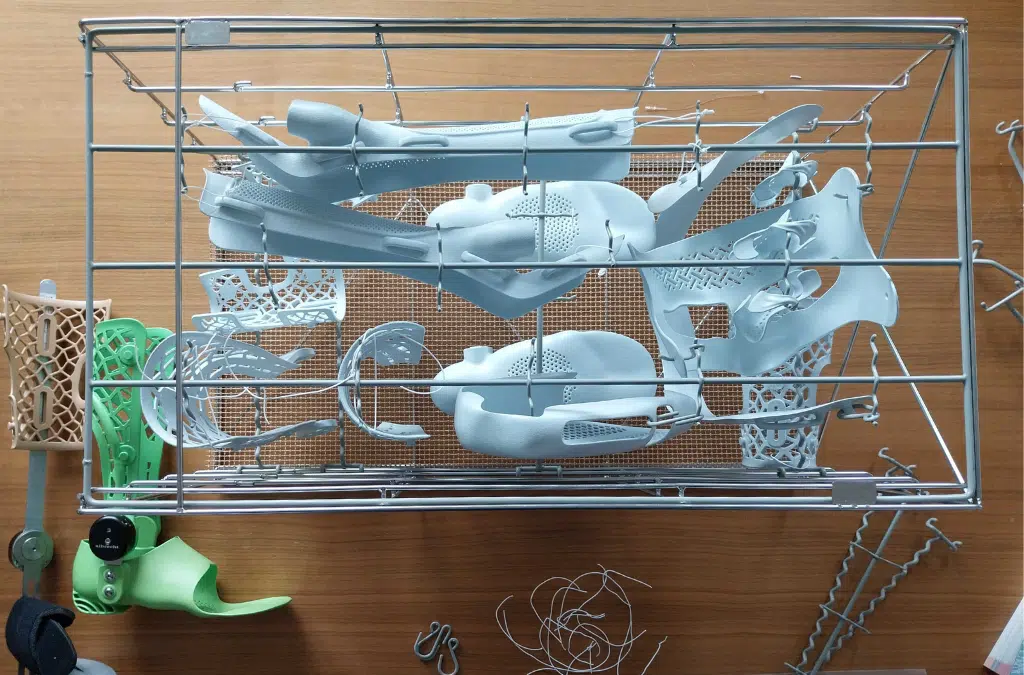
As prosthetic and orthotic providers invest in digital scanning, CAD software and additive manufacturing, increasing attention is turning towards a stage that is sometimes underestimated: what happens after the device leaves the printer?
A newly printed component is not necessarily ready for clinical use. Powder-bed parts must be unpacked and cleaned, residual powder removed and surfaces finished to an appropriate standard. Depending on the application, the device may also require smoothing, colouring, assembly and quality inspection.
DyeMansion is positioning automated post-processing as the link between printing an O&P component and producing a consistent, professional end-use device.
From patient scan to finished product
A complete digital O&P workflow may involve:
- Capturing the patient’s anatomy
- Creating or modifying the digital model
- Preparing and nesting the build
- Printing the device
- Depowdering and cleaning
- Surface finishing
- Colouring where required
- Assembly and clinical fitting
- Inspection and outcome evaluation
The printer is therefore only one part of the production chain.
DyeMansion describes its “Print-to-Product” workflow through three post-processing stages: cleaning, surfacing and colouring. Its systems are intended primarily for polymer parts produced through powder-bed technologies such as Multi Jet Fusion and selective laser sintering.
Cleaning without creating a manual bottleneck
Powder-based manufacturing leaves loose or partially attached material on and inside the printed parts. This must be removed thoroughly, including from lattices, channels and other complex geometries.
Manual blasting can be time-consuming and dependent on operator technique. It may also become a production bottleneck when a central fabrication facility processes many individually customised devices from the same print build.
Automated cleaning aims to make this stage faster and more repeatable. This can be particularly valuable when a production centre is manufacturing multiple AFOs, insoles, sockets or other devices each day.
The company’s Powershot systems use automated blasting processes for cleaning and surface treatment. DyeMansion says its equipment can work with materials including PA11, PA12, TPU, TPE, PEBAX and polypropylene, although compatibility depends on the particular machine and process.
Surface quality is not merely cosmetic
Raw powder-bed parts often have a visibly layered, granular or slightly rough surface. In a prototype, this may be acceptable. In a patient-facing product, it can affect appearance, cleanability, comfort and the user’s perception of quality.
DyeMansion offers two principal approaches.
PolyShot Surfacing is a mechanical process intended to create a more homogeneous finish while maintaining detailed geometry and defined edges.
VaporFuse Surfacing uses controlled vapour treatment to smooth and seal the external surface. DyeMansion presents this process as a route to a more injection-moulded appearance and feel.
For O&P applications, the most appropriate process depends on the material, device geometry, intended skin contact, mechanical requirements and validated manufacturing specification.
A smoother-looking part should not automatically be assumed to be safer or clinically superior. Manufacturers must confirm that post-processing does not adversely affect dimensions, stiffness, fatigue behaviour, interface geometry or the traceability of a regulated device.
Consistent colour for patient acceptance
Colour can be clinically relevant when it increases a patient’s willingness to wear an orthosis or prosthesis.
Children may prefer bright colours or a device that reflects their personality. Other users may favour discreet black or neutral finishes that attract less attention beneath clothing. Consistent colouring can also support brand identity or differentiate component sizes and production batches.
DyeMansion’s DM60 systems use the company’s DeepDye Coloring process to colour polymer parts after printing and surface preparation. The company promotes automated recipes designed to support repeatability across production batches.
For medical-device manufacturers, however, colourants and processes must form part of the documented and validated production system. Appearance cannot take priority over biocompatibility, mechanical integrity or regulatory compliance.
Moving from isolated devices to serial customisation
O&P presents an unusual manufacturing challenge: devices may be individually designed, but the production system must still operate consistently at scale.
A central fabrication centre might print dozens of unique parts in one build. Each belongs to a different patient, yet every device needs controlled cleaning, finishing, identification and inspection.
DyeMansion’s newer Powershot Dual Performance combines cleaning and surfacing within an automated system. According to the manufacturer, it can process powder-bed polymer parts in approximately 10 to 20 minutes per process and includes automatic unloading and options for connection with manufacturing-management systems.
This type of automation is likely to be more relevant to high-volume central fabrication operations than to small clinical workshops producing only a few devices each month.
Implications for IMEA providers
Across India, the Middle East and Africa, many organisations are considering whether to establish internal additive-manufacturing capacity or use an external production bureau.
Post-processing should be included in that decision from the beginning.
Prospective investors should calculate:
- Expected device volume
- Compatible printing materials
- Cleaning and finishing labour
- Compressed-air and utility requirements
- Equipment footprint and ventilation
- Consumables and maintenance costs
- Staff training
- Process validation
- Part identification and traceability
- Quality-control procedures
- Cost per completed device, not merely cost per print
At lower volumes, outsourcing printing and finishing may be more economical than purchasing an entire production line. A clinic can retain assessment, prescription, design approval and patient fitting while using a qualified external facility for manufacturing.
At higher volumes, automated post-processing may reduce manual labour and help deliver more consistent finishes across multiple operators and locations.
The clinical workflow must remain in control
Scanning, software, printing and post-processing can improve efficiency, but they do not independently determine whether an orthosis or prosthesis is clinically appropriate.
CPOs must still define the prescription, control the design, assess fit and alignment, examine the patient’s skin and function, and monitor outcomes.
The significance of DyeMansion’s approach is that it draws attention to the full production system. Digital O&P cannot be judged solely by what comes out of the printer. The finished device must be clean, consistent, traceable, clinically appropriate and acceptable to the person expected to use it.
For the next generation of O&P central fabrication, the competitive advantage may not come from owning a printer alone. It will come from controlling every stage between the patient scan and the successfully fitted device.
- DyeMansion: 3D Printing for Orthotics and Prosthetics
- DyeMansion Print-to-Product workflow
- Powershot Dual Performance
- HP 3D Printing events and O&P resources