

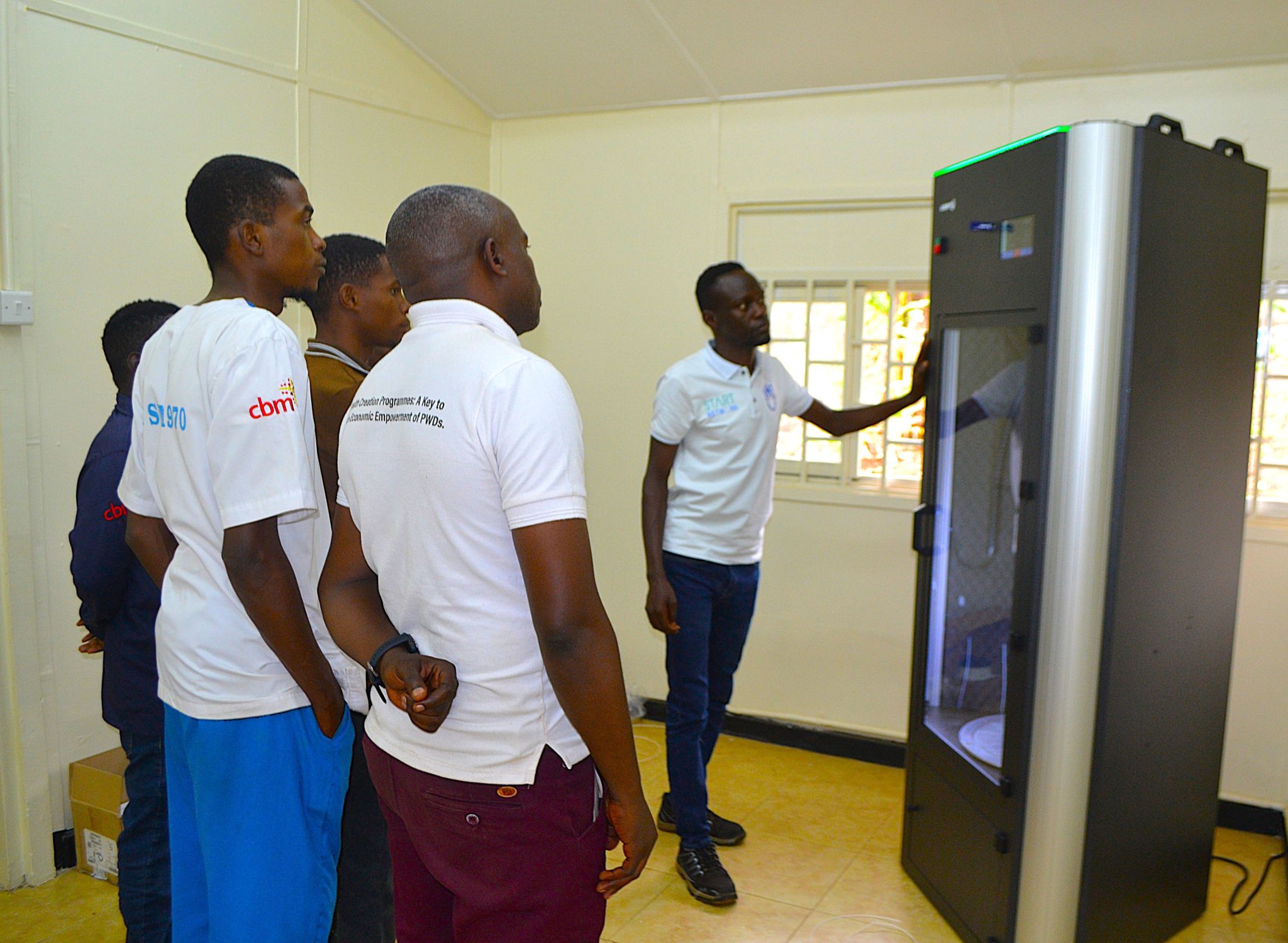
Katalemwa Cheshire Home has announced the introduction of 3D-printing technology at its Assistive Technology Centre in Uganda, marking an important step in the organisation’s transition towards digital orthotic and prosthetic production.
Supported by Humanity & Inclusion, the initiative will initially strengthen the centre’s plastics section and explore the production of patient-specific devices such as ankle-foot orthoses, knee-ankle-foot orthoses and prosthetic sockets.
Orthopaedic technologists and technicians at Katalemwa have already undertaken practical training intended to equip them with the skills required to use the new technology safely and effectively.
The development reflects a wider movement across Africa towards locally controlled digital manufacturing. Its long-term importance will depend not simply on installing a printer, but on integrating scanning, clinical prescription, computer-aided design, production, fitting and follow-up into one accountable clinical workflow.
Building on an established production centre
Katalemwa Cheshire Home is not beginning from scratch.
Founded in 1970, the Ugandan organisation provides rehabilitation and social services for children and young people with disabilities through centre-based and community-based programmes.
Its Assistive Technology Centre was established in 1998 and has developed into a production facility for orthopaedic footwear, foot-abduction braces, wheelchairs, calipers, knee pads, AFOs, KAFOs, prostheses and other assistive products. Katalemwa Cheshire Home
This existing clinical and technical foundation matters. Three-dimensional printing is most effective when introduced into a service that already understands patient assessment, biomechanics, material behaviour, device fitting and rehabilitation.
The printer is therefore an additional production tool—not a replacement for the judgement of the orthopaedic technologist, prosthetist or orthotist.
From manual fabrication to a digital workflow
A traditional thermoplastic orthosis may require casting, rectification of a plaster model, vacuum forming, trimming and finishing. A digital workflow can replace parts of that process with:
- Clinical assessment and prescription
- Three-dimensional scanning
- Digital model modification
- Computer-aided device design
- Printing and post-processing
- Clinical fitting and adjustment
- Follow-up and outcome assessment
Digital capture can reduce dependence on plaster and make patient information easier to store, review and reproduce. It may also allow experienced designers to support cases remotely when specialist expertise is not available at the point of assessment.
For Katalemwa, this could eventually support both its centre-based services and its wider network of community and rehabilitation partners.
Potential benefits for Ugandan patients
When the complete process is properly validated, 3D printing may offer several advantages:
- Patient-specific designs based on digital anatomical capture
- Consistent production from an approved digital file
- Reduced plaster use and workshop waste
- Easier reproduction when a device is lost or outgrown
- Potential for lighter and better-ventilated designs
- Remote collaboration between clinicians and fabrication specialists
- Digital documentation for quality assurance and follow-up
- Faster production for suitable device categories
These advantages are not automatic. Production time will depend on scanning, design, print duration, post-processing and available staff. A poorly prescribed or inadequately fitted printed device will not become clinically effective simply because it was manufactured digitally.
Material selection, wall thickness, print orientation, structural reinforcement and finishing must all correspond to the forces that the device will experience.
This is particularly important for KAFOs and prosthetic sockets, where structural failure could place the user at risk.
Training is the critical investment
Katalemwa’s decision to train its orthopaedic technologists and technicians is therefore one of the most important parts of the announcement.
A sustainable digital O&P programme requires competence across several connected areas:
- Anatomical scanning
- Digital rectification
- Orthotic and socket design
- Printer operation
- Material handling
- Post-processing
- Equipment maintenance
- Clinical fitting
- Documentation
- Quality control
- Failure reporting
- Outcome measurement
Staff must also learn when conventional fabrication remains the better option. Some complex devices may continue to require thermoplastic forming, lamination, metalwork or hybrid construction.
The objective should not be to print every device. It should be to select the production method that offers the best combination of clinical performance, cost, durability and serviceability for each patient.
Building on Humanity & Inclusion’s Ugandan experience
Humanity & Inclusion has already demonstrated the potential of digital rehabilitation workflows in Uganda.
Its 3D PETRA programme used portable scanning, remote digital modification and additive manufacturing to provide customised orthoses and prostheses to people living in refugee settlements. In one documented case, a patient was scanned near his home, the digital model was modified remotely and the finished orthosis was returned through his rehabilitation team. humanity-inclusion.org.uk
That experience provides useful technical and operational knowledge for Katalemwa. It demonstrates how digital tools can connect remote communities with specialist production capacity while keeping physiotherapy, psychosocial support and follow-up close to the patient.
The partnership also illustrates an important principle for technology transfer: equipment should be accompanied by training, protocols, quality assurance and continuing technical support.
An opportunity for African-led manufacturing
Across Africa, many O&P workshops face shortages of materials, ageing equipment, limited specialist staff and long travel distances between patients and production centres.
Digital manufacturing will not resolve every one of these constraints. Printers require reliable electricity, maintenance, spare parts, suitable materials and trained operators. Imported consumables can also create a new form of supply-chain dependence.
However, a well-managed programme can strengthen local production rather than replacing it. Digital files can be designed around local clinical needs, staff can develop new technical skills and successful workflows can be shared with other rehabilitation centres.
Katalemwa’s move into 3D printing is therefore about more than acquiring new machinery. It represents an opportunity to combine more than 25 years of assistive-technology production experience with a new generation of digital tools.
If the programme remains clinically led, properly validated and supported by ongoing workforce development, it could improve production capacity at Katalemwa while contributing valuable African experience to the global development of digital orthotics and prosthetics.
- Katalemwa Cheshire Home
- Katalemwa Assistive Technology Centre
- Katalemwa Assistive Technology Products
- Humanity & Inclusion: 3D Printing in Uganda
- Humanity & Inclusion 3D-Printing Project