

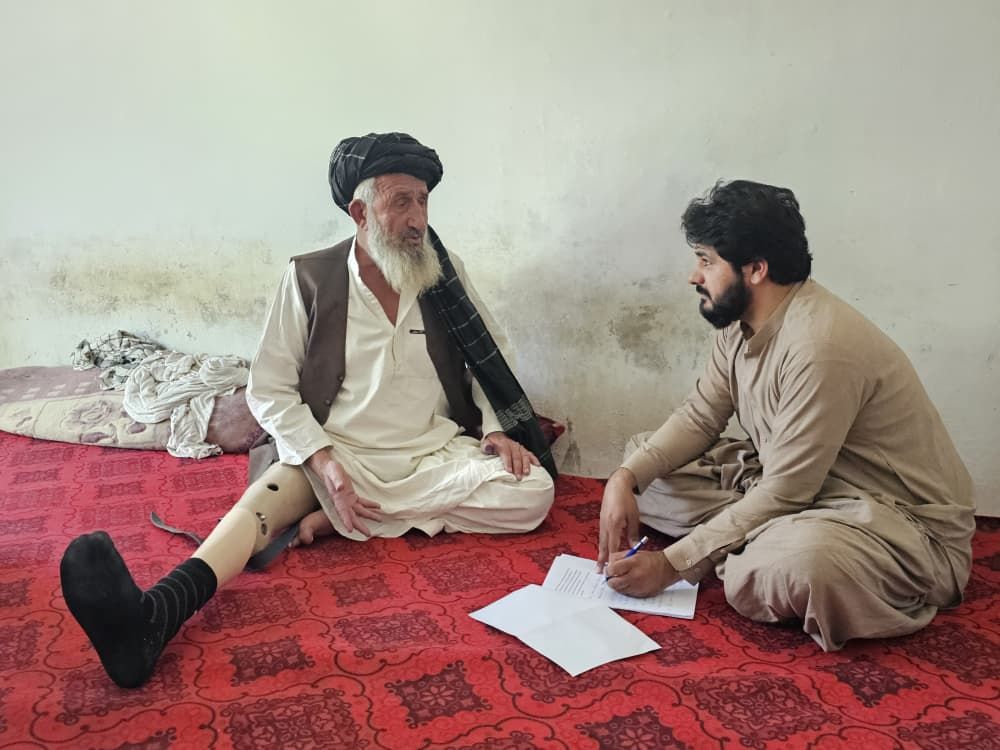
Afghanistan prosthetic repairs have become a long and costly journey for people in Spin Boldak District, where a rehabilitation centre stopped services after aid cuts. Patients now travel about 100 km to Kandahar city for care, according to Humanity & Inclusion (HI), which published the account on 2 November 2026.
What Humanity & Inclusion reports
HI describes the case of Mohammad Rafiq, 60, who lost a leg when a mortar shell hit his home during Afghanistan’s civil war. He has used a prosthesis for 33 years and lives with his sons’ family in Spin Boldak District, Kandahar province.
According to HI, about three months before its article he found that the rehabilitation centre inside the Spin Boldak district hospital had stopped services because of aid cuts. HI had run that centre, and it was the only rehabilitation centre serving his district.
Care has moved to HI’s centre at Mirwais Regional Hospital in Kandahar city. HI says the round trip costs about 3,000 AFN, roughly 40 euros, and that Mr Rafiq travels once or twice every two months, sometimes staying one or two nights. HI quotes him as saying that without rehabilitation services and mobility support, persons with disabilities become more dependent on others.
The article adds that women with disabilities cannot travel without a family member and often cannot afford the fare. It cites OECD data showing international aid fell 23.1% between 2024 and 2025, and HI says it will release a report on the impact of funding cuts on persons with disabilities in December.

Why prosthetic repair access matters
A prosthesis that cannot be adjusted or repaired locally can leave a user without mobility, or force a costly journey for a minor fix. Long-term users such as Mr Rafiq depend on maintenance as much as on the first fitting. The case also shows how closing a single district-level centre can shift the whole burden onto patients and families.
IMEA CPO Perspective
This section is IMEA CPO’s reading, not HI’s claim. The account is one individual’s experience in one district, and it does not measure how many people are affected nationally. It does point to a gap that prosthetists and orthotists working in South Asia and fragile settings often raise: repair and follow-up care are easier to lose than initial fittings when funding contracts.
For CPOs and programme managers, the practical questions are where basic repair capacity can sit closer to users, whether technicians in district facilities can be trained for common repairs, and whether outreach visits can replace long patient journeys. HI’s December report may add evidence on these points. For related South Asia coverage, see O&P South Asia News, including Mayo Hospital’s prosthetics upgrade and the CRP Bangladesh Hanger Foundation grant.
Suggested hyperlinks / sources
- Humanity & Inclusion: For Mohammad, prosthetic repairs now cost a 100 km trip and a loan (original source, 2 November 2026)
- ICRC: Afghanistan orthopaedic centres and physical rehabilitation
- IMEA CPO: O&P South Asia News
Image: © HI (Humanity & Inclusion).