

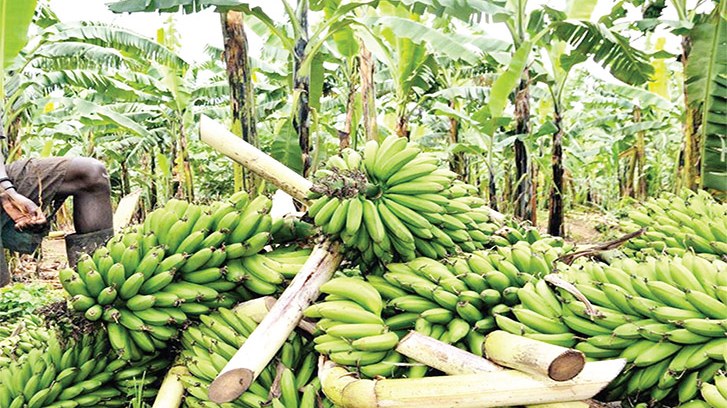
A research team at the Federal University of Technology, Owerri (FUTO) in Imo State, Nigeria, has built a prototype wrist hand orthosis in which half of the usual carbon fibre is replaced by fibre extracted from banana stems, a plentiful agricultural waste. The university presented the work as the fourth in a series of innovations announced on its official LinkedIn page.
The project is led by Engr. Dr. (Mrs.) Chioma Anyiam, working with Dr. (Mrs.) Jovita A. Daniel, Mr. Darlington Onyido and Miss Mary Magret Nwagu. Its starting point is cost: carbon fibre is strong and widely used in orthoses, but it is expensive, putting braces and supports out of reach of many Nigerians.
What the FUTO team reports
According to FUTO, the team extracted fibre from banana stems, treated it so it bonds well with carbon fibre, and used it to replace 50% of the carbon fibre in the device. The university reports that:
- the hybrid material reaches 60–75% of the strength of pure carbon fibre, which the team considers sufficient for a wrist hand orthosis;
- the prototype, made from the best-performing mix, is 30–40% lighter than plaster of Paris and 15–20% lighter than thermoplastic;
- it is rigid enough to hold the wrist in a neutral position.
The team lists possible uses including stroke patients with wrist drop or spasticity, wrist fractures and carpal injuries, sprains and ligament injuries, cerebral palsy, nerve injuries, work-related repetitive strain and children needing orthotic support. It sees orthopaedic, general and military hospitals, as well as individual patients, as likely users. FUTO’s announcement describes a working prototype; it does not report patient trials, durability testing or a route to manufacture.
Part of a wider Nigerian research thread
FUTO’s work builds on earlier Nigerian research into banana fibre for P&O devices. A 2016 study from the University of Ilorin tested banana pseudo-stem fibre in epoxy composites as a replacement for the glass fibre used in transtibial prosthetic sockets, noting that the fibre is strong, light and cheap because it is usually treated as waste. Researchers in Enugu State have also evaluated plantain pseudo-stem fibre for transtibial sockets, and an Ethiopian team has developed a false banana fibre composite for prosthetic sockets.
IMEA CPO Perspective
- Cost is the barrier: Across West Africa, imported carbon fibre and thermoplastics drive up the price of upper-limb orthoses. A locally sourced fibre that halves carbon fibre use could make a real difference to affordability if the savings hold at production scale.
- Evidence still needed: Before clinical use, orthotists will want fatigue and moisture-resistance data, skin-contact safety, consistency between fibre batches and fitting outcomes in patients.
- A role for clinics: Nigerian P&O departments and orthotists in the South East are well placed to partner with the FUTO team on clinical evaluation and design feedback.
- Local value chains: Banana and plantain are grown widely across the region, so a proven process could support local fibre processing alongside device fabrication.
Suggested hyperlinks / sources
- Federal University of Technology, Owerri (FUTO) on LinkedIn
- University of Ilorin: banana pseudo-stem fibre composite for transtibial sockets (2016)
- Plantain pseudo-stem fibre transtibial socket study (JASEM)
- False banana fibre composite for prosthetic sockets (Journal of Natural Fibers, 2024)
- IMEA CPO: Tanzania’s Roverlabs makes custom orthoses locally
- IMEA CPO: NAPOTS South East Zonal Convention 2026 in Owerri