 By
By
Modern technologies, often associated with expensive gadgets and industry, are also having a growing social impact. One example of this approach is the nonprofit organization Make Good, which uses 3D printing to provide real, practical help to people with disabilities, especially children.
 The organization’s founder, Noam Platt, started from one powerful belief: sooner or later, everyone will experience some form of disability, even if only due to aging. It is hard to accept a vision of the world in which declining physical ability means losing the chance to do the things we love. This reflection gave rise to the idea behind Make Good.
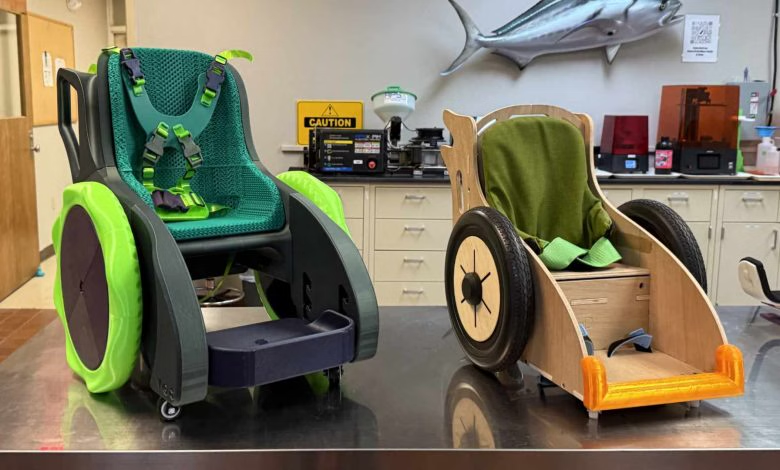
The organization’s mission is to design and share solutions that support people with limited mobility, without a profit motive. One of its key projects is the 3D printing of wheelchairs, mainly for children. The cost of professional wheelchairs can be extremely high, and many families simply cannot afford them. Make Good aims to fill this gap.
The project was first widely presented at the Formnext 2025 trade fair. At the Bambu Lab booth, the team showcased the first fully functional 3D-printed children’s wheelchair. Moreover, one of the wheelchairs was later donated to a family in need, proving that the initiative is not just for demonstration but truly practical.

Make Good’s goal was to design a wheelchair that is as simple to produce as possible, yet durable and reliable. The creators wanted a design that is easy to replicate and modify while still offering functionality comparable to high-end commercial models.
 Make Good has released the complete wheelchair design for free on the MakerWorld platform. To produce the parts, even a basic 3D printer is enough, as long as it can print PETG and TPU, such as the Bambu Lab A1. The production process takes about a week and requires roughly ten spools of filament.
Additionally, with the help of AI, Make Good created a map displaying all individuals, companies, and institutions that have participated in the initiative. The map already includes around 200 contributors.
Make Good’s work shows that 3D printing can be more than just a specialized industrial technology. In the right hands, it becomes a tool for real social change, improving access to medical equipment
and giving greater independence to those who need it most.