 By
By
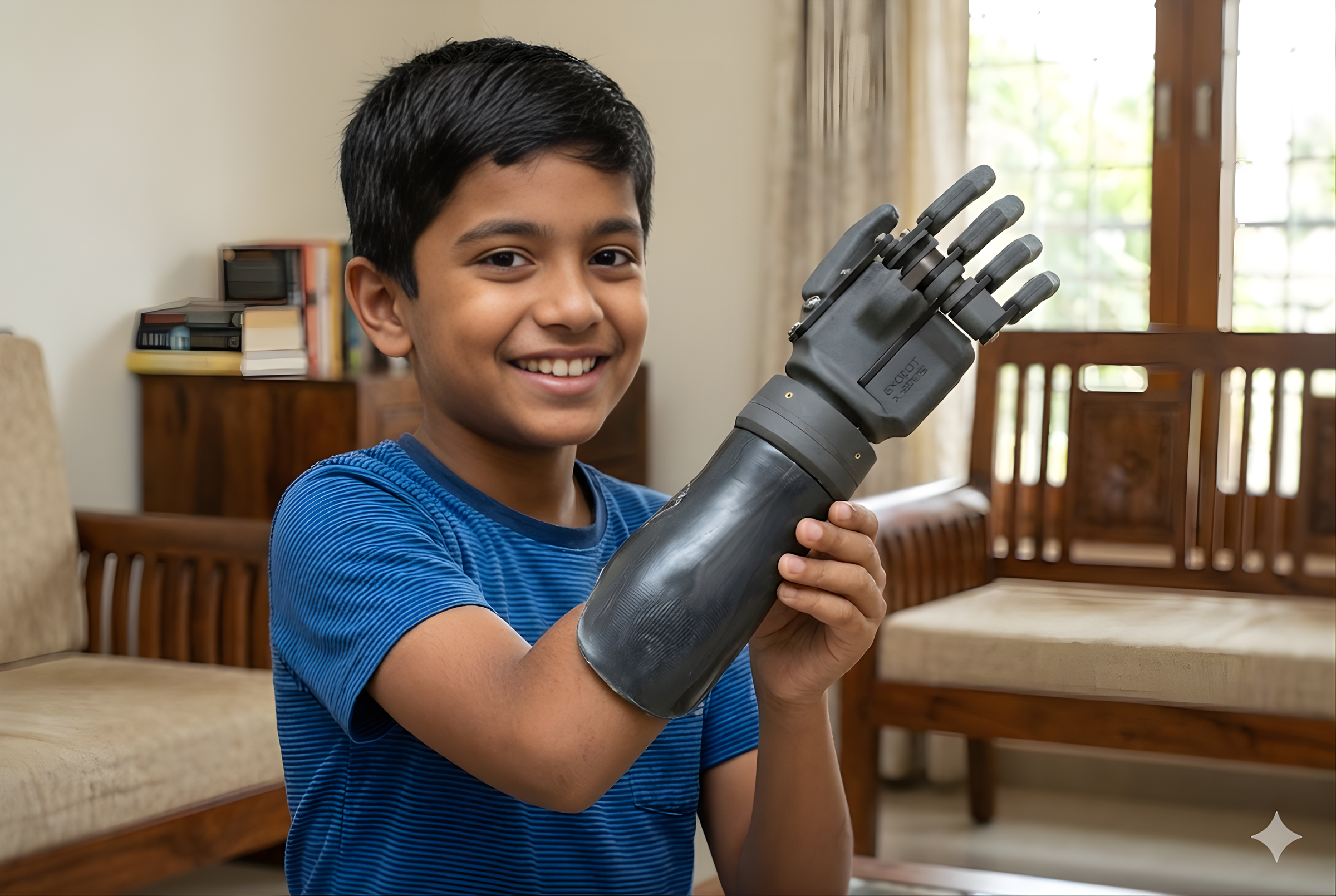
A young innovator from Bhiwani, Haryana has secured ₹30 lakh in funding for his prosthetic startup after FICCI–Mercedes-Benz India selected his product, the GripX hand, under the Bharat Innovation and Business Ideas Challenge 2026. According to The Tribune, the funding is aimed at supporting a prosthetic innovation focused on making advanced artificial limbs more affordable and accessible for Indian patients.
The startup behind the product is Exobot Dynamics, founded by Munish Kumar, who completed his MTech and PhD at Guru Jambheshwar University of Science and Technology (GJUST). The Tribune reports that Kumar developed the prosthetic device, secured a government patent for it, and is now using the funding to move the product closer to real-world impact.
According to the report, Exobot Dynamics has identified 20 persons with disabilities who will receive the device free of cost as part of the next phase of deployment. That detail matters because it suggests the project is not being positioned only as a prototype or competition entry, but as a practical assistive technology effort intended to reach users directly.
The story also has a strong personal origin. Kumar told The Tribune that his father lost both hands in an accident in 2013, when he was still a student. Seeing the challenges his father faced appears to have shaped the direction of his work, leading him to focus on building a device that could be both functional and realistically affordable for Indian users.
Kumar said he began working on the project in 2019 during his PhD and later received support or recognition from a number of Indian startup and innovation bodies, including Atal Incubation Centre IIT Delhi, IHFC, SACC, COEP’s Bhau Institute, BIRAC, DST NIDHI, NCPEDP, and MeitY. That wider support network suggests Exobot has already been moving through India’s medtech and startup ecosystem for some time rather than emerging overnight.
Additional public material from Exobot and its ecosystem points to the company’s broader positioning. Exobot describes GripX as an advanced myoelectric prosthetic hand, while incubator and partner posts describe it as being controlled through muscle signals and designed to offer greater accessibility than many imported alternatives. A recent company profile also describes Exobot as a developer of lightweight, adaptive upper-limb prostheses with EMG sensor-driven movement and adaptive grip.
For IMEA CPO readers, the real significance of this story is not only the funding round. It is the type of problem Exobot is trying to solve. Upper-limb prosthetics remains one of the hardest categories to make both functional and affordable in cost-sensitive markets. A startup focused on indigenous myoelectric technology, lower pricing, and local deployment is therefore operating in one of the most important unmet areas in the sector. This is an inference based on the company’s positioning and the nature of the product described publicly.
There is also a wider manufacturing and innovation angle. The Bharat Innovation & Business Ideas Challenge Programme is presented by FICCI and Mercedes-Benz India as a national initiative designed to support startups, researchers, and academic teams working on real-world problems. Public coverage of the programme says seven winners were selected from a shortlist of 32 finalists, with Exobot among those chosen. That makes the award more than a local recognition story; it places the startup within a broader national innovation pipeline.
The bigger question now is execution. Funding and recognition are important, but the long-term test will be whether Exobot can turn GripX into a clinically robust, supportable, scalable prosthetic solution with reliable fitting, maintenance, and follow-up. That is especially important in upper-limb care, where device usability and service support often determine whether a product succeeds in everyday life. This is an inference, but it follows directly from the realities of upper-limb prosthetic provision.
For now, though, the funding marks a meaningful milestone. It shows that Indian innovation programmes are beginning to back assistive technology projects that aim not just to invent, but to close real affordability and access gaps in prosthetic care.
Suggested hyperlinks: