 By
By
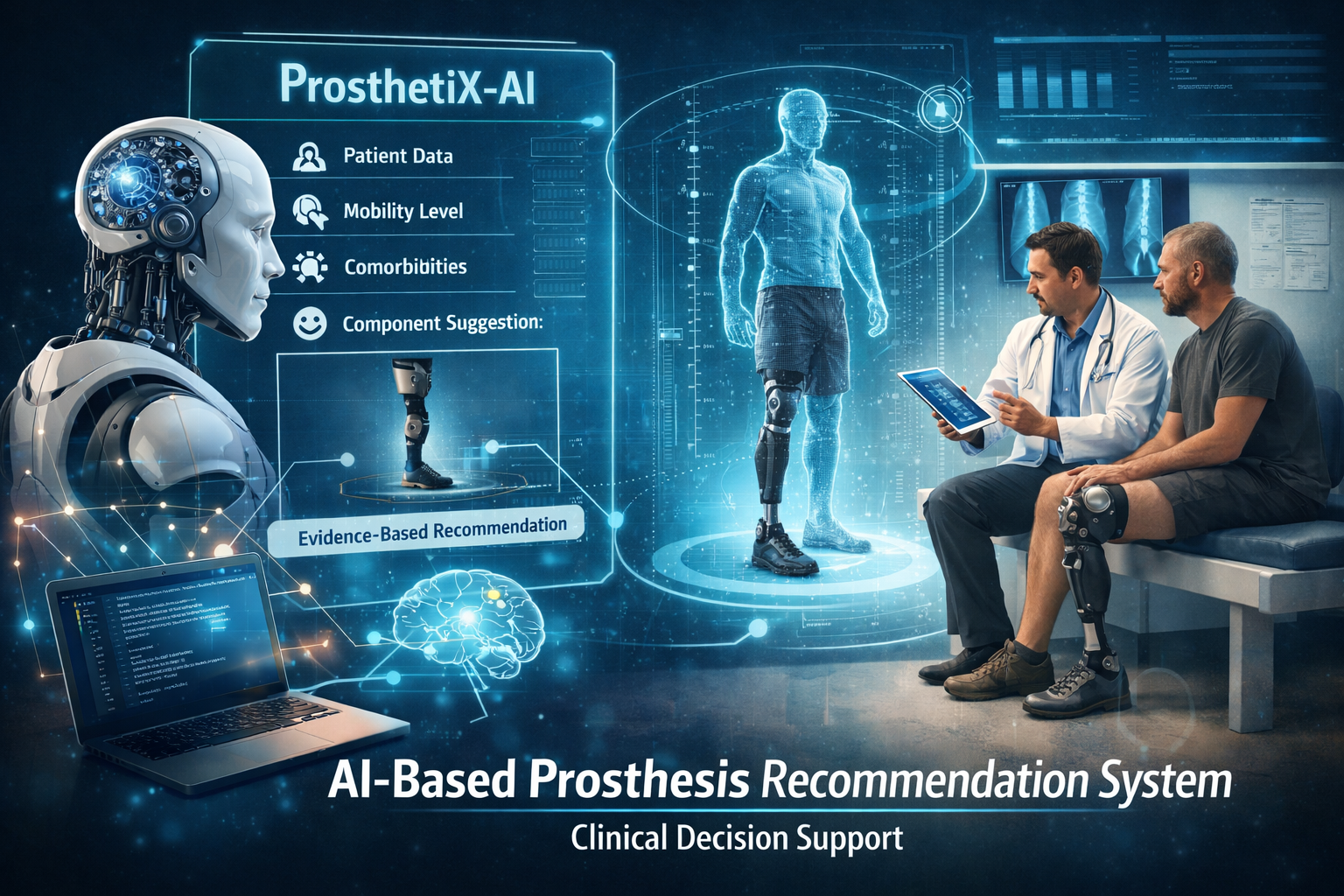
Researchers have developed a new artificial intelligence-based clinical decision support system designed to assist with lower-limb prosthesis recommendations, in a move that could add a new layer of structured, evidence-based support to prosthetic prescription. The system, called ProsthetiX-AI, was highlighted by The O&P EDGE on 15 April 2026 and formally published in Health Information Science and Systems on 11 April 2026.
According to the study summary cited by The O&P EDGE, the system was created in response to a familiar problem in prosthetic care: conventional selection approaches can rely heavily on subjective clinical judgment and relatively static protocols, sometimes failing to capture the full complexity of individual patient needs. The researchers say ProsthetiX-AI dynamically evaluates patient-specific factors including amputation level, mobility classification, comorbidities, weight, and biomechanical characteristics in order to generate recommendations aligned with established clinical guidance.
What makes the project especially notable is its attempt to combine rules-based decision logic with explainable AI. The paper describes ProsthetiX-AI as integrating a deterministic policy engine with evidence-based reasoning, supported by a large language model explanation module. In practical terms, that means the system is not only meant to produce a recommendation, but also to explain why that recommendation was made by pointing back to peer-reviewed evidence, mobility classification standards, and weight-based component selection criteria.
That explainability point matters. In prosthetics, clinicians are not simply choosing from a menu of components. They are balancing safety, function, patient goals, reimbursement realities, comorbidities, and the likely real-world performance of a device. Any AI tool that hopes to gain credibility in O&P will need to do more than generate outputs quickly. It will need to show its reasoning transparently and fit into clinical workflows rather than attempt to replace them. That is an editorial inference, but it is strongly supported by the study’s emphasis on transparent justification and evidence retrieval.
Initial evaluation of the system was small but encouraging. The O&P EDGE reported that five lower-limb prosthesis users with complex comorbidity profiles and five clinicians assessed ProsthetiX-AI and gave it high ratings for accuracy and usability. That does not make it clinically validated at scale, but it does suggest early promise for decision-support use cases, particularly where clinicians are dealing with more complex presentations.
The paper was authored by Vidyapati Kumar and Dilip Kumar Pratihar. Based on the abstract information surfaced online, the authors position ProsthetiX-AI as a patient-centred decision-support framework that could help augment clinical decision-making, address some barriers to AI adoption in healthcare, and potentially support more consistent recommendations in resource-constrained environments.
For the O&P sector, that last point is especially relevant. In many IMEA markets, prosthetic prescription decisions are made under pressure, with uneven access to specialist staff, variable documentation standards, and inconsistent access to formal evidence-based tools. A system that can structure reasoning around clinical guidelines and patient variables may eventually prove useful in supporting less-resourced teams, training newer clinicians, or standardising parts of the component selection process. This is a forward-looking interpretation rather than a demonstrated real-world outcome from the study.
That said, caution is still warranted. The published article and the O&P EDGE report point to an important early-stage concept, not a finished replacement for clinical expertise. The evaluation group was very small, and no large multi-centre clinical adoption data has yet been cited in the reporting reviewed here. For now, ProsthetiX-AI looks best understood as an emerging decision-support tool rather than a proven autonomous prescribing platform.
From an IMEA CPO perspective, the broader significance is clear: artificial intelligence in prosthetics is moving beyond control systems and gait adaptation into the more complex territory of clinical recommendation and evidence-guided prescription support. Whether tools like ProsthetiX-AI become widely adopted will depend on validation, usability, clinician trust, regulatory clarity, and how well they adapt to real clinical environments. But the direction of travel is worth watching closely.