 By
By
Patients rarely get to select a new prosthetic foot after a lower-limb amputation, but Humotech is trying to change that.
“There’s no shoe store for prosthetics, where you can go in and try different shoes out and see what you like, look in the mirror, walk around,” said Josh Caputo, founder and CEO of Humotech.
Instead, the process is centered around clinician judgment — leaving the patient a passive recipient.
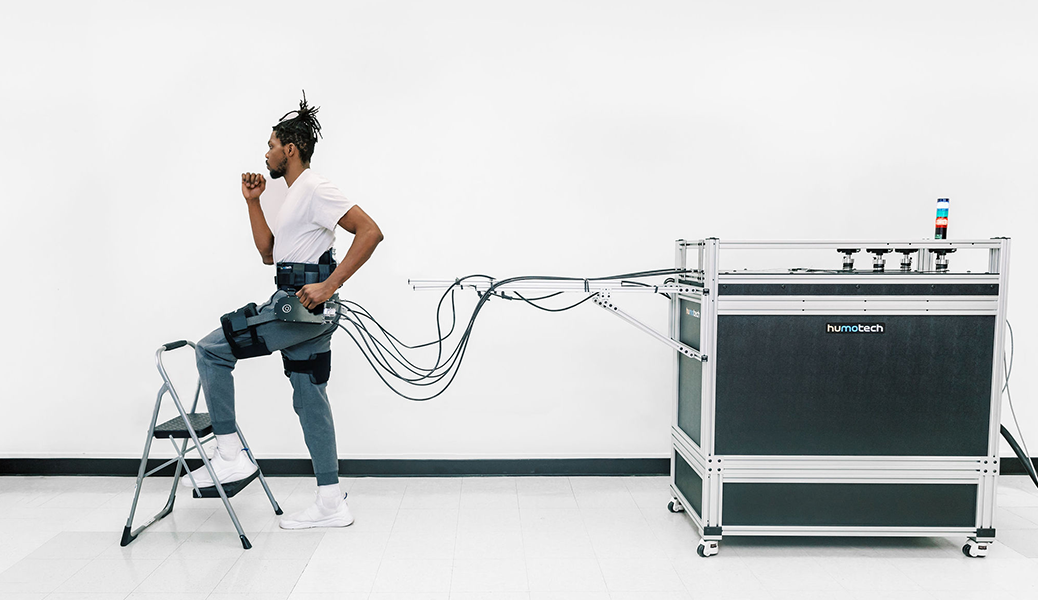
Humotech hosted a demo day for University of Pittsburgh students studying orthotics and prosthetics last week on campus. Mr. Caputo’s team showcased its Caplex System technology with the help of a wearable device, a “prosthetic foot emulator,” that is able to emulate models of prosthetic feet on the market.
“As much as this exists, it’s not accessible to the amputee population,” said Rachel Sumrada, a Pitt student studying orthotics and prosthetics.
Ms. Sumrada is familiar with the “test drive” problem. She was born without a lower left leg. She only has access to this technology because she’s studying it — and she said she has never been to a clinic where she was able to sample three different feet. Humotech’s technology lets her do that in seconds.
“They want to be able to do this for their patients,” she said. “It’s just, there’s time constraints, there’s insurance and everything that gets involved.”
One of Humotech’s big goals, he said, is to foster more trust and understanding between prosthetic companies like ēlizur, and the payers.
“You cannot do anything in health care without thinking about the payers because the payers are funding everything that is done for the patient,” Mr. Caputo said.
By providing a patient’s “experiential” data to insurance payers, Humotech helps them make decisions based on evidence and “medical necessity.” Since prosthetic feet can cost up to $30,000, that data matters, Mr. Caputo said.
When a patient puts on the Caplex technology and walks on a treadmill, the operator uses Humotech’s computer program to change the way the “foot” feels in stiffness, weight, shape and responsiveness.
For one Pitt student, the operator made the foot feel as though it was walking through mud — and the student said it felt exactly like that.
As the foot changes, the patient gives feedback on comfort, preference and other metrics while the computer program takes additional measurements.
“That is a conversation or a thought process that is more art than science, really,” Mr. Caputo said. “It’s human emotions. It’s personal preference.”
He said he almost cried at how “jazzed” a trial patient was in testing out the technology, saying that they had not walked that fast in five years.
Pitt professor Robert Maguire said, too, that insurance drives a lot of this process, and that adding science into the equation benefits the patient. Activity level, lifestyle and patient goals matter to a prosthetic foot pairing, as one might better suit a brisk walker, and another might align with the patient’s hiking goals.
“We’re training our students to know how to put a foot match with the activity,” Mr. Maguire said. “The emulation that you’re seeing here has a way of proving what type of foot that a patient will need, as opposed to taking the marketing point put out by a manufacturer.”
On Wednesday, Humotech announced its first “real-world” customer, ēlizur. Based in Ross, ēlizur provides prosthetics and orthotics to patients, and will be piloting Caplex in its clinical practice.
“I believe this patient-centric technology will create a more efficient and appropriate prosthetic foot selection process for both the patient and the prosthetist,” said Brad Scott, director of prosthetics and orthotics at ēlizur. “Patients will spend less time in the clinic while being matched with the most biomechanically suitable foot. Meanwhile, practitioners will no longer have to juggle ordering and returning multiple feet from manufacturers.”
There are about 850,000 major lower limb amputations every year across the world, Mr. Caputo said.





.jpeg)

-1.png "Gaza Fund (1)-1")
.jpeg)