 By
By
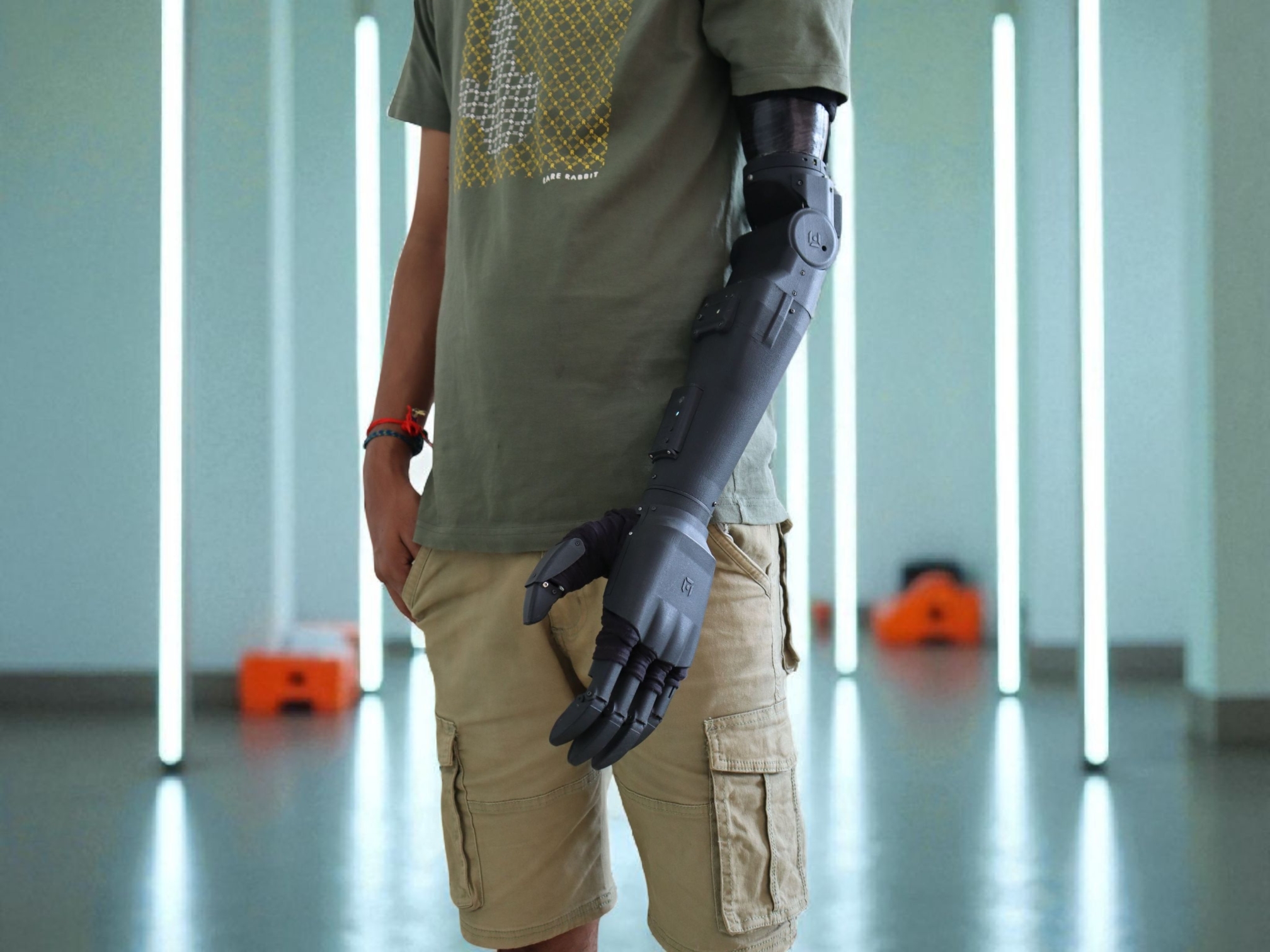
A Kerala-based startup is trying to address one of the most persistent gaps in India’s upper-limb prosthetics market: the divide between advanced imported devices that remain out of reach for many users and lower-cost options that often offer limited functionality. According to Startup Pedia, Bendita Bionics, founded in 2022 by Rover C Joseph and Ashik Ansary, is developing bionic hands, motorized elbows, and related assistive technologies for people with upper-limb differences or hand paralysis.
The company’s core pitch is straightforward. It wants to make upper-limb prosthetic systems that are lighter, more practical for daily use, and more affordable than many of the high-end imported devices currently available in the Indian market. Bendita’s own website says its advanced prosthetic offerings include a multi-grip bionic hand and a motorized bionic elbow, aimed at both below-elbow and above-elbow users, and highlights low weight as a key selling point.
According to the Startup Pedia report, the founders were drawn into the field after identifying multiple pain points in the prosthetics sector, including limited access, high pricing for advanced devices, heavy systems for above-elbow users, and performance issues linked to hot, humid conditions. The article says they began by pooling around Rs 10 lakh of personal savings and then building their products through a hybrid model that combines in-house design with MJF 3D printing through a manufacturing partner in Bengaluru.
That climate-related design angle is particularly notable. The founders told Startup Pedia that sweating inside the socket can affect EMG signal reliability, which in turn affects prosthetic control. Their response, according to the article, was to add a manual joystick backup so users can continue operating the device when EMG control becomes less dependable. In markets such as India and across much of IMEA, where heat and humidity are real daily-use factors rather than edge cases, that kind of adaptation could be commercially and clinically significant.
The company’s current product lineup, as described by Startup Pedia and supported by Bendita’s website, includes a multi-grip bionic hand and a motorized elbow for above-elbow users. The startup says its bionic hand supports multiple grip patterns, while the motorized elbow is intended to improve arm positioning and function for transhumeral users. Bendita’s site also claims the hand weighs around 400 grams, and presents the system as a lightweight alternative designed for day-to-day use.
Pricing is one of the biggest parts of the story. Startup Pedia reports that advanced bionic arms in India can range from roughly Rs 8 lakh to Rs 25 lakh, while Bendita says its own bionic hand is priced at under Rs 5 lakh. That claim should still be viewed as company-reported positioning rather than an independently verified market benchmark, but it does underline the gap the founders are trying to target: not the lowest-cost purely cosmetic segment, but a mid-point where greater function is still kept within closer reach.
For IMEA CPO readers, the most relevant part of the story is not the “Iron Man” inspiration angle that frames the original article. It is the fact that upper-limb prosthetics remains one of the hardest categories to make both functional and accessible in lower-cost markets. There is often a steep trade-off between usability, weight, serviceability, and price. A startup that is explicitly trying to reduce weight, improve comfort, and lower cost while keeping meaningful function is operating in one of the sector’s most important problem areas. That is an inference, but it is strongly supported by the product claims and market gaps described in the source article.
There is also a broader manufacturing point here. Bendita’s use of additive manufacturing for component production reflects a continuing trend in prosthetics: small and emerging companies are increasingly using digital design and outsourced advanced manufacturing to reduce tooling constraints and accelerate product iteration. That does not automatically guarantee scale or long-term service success, but it does show how digital production methods are lowering barriers for local device innovation.
At this stage, Bendita Bionics still appears to be a small company. Its LinkedIn profile lists it as a medical device business with a small team, and the Startup Pedia report says it currently operates with around five people. But that does not make the story less important. In many emerging O&P markets, some of the most relevant innovation is not coming from large incumbents alone. It is also coming from small teams trying to close specific gaps that bigger suppliers have left unresolved.
The bigger question now is whether Bendita can translate promising design choices into durable clinical adoption, after-sales support, and broader distribution. Upper-limb users need more than an interesting device. They need reliability, service access, training, repair pathways, and realistic long-term ownership. If Bendita can build those systems alongside its hardware, it may become a company worth watching far beyond Kerala. That last point is an inference, but it follows directly from the realities of upper-limb prosthetic provision in cost-sensitive markets.