 By
By

In marketing, people call it messaging.
In a cranial clinic, parents call it peace of mind.
When families walk through your doors, they aren’t simply looking for a cranial orthosis. They’re looking for reassurance. Most have spent hours online reading worst-case scenarios, comparing brands, and absorbing contradictory advice. They arrive anxious, overwhelmed, and unsure of who to trust.
And in that moment, the language your team uses matters just as much as the scanning technology, the design system, or the fabrication method behind the helmet.
Because before parents trust your tools, they need to trust you.
Clarity Is What Parents Remember
Think about the last time you had something complex explained to you—whether it was a medical professional, an engineer, or a colleague.
Chances are you don’t remember the entire explanation.
You remember the one sentence that made it click.
That’s the power of clarity in healthcare. It’s not about saying more. It’s about saying what matters most—at the moment the family needs it.
Parents are listening the same way.
The Real Questions Behind Every Appointment
Clinicians may focus on clinical outcomes, accuracy, and fit.
Parents are silently asking something different:
- Can I trust this clinic?
- Will my baby be okay?
- Are you confident in what you’re doing?
- Do you actually care—or is this just a sales process?
Your words answer those questions long before a scan is taken, a measurement is reviewed, or a treatment plan is finalized.
From Features to Reassurance
Many clinics communicate primarily through features:
- lightweight design
- digital scans
- custom pads
- advanced materials
- manufacturing precision
These details are important—but on their own, they often inform without reassuring.
What parents respond to most is meaning.
When you tell a parent something like:
“We stand by your baby’s journey. You’ll only ever need one band.”
You’re not just describing a guarantee.
You’re communicating confidence and trust. You’re saying:
We believe in our clinical process.
We believe in the technology.
We believe in your child’s progress.
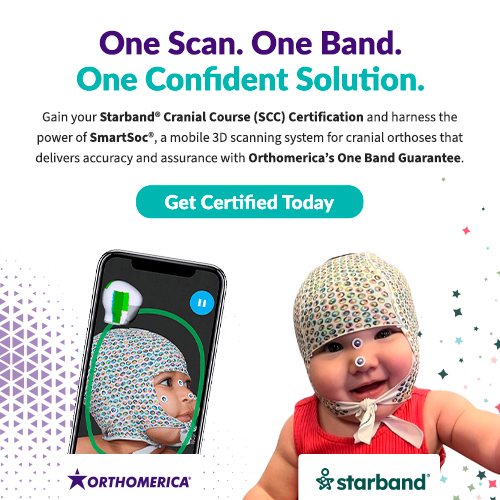
This is the heartbeat behind Starband’s One Band Guarantee—and why it resonates so strongly with families. It reframes the conversation from “how helmets work” to “how we will support you.”
A Guarantee Is Also a Communication Strategy
A program like the One Band Guarantee isn’t only a company promise. It’s a message that tells families:
“We’re in this with you.”
And whether a clinic uses Starband or another solution, the principle remains the same:
families need to feel guided, supported, and safe throughout the full journey.
A simple sentence such as:
“We’ll support your family from the first scan to the last smile.”
shifts the entire appointment from a technical transaction into a trusted care pathway.
What IMEA O&P Clinics Can Take From This
For cranial teams across the IMEA region—where awareness, access, affordability, and patient education can vary widely—communication becomes a clinical tool.
Because in real-world cranial care:
✅ Trust improves compliance
✅ Confidence reduces drop-outs
✅ Clear expectations improve satisfaction
✅ Families who feel supported tell other families
Technology Matters. But Transformation Starts With Communication
In cranial treatment, success isn’t only about the helmet. It’s about the family believing in the process—and believing in the team delivering it.
Healthcare transformation doesn’t start with technology.
It starts with how you communicate it.
One sentence at a time.