 By
By


Just a year ago, nine-year-old Rateb Aqliq ran barefoot through the narrow alleyways of his neighbourhood, laughing as his mother called him home for lunch.
Life seemed ordinary, full of small joys — until one afternoon, when an Israeli airstrike destroyed his home, killing his mother, father and older brother, and leaving Rateb to wake days later without his right leg.
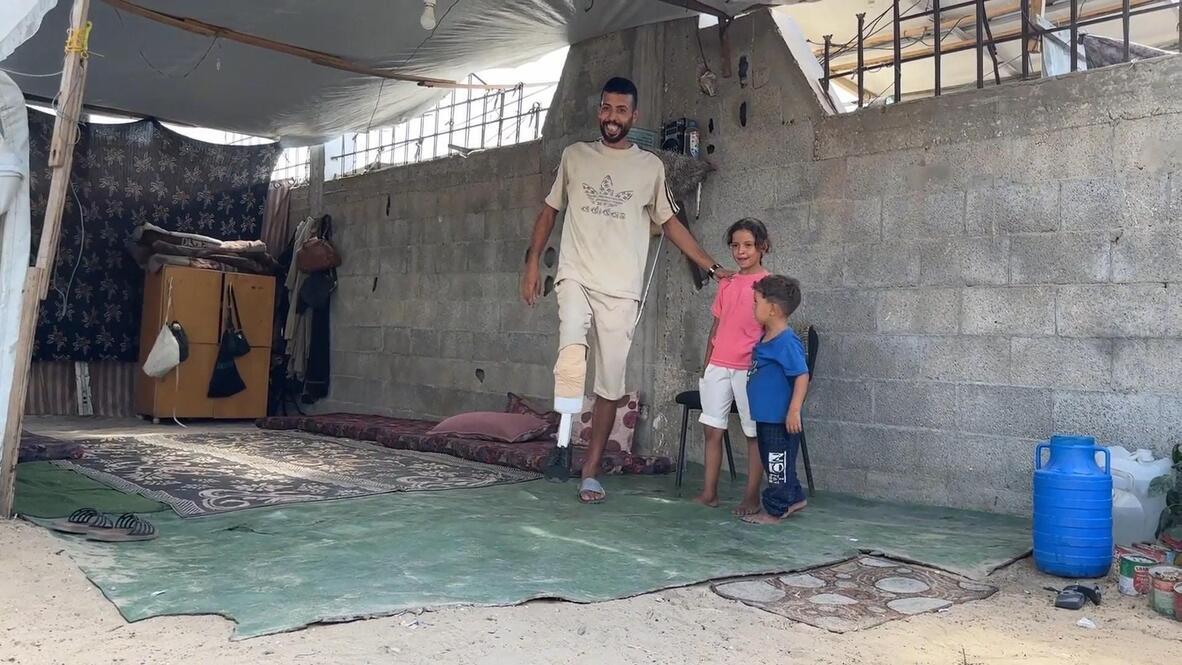
Devastated and overwhelmed, Rateb now sits in a torn, wind-battered tent in Deir Al-Balah, central Gaza, struggling to rebuild his life.
Carefully, he balances on a plastic tube leg made with a friend's help, wobbling with each unsteady step as dust rises from the bare floor. Clearly in pain, he refuses to let go.
Rateb's uncle, Mohammed, will never forget the instant his nephew's eyes fluttered open after the coma. "He didn't ask about his mother," he said, his voice low and trembling. "When he learned she was gone, the pain of losing his leg felt smaller than the pain in his heart."
Despite the brutal conditions of the tent, Mohammed says Rateb still finds the strength to keep practising to walk, picking up his plastic tube every few days to walk, fall, laugh and try again.
Rateb himself explains why he keeps going. With his small, bandaged hands gripping the leg pipe tightly, he says, "I keep going so I can walk again. I want to visit my mother's grave and play with the other children once more."
According to Rateb, he and his friend Yousef made the leg from whatever materials they could find. Last month, when a relief team was distributing aid, they came across a long piece of discarded plumbing pipe behind a damaged water tank. Using a shard of broken glass, they cut it to size, then filled the hollow end with cloth, sand, and cardboard to cushion Rateb’s injured stump, securing it to his thigh with a worn shoelace.
Yousef explains their thinking: "We saw older boys using sticks as crutches, so we thought we could make something better for him — something that actually looked like a real leg."
He adds that, although the leg is uneven, painful to wear and far from stable, it still represents dignity for Rateb, and each time he tightens the strap, it feels as though he is stitching back a piece of himself that the genocide tried to take away.
Looking ahead, Rateb shares his hopes for the future: "I want to go back to a normal life. This is just the beginning. I need to travel for treatment and get a permanent prosthetic foot so I can live like everyone else."

'We had no weapons, only a ball'
Similar to Rateb's fate, 15-year-old Obaida Atwen now sits in a wheelchair.
He watches a group of boys playing football on the sand in Deir Al-Balah, unable to stop thinking about the life he once had.
Before the genocide, Obaida trained at a youth football academy and dreamed of wearing Barcelona's number 10 shirt, hearing his name cheered from the stands. Football was more than a game; it was the rhythm of his life, the language he spoke best.
But in March, a missile struck his family's tent, taking his right leg and left hand in an instant.
"I had just come back from the market and sat down to rest for a minute. Then everything went dark. When I woke up, my leg and hand were gone," he recalls.
His father, Mohammed, sitting beside him, looks away. "He used to sleep holding his football," he murmurs. "Now, he dreams of walking again, instead of scoring goals."
In the long, sleepless nights, Obaida asks questions no one can answer. "Why did they do this to us?" he whispers to his father. "Why did Israel bomb our tent? We weren't soldiers. We had no weapons, just a ball."
His father tries to respond, but words fail him. "He keeps asking who they were trying to kill," Mohammed says quietly. "I tell him I don't know — maybe they didn't see him, maybe they didn't care."
For Obaida, these questions weigh more heavily than the loss of his limbs. "I don't understand," he says. "If they wanted to stop fighters, why did they take my leg? Why did they take my hand?"
Still, his spirit remains unbroken, and he is determined to play again, even with a prosthetic leg.

A lifetime of recovery
Across Gaza, stories like those of Rateb and Obaida no longer shock anyone; they reflect the reality facing an entire generation.
According to the Ministry of Social Development, more than 12,000 people in Gaza have been permanently disabled since the genocide began, including around 2,500 children.
Of these, more than 4,500 amputations have been recorded since October 2023, with children making up roughly 15 percent of all cases.
Over the two-year genocide, an average of ten children have lost a limb every day, whether due to direct shelling or unexploded ordnance.
At the Artificial Limbs and Polio Centre in Gaza City, engineer Mohammed Issa moves through crowded rooms, the noise of drills and patients' cries filling the air.
He shares with The New Arab, "We used to serve around 2,000 patients a year. Now we're seeing that number three times. But the occupation prevents the entry of materials, resins, fibres, and even screws, so we have to recycle old parts over and over."
Gesturing toward the dozens of children waiting, some on crutches and some crawling, Mohammed continues, "We make temporary limbs so they can stand, but most need advanced prosthetics that we simply can't provide here."
Outside the clinic, the challenge continues, with physical therapist Khaled Matar from Al-Wafa Rehabilitation Hospital in Gaza City explaining that the destruction across Gaza makes rehabilitation nearly impossible.
"The streets are filled with rubble and shrapnel," he says. "A child with a prosthetic leg can't even walk safely. There are no ramps, no pavements — only ruins."
He adds, "We teach them to walk again, but outside, the streets strip them of that ability."
A broken childhood
Beyond the physical injuries these civilians endure, the psychological impact is equally severe and often overlooked.
In Khan Younis City, in southern Gaza, psychologist Hala Al-Banna moves carefully between rows of children waiting for therapy at a small clinic, observing the weight of trauma on their young faces.
"The physical wounds heal, but the psychological ones grow deeper every day," she tells The New Arab. "Many of these children feel guilty for surviving when their siblings didn't. Some refuse to sleep at night. Others burst into tears at the sound of planes or even fireworks."
Her team, supported by a few international NGOs, provides short-term counselling sessions, drawing therapy, breathing exercises and group storytelling circles where the children are encouraged to speak about their dreams rather than their fears.
But as she puts it, these efforts are barely scratching the surface, with most centres destroyed during the genocide, many staff members displaced or killed, and a pain that cannot be measured in numbers or words.
As she shares this, she looks outside the clinic, where the noise of generators and ambulance sirens serves as a constant reminder that trauma is never far away.
Hala adds, "Gaza's health system is collapsing under the weight of need. Over 60 percent of amputees are still waiting for treatment. Fuel shortages delay surgeries, and power cuts interrupt therapy mid-session. Sometimes, we lose connection just as a child begins to open up."
She recalls one young patient, eight-year-old Amira, who lost both legs when a missile struck her home in Rafah.
"Every time I ask her to draw what she misses most, she draws a swing," Hala says, her voice breaking. "She tells me she dreams of feeling the air on her feet again."
"We're trying to teach them how to live again," she adds. "But how do you heal a child who no longer believes there's a safe place left to stand?"
For Mahmoud Shaath, who runs the ministry's rehabilitation programme, these tragedies signal the beginning of a new social reality.
"Thousands of children will grow up with prosthetic limbs or wheelchairs," he explains. "We must adapt our schools, our streets, and even our mindset to include them. But for now, survival still takes priority over rebuilding."
He notes that international aid groups face the same impossible dilemma. "Funds are drying up," Mahmoud adds. "Every day we delay, another child loses a part of their childhood."
As Gaza reels from Israel's ongoing destruction, with neighbourhoods flattened and hospitals struggling for fuel, every child learning to stand again is an act of resistance against erasure.
For Rateb, Obaida, and thousands like them, survival is no longer just about breathing — it is about reclaiming the right to move, play, and dream.
And in a land where even hope has been bombed, these children, Gaza's new generation of amputees, are proving one unbreakable truth: a dream, unlike a limb, can never be taken away.