

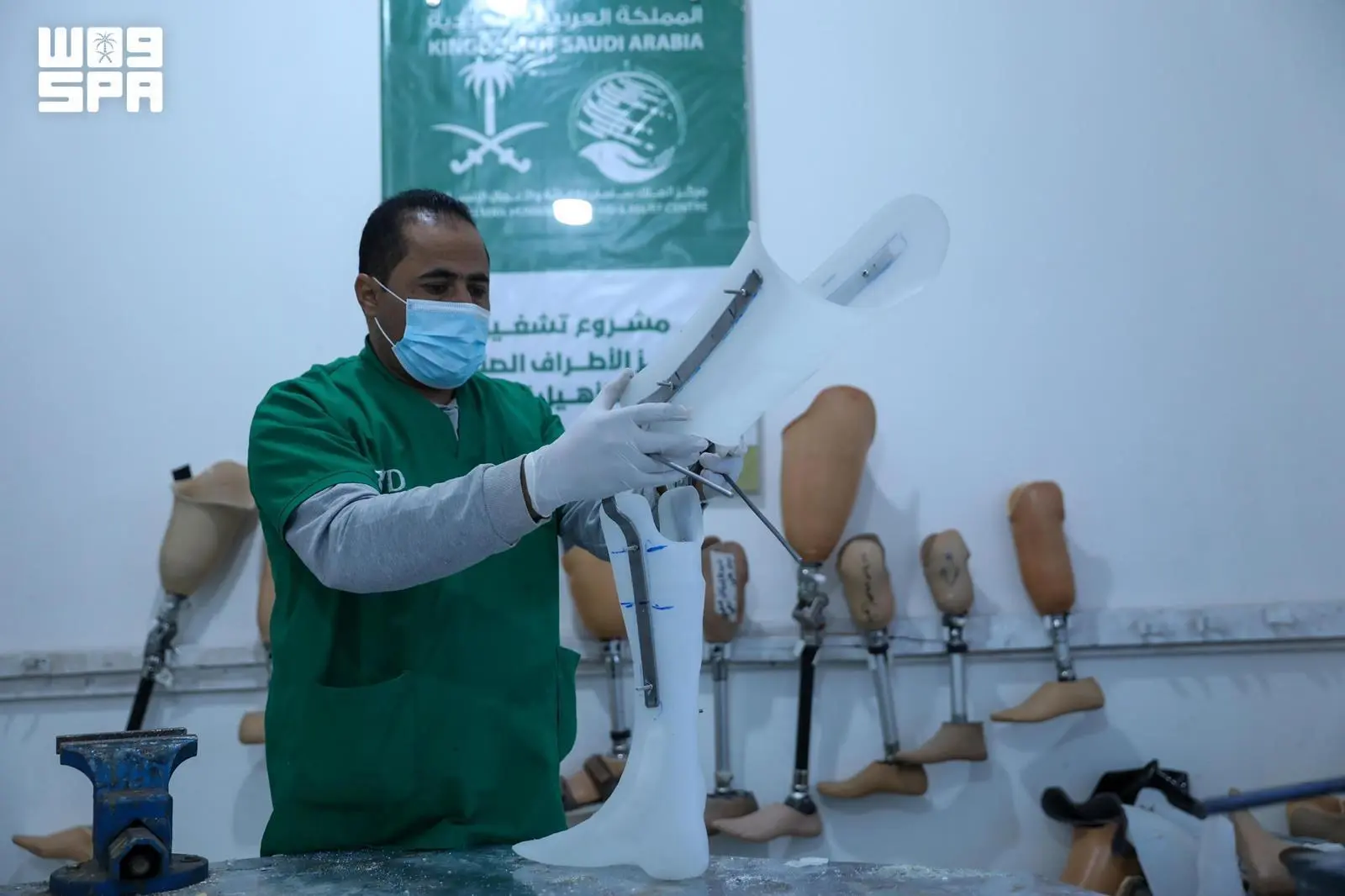
The King Salman Humanitarian Aid and Relief Center (KSrelief) has reported that its prosthetics and rehabilitation centre project in Taiz, Yemen has served 8,050 beneficiaries, underlining the continued need for prosthetic, orthotic and rehabilitation services in conflict-affected regions.
According to Arab News, KSrelief implemented the eighth phase of the project to operate the Prosthetics and Rehabilitation Center in Taiz from January 1 to May 31, 2026. The centre provides prosthetic limbs and physical rehabilitation services for patients with mobility impairments, including people affected by limb loss and other disabling injuries. (Arab News)
Over the past 12 months, the project manufactured 300 new upper- and lower-limb prostheses, provided physical rehabilitation services to 3,900 people, and delivered technical rehabilitation and maintenance services to 700 patients. It also offered medical and technical consultations to 3,100 beneficiaries. (Arab News)
The project has also created 50 employment opportunities for local staff, an important detail for the long-term sustainability of rehabilitation services in Yemen. In humanitarian prosthetics and orthotics, local capacity is essential. Centres must not only provide devices, but also maintain them, repair them, adjust them and support users through repeated follow-up.
For Yemen, where years of conflict have placed enormous pressure on the health system, prosthetic and rehabilitation services remain a critical part of recovery. People with limb loss or mobility impairment often require a complete care pathway: clinical assessment, socket design, device fitting, physical therapy, gait training, maintenance and psychosocial support.
The reported figures from Taiz show that the centre is not operating as a simple device-distribution project. Its work includes new prosthetic fabrication, rehabilitation, technical maintenance and consultations. This combination is important because prosthetic users frequently need follow-up after fitting, especially if they experience pain, socket changes, component wear or changes in activity level.
The centre also forms part of a wider pattern of KSrelief-backed rehabilitation activity in Yemen. Arab News recently reported that a prosthetics and rehabilitation centre in Marib supported by KSrelief helped almost 500 people in May 2026 and delivered 1,559 services, including prosthetic limb manufacture, fitting, rehabilitation, physical therapy and specialised consultations. (Arab News)
For prosthetists, orthotists and rehabilitation professionals across the Middle East, the Taiz project highlights the importance of sustained rehabilitation infrastructure in post-conflict and displacement-affected settings. A prosthetic limb can restore mobility, but the wider service model determines whether a person can return to family life, education, work and community participation.
KSrelief’s Taiz programme also demonstrates how humanitarian rehabilitation can support local systems by combining direct patient care with employment and technical service capacity. As the number of people requiring assistive technology continues to rise across conflict-affected communities, long-term investment in prosthetics and rehabilitation centres will remain essential.
- Arab News: KSrelief prosthetics center serves 8,050 beneficiaries in Taiz
- KSrelief official website
- KSrelief health projects
- Arab News: Almost 500 people helped by Marib prosthetics center in May
- WHO: Rehabilitation
- ICRC: Physical rehabilitation programme
- ISPO: International Society for Prosthetics and Orthotics