

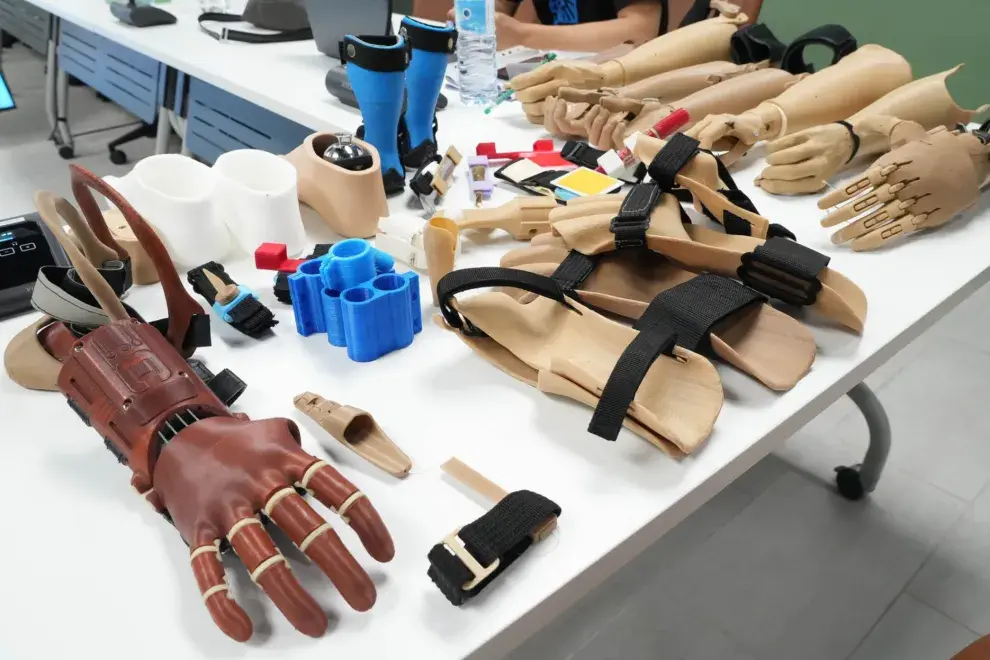
Students and researchers at Queen’s University in Canada have developed an open-source 3D-printed above-elbow prosthetic designed to support people in resource-limited humanitarian settings.
The project was reported by 3D Printing Industry and is based on a collaboration between Queen’s University students, the Queen’s Biomedical Innovation Team (QBiT) and the Burma Children Medical Fund (BCMF), a Thailand-based NGO working near the Myanmar border. Queen’s Gazette reports that the work has focused on helping migrants fleeing one of the world’s longest-running civil wars. (3D Printing Industry, Queen’s Gazette)
The initiative began after biomedical computing student Emese Elkind completed a volunteer placement in Southeast Asia and identified a major gap in available prosthetic options. BCMF already had access to donated 3D printers and open-source prosthetic designs, but no suitable open-source option existed for above-elbow amputees, where both elbow movement and hand function must be addressed together. (Queen’s Gazette)
According to Queen’s University, above-elbow prosthetic design is more complex because it involves multiple joints and many conventional solutions depend on electronics or robotics. These systems can be difficult to maintain in border-region clinics where power, spare parts, specialist servicing and long-term technical support may be limited. (Queen’s Gazette)
The Queen’s student team therefore focused on a body-powered, 3D-printed solution that could be produced, repaired and adapted in low-resource environments. Through two years of iterative design, the team developed a harness system capable of independently moving the elbow and individual fingers without relying on electronics or robotics. (Queen’s Gazette)
For the prosthetics and orthotics community, the project is significant because it addresses a difficult clinical and technical category: transhumeral prosthetic users. Above-elbow limb loss typically requires solutions that balance suspension, comfort, elbow control, terminal device function, weight, durability and user training. In humanitarian contexts, these requirements become even harder because devices must also be affordable, repairable and suitable for local environmental conditions.
The Queen’s team’s approach shows how open-source design and 3D printing can support rehabilitation providers working in settings where conventional supply chains may be limited. Rather than presenting 3D printing as a complete replacement for clinical prosthetics, the project demonstrates a more practical role: helping local teams produce functional, adaptable devices when standard components are unavailable or unaffordable.
The collaboration also highlights the importance of field-led design. BCMF’s experience with patients in Thailand and Myanmar informed the technical priorities, while Queen’s students contributed engineering and design capacity. This type of partnership can help ensure that technology responds to the realities of daily life, local maintenance and user needs rather than simply transferring high-cost solutions into low-resource settings.
The project has already received recognition in North American engineering competitions, including a first-place finish at the Rehabilitation Engineering and Assistive Technology Society of North America (RESNA) student design competition and runner-up recognition at Rice University. Queen’s University also reported that part of the prize money was donated back to BCMF to support surgeries, translation services and transitional housing for patients. (Queen’s Gazette)
For countries across the Middle East, Africa, Central Asia and South Asia, the project offers an important lesson. Open-source prosthetic design can be most valuable when paired with trained clinicians, local fabrication capacity, patient feedback and sustainable maintenance pathways. Above-elbow prosthetic users need more than a printed device; they need fitting, training, follow-up, repair and ongoing rehabilitation support.
The Queen’s University and BCMF partnership is a reminder that innovation in prosthetics does not always mean higher-cost technology. Sometimes, the most meaningful innovation is a design that can be shared, repaired, adapted and used where the need is greatest.
- 3D Printing Industry: Queen’s University engineers open-source above-elbow prosthetic
- Queen’s Gazette: Queen’s students develop 3D-printed prosthetics
- Queen’s Biomedical Innovation Team
- Burma Children Medical Fund
- RESNA Student Design Challenge
- OpenSCAD official website
- WHO: Assistive technology
- ISPO: International Society for Prosthetics and Orthotics