

New Cairo Technological University has signed a cooperation protocol with Germany’s Human Study to develop what is intended to become Egypt’s first internationally accredited bachelor’s programme in prosthetics and orthotics.
The partnership will combine the university’s expanding academic and clinical infrastructure with Human Study’s experience in internationally recognised prosthetic and orthotic education. The proposed programme will be developed towards accreditation by the International Society for Prosthetics and Orthotics, providing students with education aligned with global professional standards.
The agreement represents a potentially important development for Egypt’s rehabilitation workforce at a time when the country is seeking to expand services for people with limb loss, physical disabilities, neurological conditions and conflict-related injuries.
It could also strengthen Egypt’s position as a regional centre for prosthetic and orthotic education serving students and healthcare systems across Africa and the Middle East.
Partnership aims to build an internationally recognised programme
The cooperation agreement was signed in the presence of Dr Tarek Abdelmalek, President of New Cairo Technological University, and representatives of Human Study and its regional partners.
Participants included Dr Mohamed Al-Souda, Dean of the Faculty of Applied Health Sciences; Dr Minerva Iskander, coordinator of the university’s Prosthetics and Orthotics Technology programme; and Dr Amr Gharib, Human Study’s representative in Egypt and a clinical P&O expert.
The partnership will establish a framework for reviewing, developing and implementing the university’s bachelor’s programme in prosthetics and orthotics.
Human Study is expected to provide consultancy covering curriculum development, clinical education, quality assurance and preparation for international accreditation.
The programme has not yet received ISPO accreditation. The agreement begins the process of developing the curriculum and educational systems required to seek that recognition.
ISPO accreditation involves a formal evaluation against international education standards and should therefore be described as an objective of the partnership rather than an already completed outcome. ISPO’s accreditation framework assesses whether programmes provide graduates with the competencies needed to deliver safe, effective and person-centred P&O services.
Correcting an important translation issue
Some translated accounts of the agreement refer to a programme in “industrial limbs and orthodontics.”
The intended professional field is prosthetics and orthotics.
Prosthetics concerns the assessment, design and fitting of artificial limbs for people with limb loss or limb absence. Orthotics involves the provision of braces and other external devices that support, protect or influence the function of the limbs, spine and neuromuscular system.
“Orthodontics” is a dental specialty and is unrelated to the programme.
Clear terminology will be important as the university presents the course to prospective students, government authorities and international accreditation bodies.
Human Study brings established P&O education experience
Human Study is a German non-profit education organisation specialising in prosthetics and orthotics.
Its existing courses combine distance learning, supervised clinical practice and face-to-face education, allowing working practitioners to develop their professional qualifications while remaining connected to local rehabilitation services.
Human Study operates ISPO-accredited educational pathways, including an Associate Prosthetist/Orthotist programme and a bachelor’s-level progression programme delivered with Mahidol University in Thailand.
The organisation also uses the World Health Organization’s standards for prosthetics and orthotics as guidance when developing its programmes and works with international and local partners to strengthen rehabilitation education.
This experience could help New Cairo Technological University establish a programme that integrates academic knowledge with the clinical and technical competencies required in contemporary P&O practice.
Bridging academic education and clinical practice
Dr Abdelmalek described the agreement as part of the university’s ambition to lead applied technological education in Egypt.
Established in 2019, the university is seeking to develop programmes that connect theoretical education with intensive practical training and the needs of the labour market.
This approach is particularly important in prosthetics and orthotics.
Students cannot become competent clinicians through classroom teaching alone. They need supervised experience assessing patients, defining treatment goals, designing devices, selecting components, carrying out fittings and evaluating outcomes.
A comprehensive P&O bachelor’s programme should cover areas including:
- Anatomy, physiology and biomechanics
- Pathology and clinical assessment
- Lower- and upper-limb prosthetics
- Lower-limb, spinal and upper-limb orthotics
- Paediatric rehabilitation
- Neurological orthotics
- Materials and workshop technology
- Gait and movement analysis
- Digital scanning and computer-aided design
- Evidence-based practice and research
- Ethics, communication and patient safety
- Supervised clinical placements
Graduates must understand both the technical production of devices and the clinical reasoning behind each prescription.
University has invested in P&O training infrastructure
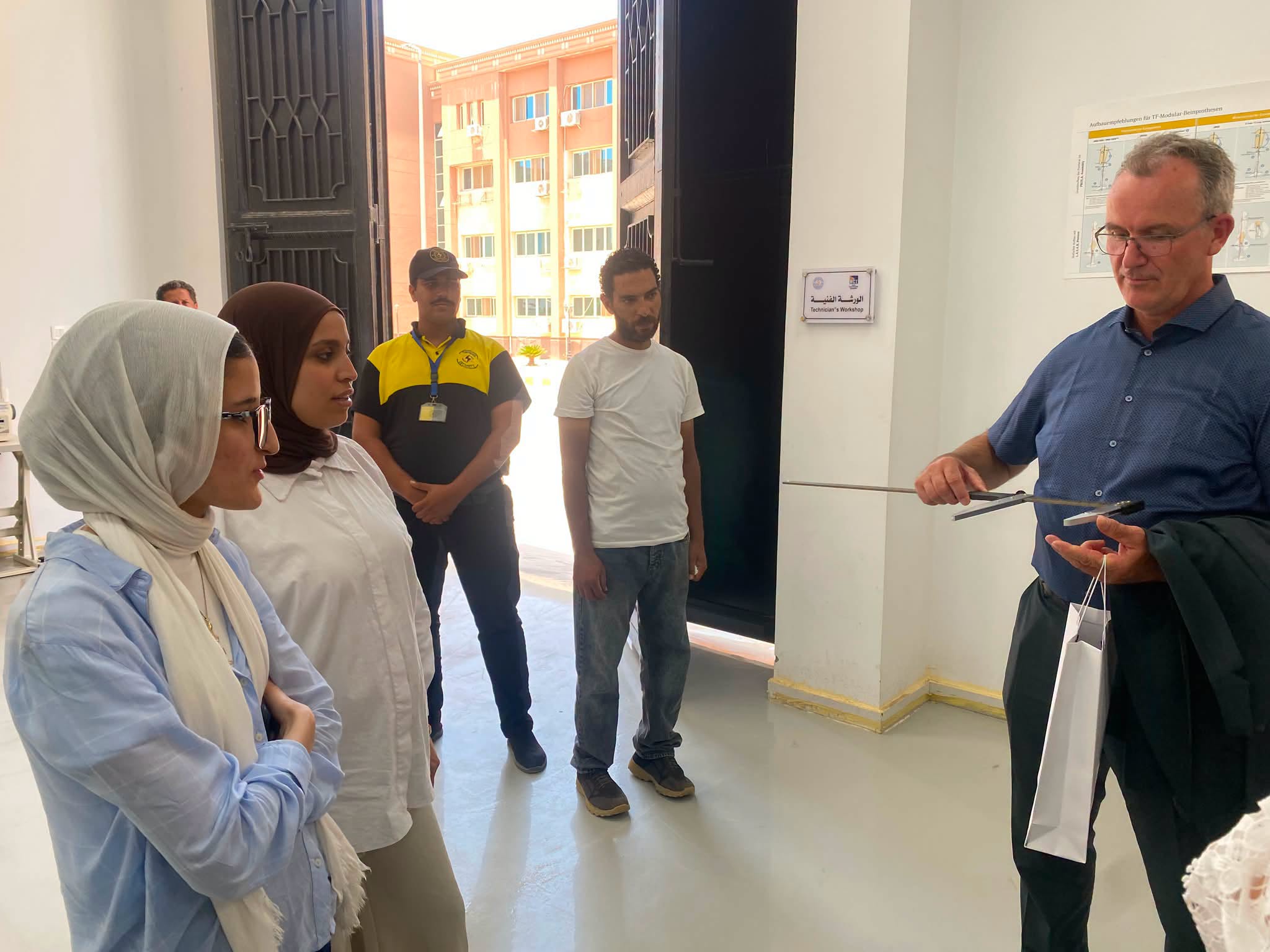
Following the signing, the German delegation toured the Faculty of Applied Health Sciences and reviewed its existing training facilities.
These included a university-based facility for the assembly, fabrication and adjustment of prosthetic and orthotic devices, as well as an anatomy laboratory, movement-analysis laboratory and patient rehabilitation unit.
Earlier reporting described the facility as Egypt’s first university-based workshop of its kind for assembling and fitting prostheses and orthoses. It is intended to provide students with direct practical training while also supporting services for people with disabilities.
The availability of workshops and clinical laboratories will be important during the accreditation process.
Internationally recognised P&O education requires more than a written curriculum. A university must demonstrate access to appropriate equipment, qualified educators, clinical placements, sufficient patient exposure and systems for assessing student competency.
The visiting delegation reportedly praised the university’s technological infrastructure and the range of prosthetic and orthotic equipment already available.
International standards can improve patient safety
Developing an ISPO-aligned programme is not simply about increasing the international recognition of a degree.
Education standards directly affect the quality and safety of services received by patients.
Poorly prescribed or fitted prostheses and orthoses can cause pain, skin damage, instability and avoidable functional limitations. Inappropriate devices may also be abandoned, wasting both public funding and the patient’s time.
Qualified practitioners must be able to assess the whole person rather than manufacture a device from measurements alone.
The World Health Organization’s P&O standards emphasise the need for appropriately trained personnel, multidisciplinary care, service-user involvement, follow-up and reliable maintenance systems. The standards were developed with ISPO and provide a framework for countries seeking to build or improve prosthetic and orthotic services.
Aligning education with these principles could support more consistent clinical practice throughout Egypt.
Egypt needs a larger specialist workforce
Egypt has a substantial and diverse requirement for prosthetic and orthotic services.
Potential service users include people affected by:
- Diabetes-related amputation
- Road traffic and workplace injuries
- Congenital limb differences
- Stroke and other neurological conditions
- Cerebral palsy
- Spinal cord injury
- Poliomyelitis and post-polio conditions
- Scoliosis and spinal deformity
- Peripheral nerve injuries
- Conflict-related trauma
- Age-related mobility impairment
The demand extends beyond artificial limbs.
Orthotists are also required to provide ankle-foot orthoses, knee-ankle-foot orthoses, spinal braces, paediatric devices, diabetic-foot products and complex neuro-orthotic systems.
A limited number of highly trained practitioners cannot provide equitable coverage for a population of Egypt’s size. Expanding high-quality education is therefore central to improving access.
The new programme could help create a more clearly defined professional pathway for P&O specialists while improving recognition of their clinical role within multidisciplinary rehabilitation teams.
Regional importance extends beyond Egypt
The programme could have implications across North Africa, the Middle East and other Arabic-speaking countries.
Human Study notes that most countries still lack access to an ISPO-accredited P&O education programme. The resulting workforce shortage restricts access to properly assessed, fitted and maintained devices.
An internationally recognised programme in Cairo could eventually attract students from neighbouring countries where formal P&O education is limited or unavailable.
Egypt is geographically well positioned to serve learners from:
- North Africa
- The Levant
- Sudan and the Horn of Africa
- Gulf countries
- Other Arabic-speaking rehabilitation systems
Arabic-language education supported by internationally aligned clinical standards could address a major gap in regional workforce development.
The university could also become a centre for continuing professional development, specialist short courses and postgraduate research.
Supporting people affected by conflict
University leaders highlighted the programme’s humanitarian significance, including its potential contribution to services for people injured by war.
Egypt has already become an important treatment and rehabilitation location for Palestinians evacuated from Gaza. Patients receiving care in Cairo may require surgery, wound management, prosthetic fitting and long-term rehabilitation.
The continuing effects of conflict in Libya, Sudan, Syria, Yemen and Palestine have also increased regional demand for clinicians trained in traumatic amputation and complex orthotic management.
Conflict-related cases can present significant challenges, including:
- Irregular or high-level amputations
- Extensive scar tissue
- Bone and nerve injuries
- Burns and soft-tissue loss
- Bilateral or multiple-limb amputations
- Delayed surgery and infection
- Psychological trauma
- Interrupted follow-up
Training students through exposure to complex rehabilitation—while maintaining ethical supervision and patient consent—could build expertise relevant to both Egyptian and regional services.
Clinical education must remain person-centred
The technological focus of the university offers opportunities to introduce students to digital scanning, computer-aided design, gait analysis and advanced manufacturing.
However, a strong P&O programme should not allow technology to overshadow patient care.
A scanner can record body shape, but it cannot independently determine why a patient has pain, whether an orthosis is clinically appropriate or how a device will affect the person’s family, work and daily activities.
Students must learn to involve patients in decisions and assess outcomes based on meaningful goals.
Success may include the ability to:
- Walk safely within the community
- Return to school or employment
- Perform personal-care tasks
- Reduce pain or pressure
- Prevent deformity
- Participate in sport
- Protect a diabetic foot
- Reduce reliance on caregivers
The device is a means of achieving these goals rather than the final outcome.
Industry partnerships could strengthen training
The university has described the initiative as an industrial-partnership programme, reflecting its intention to connect education with employers and technology providers.
Responsible industry partnerships can give students exposure to current components, digital systems and manufacturing methods. They may also create placement and employment opportunities.
Potential areas of cooperation include:
- Student internships
- Equipment training
- Educator development
- Clinical workshops
- Research projects
- Materials testing
- Digital workflow education
- Graduate recruitment
- Support for local manufacturing
However, the curriculum should remain broad and manufacturer-neutral.
Graduates must be able to evaluate devices from different suppliers and make prescriptions according to the patient’s needs rather than commercial relationships.
Faculty development will determine programme quality
Modern laboratories and equipment are important, but the quality of a P&O programme ultimately depends on its educators and clinical supervisors.
The partnership should therefore include a long-term faculty-development plan.
This could involve:
- Training Egyptian P&O educators
- International teaching exchanges
- Mentoring in curriculum development
- Education in competency-based assessment
- Support for clinical research
- Training clinical-placement supervisors
- Development of teaching resources in Arabic
- Continuing professional development
- Participation in international P&O networks
Building local teaching capacity will reduce long-term dependence on visiting international lecturers.
It will also allow the programme to grow while remaining responsive to Egyptian clinical needs.
Accreditation should be part of a wider national strategy
An internationally accredited degree could become a major milestone, but it will not resolve every barrier facing Egyptian rehabilitation services.
Graduates will need recognised professional roles, employment opportunities, appropriate salaries and access to functioning clinical workshops.
A wider national strategy should address:
- Regulation and professional registration
- Defined scopes of practice
- Public-sector employment structures
- Procurement and reimbursement
- Geographic distribution of professionals
- Continuing education
- Clinical quality standards
- Research and outcome data
- Access to components and maintenance
Without these supporting systems, highly trained graduates may leave the profession or seek work outside Egypt.
Workforce planning should therefore accompany programme development from the beginning.
A potential turning point for Egyptian P&O education
The agreement between New Cairo Technological University and Human Study could become an important turning point for prosthetic and orthotic education in Egypt.
It brings together an Egyptian university investing in applied health technology and a German organisation with experience delivering ISPO-accredited P&O education.
The next stages will require detailed curriculum development, faculty preparation, clinical-placement agreements and formal evaluation against international standards.
Should the programme successfully achieve accreditation, it would provide Egyptian students with a globally benchmarked professional pathway and could support the wider development of rehabilitation services throughout the region.
The most important outcome will not be the accreditation certificate itself.
It will be the creation of practitioners who can combine clinical judgement, technical skill and compassion to deliver safe, appropriate and sustainable prosthetic and orthotic care.
- New Cairo Technological University
- Human Study
- Human Study Bachelor’s Degree in Prosthetics and Orthotics
- International Society for Prosthetics and Orthotics
- ISPO education standards
- World Health Organization standards for prosthetics and orthotics
- WHO prosthetics and orthotics services