

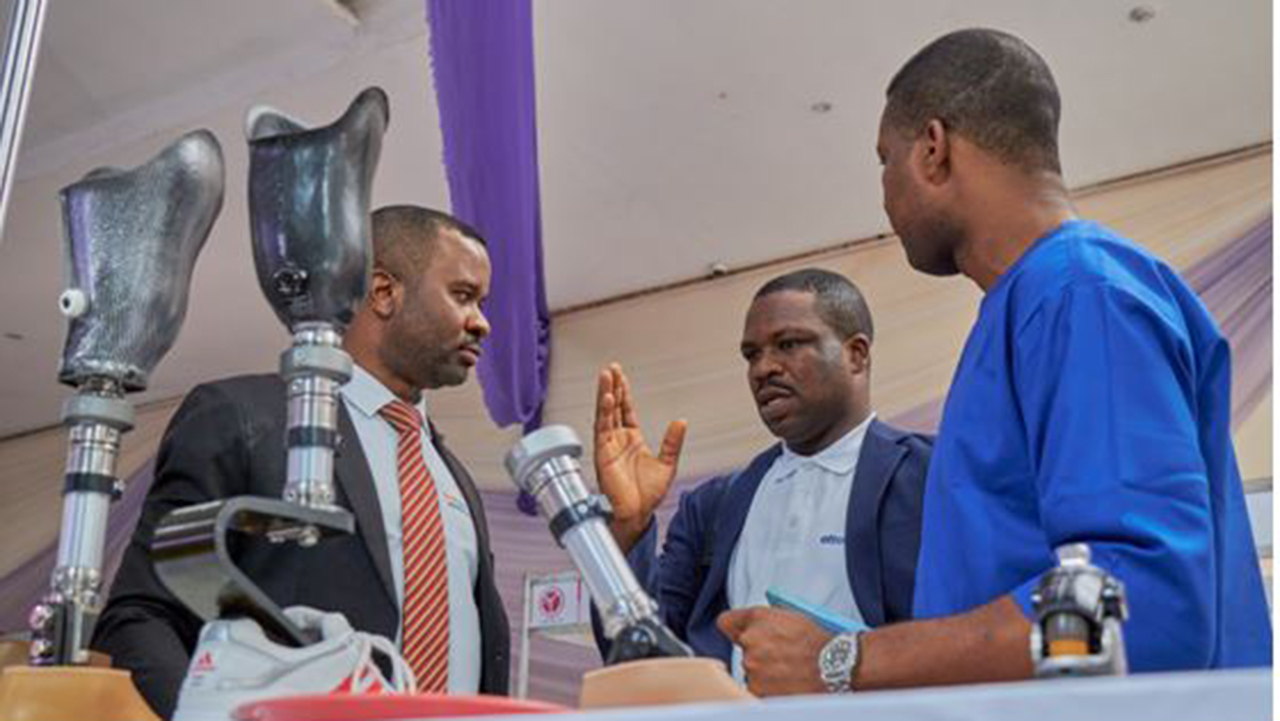
The United Nations Industrial Development Organization has entered the implementation phase of a programme introducing Japanese 3D-printed prosthetic technology to Nigeria, with a focus on improving access for landmine survivors and strengthening local rehabilitation capacity.
The initiative brings together UNIDO, Japanese digital-prosthetics company Instalimb and Nigerian clinical provider IfeanHealth Nigeria Limited. IfeanHealth will serve as UNIDO’s private-sector contractual partner in Nigeria, supporting the local deployment of the technology and its integration into existing prosthetic services.
The programme is intended to do more than import prosthetic limbs. Its wider objective is to transfer manufacturing knowledge, train Nigerian professionals and establish a more sustainable local system for producing and maintaining personalised prostheses.
For Nigeria’s prosthetic and orthotic profession, the project could become an important test of whether digital manufacturing can improve productivity and geographic access without weakening clinical quality or creating dependence on imported software, materials and equipment.
Japanese technology combined with Nigerian expertise
Instalimb uses digital residual-limb scanning, computer-aided design, AI-supported modelling and additive manufacturing to produce customised prosthetic devices. The company says its system is designed to create affordable prostheses through a standardised digital workflow and can print certain devices within several hours.
IfeanHealth brings local clinical experience, workshop capacity and an established Nigerian prosthetic service network. The company provides upper- and lower-limb prostheses, paediatric devices, gait training and residual-limb education through facilities in several parts of the country.
This combination is important because 3D printing alone does not deliver rehabilitation.
A safe prosthetic pathway still requires:
- Clinical assessment
- Residual-limb examination
- Appropriate component selection
- Socket design
- Trial fitting
- Alignment
- Gait training
- Skin monitoring
- Repairs and replacement
- Long-term follow-up
The technology can support parts of this pathway, but it cannot replace qualified prosthetists, orthotists, physiotherapists and rehabilitation physicians.
Programme targets landmine survivors
The project is formally focused on supporting people injured by landmines and other explosive hazards in Nigeria.
UNIDO previously announced that Japanese-funded industrial-development projects would include a Nigerian initiative increasing the availability of prosthetic limbs for landmine survivors and supporting their mobility and social reintegration.
The organisation’s inception report identifies the programme as “Transferring Japanese 3D-Printed Prosthetics Technology to Support Landmine Victims in Africa.” It states that the technology-transfer contract was awarded to Instalimb and that equipment procurement, institutional engagement and service assessments formed part of the initial implementation stage.
Nigeria’s need extends beyond landmine injuries. Prosthetic services also support people affected by road traffic trauma, diabetes, infection, workplace injuries, congenital limb difference and other causes of amputation.
Infrastructure developed through the project could therefore have wider value if it becomes available to the broader population.
The project has moved into implementation
UNIDO officials, a Japanese delegation and IfeanHealth representatives have held stakeholder meetings in Abuja to agree implementation plans and the programme’s next phase.
IfeanHealth founder and chief executive Ejike Anih described the partnership as an opportunity to combine advanced manufacturing with Nigerian clinical knowledge and local workforce development.
The inception report indicates that Nigeria already has several strengths that could support the programme, including trained clinical staff, an established professional regulatory structure, stakeholder acceptance of 3D technology and industry interest in digital manufacturing.
However, it also identifies significant weaknesses, including:
- Poor access to healthcare
- Limited resources for P&O services
- High device costs
- Workshop quality and efficiency challenges
- Weak health-insurance coverage for rehabilitation
- Gaps in rehabilitation administration and policy
These barriers show why the success of the project cannot be judged only by whether printers are installed.
Digital production may reduce some manufacturing bottlenecks
Conventional prosthetic socket production may involve plaster casting, rectification, mould preparation, lamination or thermoplastic forming, trimming and repeated trial fittings.
These methods remain clinically valuable, but they can be labour-intensive and require substantial workshop space, materials and manual skill.
A digital workflow may allow clinicians to:
- Capture the residual limb using a scanner
- Modify the shape in CAD software
- Store the design electronically
- Produce the socket through 3D printing
- Reproduce or adjust the design later
Potential benefits include reduced plaster use, simpler file storage, greater design repeatability and easier transmission of cases between clinics and production centres.
The Instalimb platform combines 3D scanning, digital modelling and 3D printing in an integrated production system. UNIDO has used a similar model in Ukraine, where local prosthetists received training and equipment to scan, design, print and fit lower-limb prostheses.
Lessons from UNIDO’s Ukraine programme
UNIDO’s work in Ukraine provides a useful precedent for the Nigerian initiative.
In Lviv, the organisation supported an eight-week digital prosthetics course involving ten Ukrainian prosthetists. The programme included practical training in scanning, digital modelling and 3D printing, followed by on-the-job experience fitting prostheses for injured veterans.
UNIDO also supplied 3D printers, laser scanners and related production equipment to increase local manufacturing capacity. The programme was designed not only to fit individual patients, but also to create a network of professionals capable of maintaining digital production after international experts had left.
Nigeria will require the same emphasis on sustained local competence.
A successful technology-transfer programme should eventually allow Nigerian clinicians and technicians to manage assessment, design, production, troubleshooting and quality control with limited external dependence.
Local training will determine long-term impact
The strongest outcome would be the creation of a Nigerian digital prosthetics workforce rather than the temporary operation of foreign-owned equipment.
Training should cover:
- Digital scanning protocols
- CAD modification
- Socket biomechanics
- Printer operation
- Material selection
- Production orientation
- Post-processing
- Structural inspection
- Alignment and fitting
- Device documentation
- Repair and failure analysis
Clinical education must remain central.
A technician may learn to operate a printer relatively quickly, but safe socket design requires understanding of anatomy, tissue tolerance, pressure distribution, suspension and the patient’s functional needs.
Nigeria already has trained P&O personnel, including graduates from recognised regional and national programmes. The UNIDO report specifically identifies qualified clinical staff as one of the programme’s local strengths.
The project should therefore build on the profession already present in Nigeria rather than presenting digital manufacturing as a replacement for existing expertise.
Quality assurance must be built into production
3D-printed prostheses are medical devices and must be produced through a controlled and documented process.
Important quality questions include:
- Is the printed material suitable for long-term clinical use?
- Does the socket tolerate expected loading?
- How does print orientation affect strength?
- Are printers calibrated consistently?
- Can every device be traced to its design and production file?
- How are defects identified?
- What happens when a device fails?
- Are environmental effects such as heat and humidity understood?
Nigeria’s climate and patterns of daily use may differ from those in Japan or Europe.
Materials and designs should therefore be validated under local conditions, including high temperatures, dust, uneven terrain and extended walking.
A digital appearance should never be treated as evidence that a prosthesis is clinically or structurally superior.
Repairability will be crucial
A prosthesis is only useful while it can be maintained.
Digital production may make socket reproduction easier, but the wider system still depends on scanners, printers, software licences, imported filaments, electronics and mechanical components.
The project should establish:
- Local stocks of printing materials
- Preventive maintenance schedules
- Printer servicing capacity
- Replacement-part availability
- Software support
- Data backup
- Alternative production routes during equipment failure
- Repair responsibility after the project ends
A clinic should not become unable to serve patients because one proprietary machine is out of service or a software subscription has expired.
Maintaining conventional fabrication capacity alongside digital production may provide useful resilience.
Access beyond major cities remains a challenge
Nigeria’s size and population create major geographic barriers to prosthetic provision.
Qualified professionals and equipped workshops are concentrated in a limited number of urban centres, while many potential users live considerable distances from specialist care.
Digital systems could support a hub-and-spoke model.
Regional teams could capture scans and clinical information closer to the patient, while a central production facility completes the design and printing. The finished device could then return to the local clinic for fitting under professional supervision.
Such a model could reduce the transport of plaster casts and make repeat production easier.
However, scanning should not be separated from clinical responsibility. The professional reviewing the digital file must have adequate information about the patient’s skin, pain, joint range, strength and functional goals.
Health financing remains a major barrier
The UNIDO assessment identifies the lack of health-insurance coverage for rehabilitation as one of the weaknesses affecting Nigerian prosthetic services.
Lower manufacturing costs will not automatically create access if patients remain unable to pay for assessment, components, therapy and follow-up.
The total cost of a prosthesis includes:
- Clinical appointments
- Socket production
- Liners and suspension
- Knee or foot components
- Alignment
- Physiotherapy
- Transport
- Repairs
- Replacement sockets
Public financing, donor support, insurance reform and corporate programmes may all be needed to ensure that the technology reaches people who would otherwise remain without a prosthesis.
IfeanHealth already participates in programmes providing prosthetic limbs and longer-term support to children, showing how commercial providers can work with corporate and charitable partners to expand access.
The project may strengthen local manufacturing
UNIDO’s mandate places emphasis on industrial development as well as healthcare access.
The Nigerian initiative could create opportunities for local production of sockets, prosthetic parts, tooling and consumables.
Over time, this may support:
- New technical jobs
- Reduced dependence on imported finished devices
- Shorter delivery times
- Local research and product development
- Collaboration with universities
- Development of African manufacturing standards
- Regional supply to neighbouring countries
The project could also connect Nigeria’s P&O profession with engineers, industrial designers, software specialists and additive-manufacturing companies.
This multidisciplinary collaboration is valuable, but the patient and clinical team must remain at the centre of product decisions.
3D printing is a tool, not a complete solution
The expansion of digital manufacturing is often presented as a revolution capable of resolving prosthetic shortages.
The reality is more measured.
3D printing may make some production stages faster, cleaner and more repeatable. It can support remote workflows and reduce dependence on plaster.
It does not eliminate the need for:
- Skilled clinical assessment
- Appropriate surgery
- Physiotherapy
- Prosthetic alignment
- Patient training
- Outcome review
- Repairs
- Replacement components
Earlier 3D-prosthetics projects in lower-resource environments have shown promising reductions in production time, but they have also demonstrated that poorly selected or uncomfortable devices may be abandoned.
The most effective implementation will combine new production technology with the full rehabilitation pathway.
Outcomes should be measured beyond device numbers
The programme should report more than how many prostheses are printed.
Useful indicators would include:
- Time from assessment to delivery
- Socket comfort
- Daily wearing time
- Skin complications
- Mobility improvement
- Device durability
- Repair frequency
- Patient satisfaction
- Return to work or education
- Number of Nigerian professionals trained
- Percentage of production managed locally
- Cost compared with conventional provision
These outcomes would provide evidence for future expansion within Nigeria and elsewhere in Africa.
They would also help determine which patient groups and amputation levels benefit most from the digital approach.
An opportunity for Nigerian leadership
The UNIDO programme could become a significant development for prosthetic manufacturing in Nigeria.
Its importance lies not simply in the arrival of Japanese printers or software, but in whether these tools are transferred effectively into Nigerian hands.
If the initiative develops skilled professionals, reliable quality systems, local production and sustainable financing, it may help expand access well beyond the original group of landmine survivors.
Nigeria could then become a regional centre for digital prosthetic education, manufacturing and research.
The project’s long-term success will be measured when Nigerian clinicians can use the technology independently, patients can obtain repairs locally and high-quality prosthetic care becomes accessible outside a small number of major facilities.
Digital manufacturing has the potential to strengthen rehabilitation.
Local ownership will determine whether that potential becomes a lasting service.
- The Guardian Nigeria – UNIDO expands 3D-printed prosthetics programme to Nigeria
- UNIDO – Japanese funding for industrial-development projects in Africa and the Middle East
- UNIDO – Digital solution for sustainable prosthetic production
- Instalimb
- IfeanHealth Nigeria
- UNIDO
- International Society for Prosthetics and Orthotics
- World Health Organization – Rehabilitation