

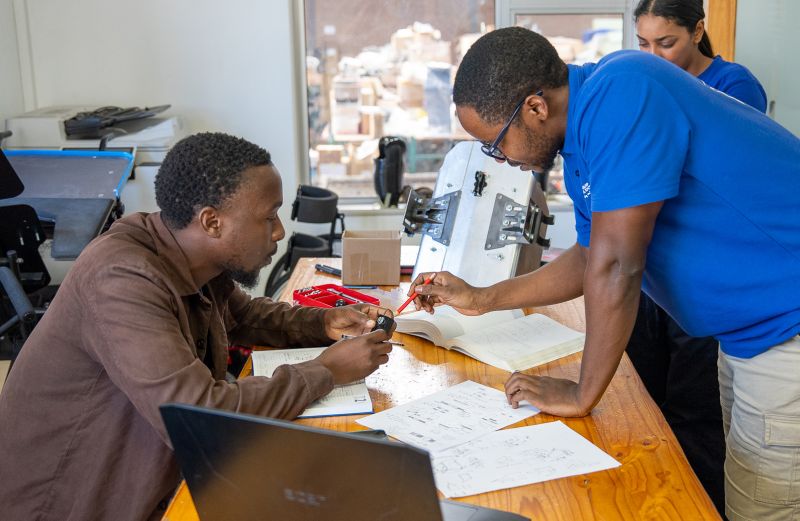
Young engineers, designers and hardware developers working on assistive technology are being invited to join a South African programme designed to help transform early-stage prototypes into clinically validated and commercially viable products.
The Centre for Inclusive Innovation & Entrepreneurship, known as CIIE, has issued a call for innovators developing wheelchairs, mobility aids, positioning systems, affordable prostheses and other assistive products that address practical access challenges within African communities.
Established by Shonaquip Social Enterprise, CIIE is described as South Africa’s first dedicated assistive technology incubator, accelerator, testing and manufacturing facility.
The programme is intended to support innovators who have produced a working concept but are uncertain how to proceed through product refinement, testing, regulation, manufacturing and market entry.
Bridging the gap between invention and access
Africa has no shortage of engineers and entrepreneurs capable of identifying unmet needs and developing creative technical solutions.
The challenge is that a functioning prototype is not yet a market-ready assistive product.
A wheelchair, prosthesis, orthosis or positioning device must perform safely and reliably under real-world conditions. It may require repeated design changes, clinical evaluation, user feedback, manufacturing controls and evidence that it meets the relevant regulatory and quality requirements.
Many promising projects stall during this stage.
The innovator may have technical knowledge but limited access to clinicians, people with disabilities, manufacturing specialists, regulatory advisers, funding institutions or government procurement channels.
CIIE has been developed to close this gap by providing a structured pathway between proof of concept and sustainable production.
An eight-stage development pathway
The centre takes participants through an eight-stage innovation and venture-building journey.
The process begins with feasibility assessment and product design before progressing through technical development, testing, clinical and field validation, manufacturing, business development and market entry.
This staged approach is important because assistive products must be evaluated as complete service solutions rather than standalone pieces of hardware.
A technically effective product may still fail if it is:
- Difficult for clinicians to prescribe or fit
- Uncomfortable for users
- Too expensive to repair
- Unsuitable for local terrain or climate
- Dependent on unavailable spare parts
- Too complex to manufacture consistently
- Excluded from hospital or government procurement
- Unsupported by training and after-sales service
By addressing these issues during development, innovators may be able to avoid costly redesigns after manufacturing has already begun.
Built on more than 35 years of assistive technology experience
CIIE draws on ShonaquipSE’s more than 35 years of experience in assistive technology design, manufacturing, service delivery and disability inclusion.
ShonaquipSE is best known for developing and supplying mobility and posture-support products for children and adults with disabilities, while also working on inclusive service-delivery systems and local manufacturing.
The organisation’s long operating history gives CIIE access to practical knowledge about how assistive products perform outside a laboratory.
This includes understanding the consequences of heat, dust, rough terrain, limited transport, long distances between users and repair centres, and the need for products that can be maintained with locally available skills and materials.
For early-stage innovators, this applied knowledge can be as important as access to engineering equipment.
Clinical testing and field validation
One of the programme’s central benefits is access to clinical and user-led evaluation.
Assistive products interact directly with the body and can affect posture, movement, skin integrity, balance and independence.
A device that appears effective during engineering testing may create unexpected problems when used for several hours a day or in different homes, schools and workplaces.
CIIE supports innovators with user testing, field validation and clinical credibility. The centre also provides guidance relating to ISO 13485, the international quality-management standard used for medical-device design and manufacturing.
For prosthetic and orthotic innovators, clinical evaluation may need to consider:
- Socket or device fit
- Pressure distribution
- Structural durability
- Joint alignment
- Range of movement
- Skin and tissue tolerance
- Functional performance
- Ease of fitting and adjustment
- Cleaning and maintenance
- User satisfaction
- Compatibility with available components
This process should involve both qualified rehabilitation professionals and the people who will ultimately use the product.
A pathway to manufacturing
Moving from one prototype to repeatable production is one of the most difficult stages in assistive technology development.
A skilled engineer may be able to fabricate an effective device manually, but the product must be manufactured consistently if it is to reach larger numbers of users.
This requires clear technical drawings, documented processes, approved materials, quality checks, traceability and reliable suppliers.
CIIE aims to give innovators access to testing and manufacturing infrastructure while helping them understand how a design must change for scalable production.
A product may need to be simplified, modularised or redesigned to reduce production time and ensure that replacement parts can be made consistently.
The programme’s manufacturing focus is especially relevant in Africa, where imported assistive products may be expensive, slow to deliver or difficult to repair.
Connecting innovators with finance and procurement
An assistive product cannot create impact if it never reaches a viable market.
CIIE therefore combines technical development with business and market support.
The programme seeks to connect innovators with development finance institutions, hospitals, government procurement systems and international assistive technology partners.
It also offers up to two years of venture-building support intended to help participants establish sustainable businesses around their products.
This may include assistance with:
- Business modelling
- Costing and pricing
- Intellectual property
- Market assessment
- Procurement readiness
- Manufacturing partnerships
- Regulatory planning
- Investment preparation
- Distribution
- After-sales support
For many African innovators, access to government and institutional procurement will be critical.
A product may be affordable and clinically valuable, but hospitals and public programmes may still be unable to purchase it unless the company can meet formal tender, registration, quality and supplier requirements.
Opening access to SADC markets
CIIE is also positioned as a regional springboard into markets across the Southern African Development Community.
The SADC region includes countries with different regulatory systems, healthcare structures, procurement procedures and levels of assistive technology provision.
Support with regional expansion could help innovators avoid remaining dependent on a small domestic customer base.
A locally developed product that succeeds in South Africa may have relevance in neighbouring countries facing similar environmental and service-delivery challenges.
However, regional growth will still require local partnerships, appropriate product registration and reliable technical support.
A wheelchair, prosthesis or positioning device should not be exported without a plan for fitting, training, maintenance and repairs.
Africa remains heavily dependent on imports
The call for innovators comes amid growing concern about Africa’s dependence on imported medical and assistive products.
Recent research has estimated that more than 85% of assistive technology used across Africa is imported. Some analyses place dependence in sub-Saharan Africa above 90%.
A 2026 technical report on international assistive technology trade found that intra-African trade accounted for only 3.6% of the continent’s assistive product imports between 2016 and 2023, with South Africa acting as the region’s leading exporter.
High import dependence creates several risks:
- Exposure to foreign currency movements
- Long delivery times
- Expensive freight and customs charges
- Shortages of replacement parts
- Products designed for different environments
- Limited local repair knowledge
- Dependence on external donors and suppliers
- Reduced opportunities for African manufacturers
Local production will not remove the need for international components or partnerships, but it can create a more balanced and resilient supply system.
Access remains extremely limited
The need for assistive technology remains far greater than existing provision.
Recent African market research has estimated that only around 10% to 25% of people who need assistive products currently have access, with availability falling as low as 3% in some resource-constrained settings.
This gap cannot be resolved by importing more products alone.
Access also depends on trained personnel, assessment, appropriate fitting, user education, repairs and long-term follow-up.
A wheelchair that does not provide suitable posture support may increase pressure and discomfort. A prosthesis without an appropriate socket may be abandoned. An orthosis that cannot be adjusted as a child grows may quickly become unusable.
CIIE’s emphasis on clinical validation and service delivery is therefore as important as its focus on manufacturing.
Local products for local conditions
Assistive products developed close to their intended users may be better suited to local environments.
African innovators are often directly familiar with the conditions that imported devices fail to address, including:
- Uneven and unpaved terrain
- Narrow homes and doorways
- Limited accessible transport
- High temperatures
- Dust and moisture
- Restricted access to electricity
- Long distances to repair centres
- Limited household income
- Informal employment
- Scarce replacement components
Designing for these conditions can produce products that are more durable, repairable and appropriate than technologies developed primarily for wealthy urban markets.
Local ownership also allows user feedback to influence future versions more quickly.
Opportunities for prosthetic and orthotic innovators
The programme may be particularly relevant to engineers and clinicians working in prosthetics and orthotics.
Potential innovations could include:
- Low-cost modular prosthetic components
- Paediatric prosthetic systems that accommodate growth
- Adjustable sockets
- Locally repairable prosthetic feet
- Affordable upper-limb devices
- 3D-printed orthoses
- Scoliosis and neuro-orthotic systems
- Digital scanning tools
- Pressure-relieving insoles
- Diabetic-foot devices
- Workshop machinery and fabrication tools
- Mobile fitting and repair systems
The strongest concepts are likely to be those developed in partnership with prosthetists, orthotists, physiotherapists, occupational therapists and users.
An engineer may understand mechanical design, while a clinician understands prescription, biomechanics and fitting. Users provide knowledge about comfort, appearance, daily activity and real-world barriers that neither group can fully reproduce.
Local manufacturing can create skilled employment
Expanding assistive technology production can also support employment beyond the direct needs of product users.
Local manufacturing requires:
- Industrial designers
- Biomedical engineers
- Prosthetic and orthotic technicians
- Machinists
- Quality specialists
- Regulatory professionals
- Clinical researchers
- Software developers
- Production managers
- Sales and service technicians
Repair and refurbishment can create additional employment with lower capital requirements than establishing complete manufacturing plants.
Research on Africa’s assistive technology landscape has identified maintenance, repair and refurbishment as practical opportunities for developing skilled local employment while strengthening service delivery.
This is especially important for younger engineers who may otherwise struggle to find pathways from university projects into viable businesses.
Innovation must be led by users
Locally manufactured does not automatically mean appropriate.
Poorly designed local products can fail just as imported products can.
Successful assistive technology development must therefore be shaped by people with disabilities from the beginning.
Users should be involved in identifying the problem, reviewing the design, testing prototypes and deciding whether the final product provides meaningful value.
Their participation should not be limited to demonstrating a finished device after the principal design decisions have already been made.
User-led development can help answer practical questions such as:
- Is the device comfortable throughout the day?
- Can it be used independently?
- Does it attract unwanted attention?
- Can it be transported easily?
- Is it acceptable within local culture?
- Can a family afford repairs?
- Does it support education, work or community participation?
- Would the intended user choose it over existing alternatives?
The future of African assistive technology should be defined with users rather than simply delivered to them.
From prototype to sustainable product
CIIE’s invitation reflects a wider shift in Africa’s innovation sector.
There is growing recognition that demonstrations, competitions and prototype awards are not enough.
A successful assistive technology ecosystem must help innovators complete the less visible work of testing, regulation, documentation, manufacturing and service development.
This is often where promising ideas disappear.
By providing a pathway that combines clinical expertise, engineering, quality systems, commercial development and market access, CIIE aims to increase the number of African-designed products that reach real users.
The programme’s central message is that the continent’s assistive technology future should be locally shaped, locally manufactured and locally owned.
For young innovators already developing a wheelchair, mobility aid, prosthesis or other device, the opportunity is to move beyond proof of concept and begin building a complete product and service system.
Interested innovators can contact ShonaquipSE at Shona@ShonaquipSE.org.za, call +27 21 797 8239, or visit www.ShonaquipSE.org.za.
- Shonaquip Social Enterprise
- Contact ShonaquipSE
- CIIE call for assistive technology innovators
- Assistive Technology Landscape in Africa
- ATscale Technical Report on Assistive Technology International Trade
- ATscale Global Partnership for Assistive Technology
- World Health Organization assistive technology resources
- WHO and UNICEF Global Report on Assistive Technology
- International Society for Prosthetics and Orthotics