

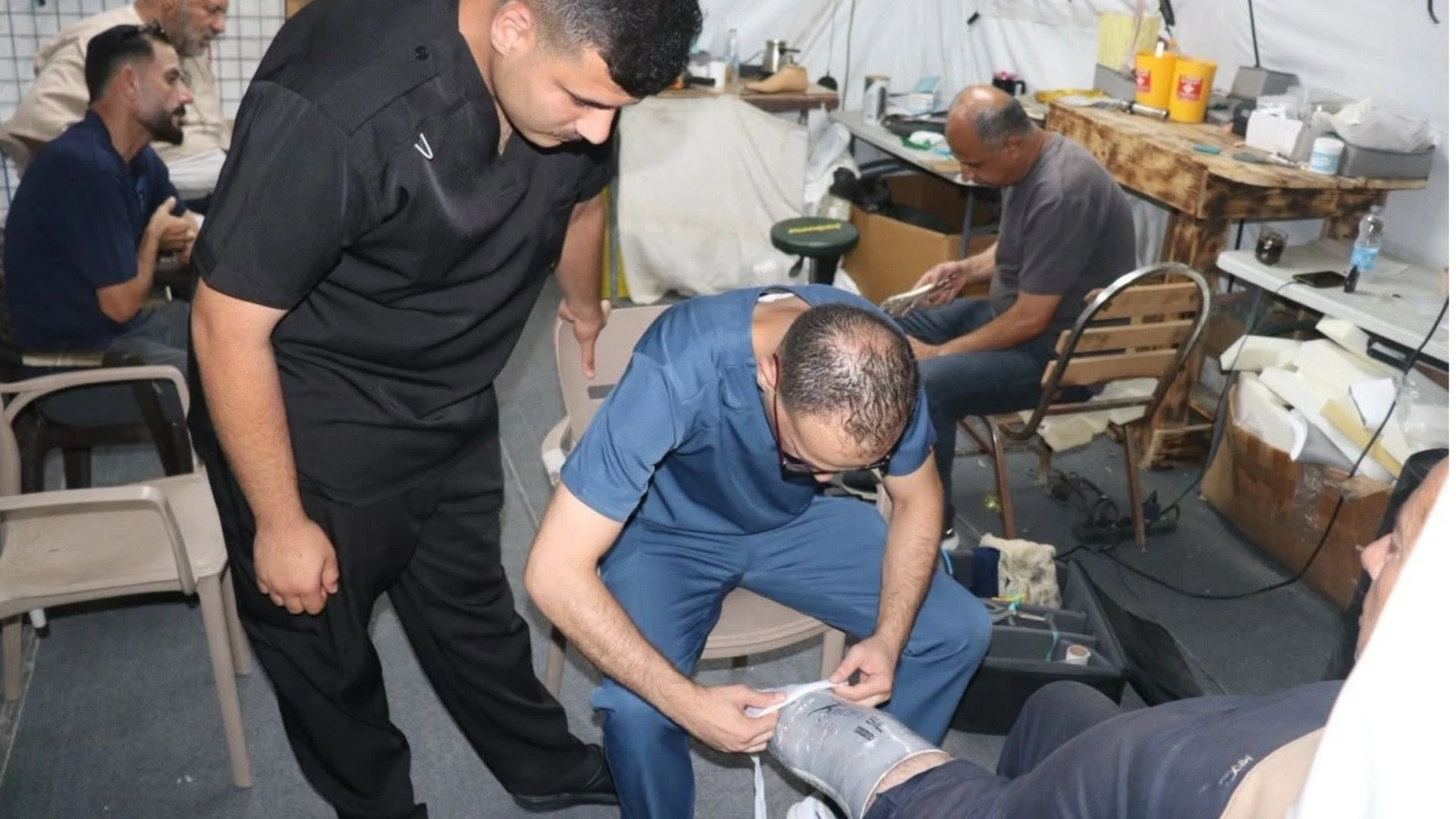
Jordan’s field hospital in southern Gaza has expanded its prosthetic and rehabilitation capacity after receiving more than 1,000 additional advanced prosthetic limbs from the Jordan Armed Forces-Arab Army, strengthening a programme that has already provided more than 1,200 prostheses to people in Gaza.
The prosthetics clinic at the Jordanian Field Hospital South Gaza/10 is operating under the Restore Hope initiative, launched by the Jordan Armed Forces to support people with limb loss in regaining mobility and returning to daily activities.
According to the Jordan News Agency, Petra, the programme is designed around rapid prosthetic provision, with clinical teams able to assess, manufacture, fit and deliver a permanent prosthesis in around two hours using modern technology. Each device is intended to reflect the patient’s condition, functional requirements and expected physical changes.
More than 1,200 prostheses delivered
Since the Restore Hope initiative began, more than 1,200 upper- and lower-limb prostheses have been provided to patients in Gaza.
During the current rotation of the South Gaza field hospital alone, the prosthetics clinic has fitted 126 upper- and lower-limb devices.
The arrival of more than 1,000 additional prostheses therefore represents a significant increase in the programme’s capacity.
For prosthetic and orthotic professionals, the figures also demonstrate the scale of the rehabilitation challenge emerging from Gaza. Providing a prosthesis is only one stage in a much longer process that may involve residual-limb management, socket fitting, alignment, physiotherapy, gait training, repairs and future replacement.
The ability to build clinical capacity alongside component supply will consequently remain crucial if large numbers of patients are to achieve sustainable functional outcomes.
Rapid permanent prosthetic fitting
One of the most striking elements of the Jordanian programme is the reported ability to provide a permanent prosthetic limb within approximately two hours.
Petra reports that the clinical team uses modern technology to take measurements, manufacture the prosthesis, complete the fitting and deliver the device during a highly compressed treatment pathway.
For humanitarian prosthetics, reducing the number of appointments can have considerable advantages.
Patients may face difficulties travelling repeatedly to a rehabilitation centre, particularly where transport infrastructure has been damaged or where mobility is already severely restricted. A workflow capable of progressing from assessment to functional fitting within a single visit may therefore reduce the logistical burden on both patients and clinical teams.
At the same time, rapid delivery increases the importance of accurate measurement, socket design and clinical evaluation. Speed is valuable only when it is accompanied by appropriate fit, comfort and function.
Paediatric prostheses designed for growth
The South Gaza clinic is also providing prosthetic limbs specifically designed for children, taking account of different stages of physical growth.
Paediatric prosthetics presents a particular challenge in humanitarian environments because a successful fitting is never a one-time intervention.
Children continue to grow, requiring repeated socket changes and eventual replacement of components. Their activity levels, gait patterns and functional needs can also change rapidly.
Programmes treating children with limb loss therefore need to consider not only immediate fitting but also the longer-term availability of follow-up care, replacement sockets and appropriately sized components.
For Gaza, where access to specialist rehabilitation remains extremely difficult, establishing systems capable of following children over several years will be an important part of any sustainable prosthetic response.
Carbon-fibre feet adapted to Gaza conditions
Another clinically relevant feature of the programme is the provision of flexible carbon-fibre prosthetic feet intended to suit Gaza’s damaged terrain.
Component selection is particularly important in environments where users may need to walk across uneven, damaged or poorly maintained surfaces.
A prosthetic prescription that performs well on a smooth clinical walkway may not necessarily meet the demands of daily mobility in such conditions.
For CPOs working in humanitarian settings, environmental factors including terrain, available footwear, maintenance capacity, heat, dust and access to replacement parts can therefore be just as important as the technical specifications of the prosthetic component itself.
Prosthetists and physiotherapists working together
The Jordanian programme also integrates prosthetic fitting with rehabilitation.
A specialised team of prosthetists and physiotherapists supports patients both before and after prosthetic fitting, with the objective of restoring mobility, balance and physical independence.
This multidisciplinary model is critical.
A well-designed prosthesis cannot, by itself, restore function. Patients may need to rebuild strength, relearn balance and develop safe gait patterns while adapting physically and psychologically to limb loss.
The involvement of physiotherapists alongside prosthetists also allows problems identified during gait training to be fed back into socket adjustment and alignment.
Building sustainable prosthetic capacity for Gaza
Jordan’s Restore Hope initiative demonstrates how humanitarian prosthetic care is increasingly moving beyond simple device distribution.
The combination of rapid manufacturing, specialised paediatric provision, terrain-appropriate components and integrated rehabilitation represents a more comprehensive model of prosthetic service delivery.
The major challenge will be continuity.
Many of the patients receiving prostheses today will require replacement sockets, repairs and new components in the months and years ahead. Children will require repeated resizing as they grow, while adult residual limbs may continue to change substantially following traumatic amputation.
For the wider IMEA P&O community, the expanding South Gaza programme therefore illustrates both the immediate capability of humanitarian prosthetic teams and the scale of the longer-term rehabilitation infrastructure that Gaza will require.
- Jordan News Agency – Jordan Field Hospital Expands Prosthetic Care Services in South Gaza
- Jordan Armed Forces – Arab Army
- Jordan News Agency – Petra
- International Society for Prosthetics and Orthotics
- World Health Organization – Occupied Palestinian Territory