

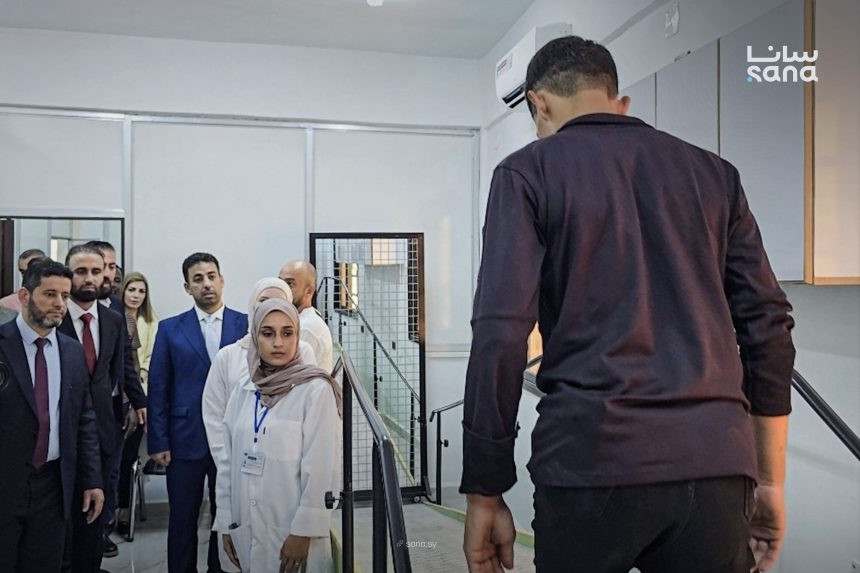
A new prosthetic manufacturing centre has opened at Deir Ezzor National Hospital in eastern Syria, expanding access to lower-limb prosthetics, rehabilitation and professional training in a region where years of conflict have created substantial unmet need.
The centre was inaugurated on 10 August by Syrian Minister of Health Musab al-Ali as part of a wider programme of new medical facilities at the hospital. According to the Syrian Arab News Agency (SANA), the prosthetics facility was established in coordination with the United Nations Development Programme (UNDP).
The centre will provide lower-limb prosthetic manufacturing, training and rehabilitation services, adding an important new piece of infrastructure to eastern Syria’s recovering healthcare system.
For Syria’s prosthetics and orthotics sector, the development is particularly significant because the challenge is no longer simply providing individual prosthetic limbs. The country increasingly needs permanent local capacity capable of assessing patients, manufacturing devices, training professionals and delivering long-term rehabilitation.
Bringing prosthetic manufacturing closer to eastern Syria
Deir Ezzor and the surrounding eastern region have endured extensive infrastructure damage and population displacement during years of conflict.
Until now, access to specialist rehabilitation and prosthetic services has often required patients to travel considerable distances or depend on humanitarian and community-based programmes.
Creating manufacturing capacity inside Deir Ezzor National Hospital could help establish a more sustainable referral pathway for people with lower-limb amputations living across the governorate and neighbouring areas.
SANA did not provide details on the centre’s production capacity, equipment or expected annual number of patients, but confirmed that prosthetic manufacturing will be combined with both rehabilitation and training.
That combination is important.
A prosthetic workshop cannot function effectively simply by providing components. Sustainable services require trained prosthetists and orthotists, technicians, physiotherapists, clinical assessment, fitting, gait training, repairs and repeated follow-up.
Part of a wider UNDP prosthetics strategy
The Deir Ezzor facility also fits into a much longer programme of prosthetic support undertaken by UNDP in Syria.
UNDP says it has supported the expansion of prosthetic services in the country since 2015, initially responding to growing numbers of people with conflict-related amputations.
Over time, that work has developed into what UNDP describes as a community-based disability inclusion model, combining prosthetic provision with local capacity development, case management, psychosocial support, employment and livelihoods programmes, and advocacy for people with disabilities.
The organisation has identified lower-limb amputations as a particularly significant consequence of the Syrian conflict, including injuries caused by explosive ordnance, mines and remnants of war.
But UNDP’s experience has also demonstrated that the principal bottleneck is not simply a lack of workshops.
Existing public, private and community-based providers have faced shortages of raw materials, disrupted supply chains, limited financing, weak integration between prosthetic and rehabilitation services, and shortages of trained professionals.
The opening of a permanent hospital-based centre in Deir Ezzor therefore represents an attempt to address some of those structural limitations.
From humanitarian response to healthcare infrastructure
This distinction is becoming increasingly important as Syria moves from emergency humanitarian response towards longer-term recovery.
During a crisis, prosthetic provision is frequently organised through short-term projects, visiting teams or externally funded workshops.
These programmes can deliver essential care, but patients with amputations require services for decades.
Sockets need replacing as residual limbs change. Components wear out. Children outgrow devices. Alignment needs can evolve, and repairs must remain available locally.
That means Syria’s long-term rehabilitation needs cannot realistically be addressed entirely through temporary programmes.
Permanent facilities embedded within hospitals and rehabilitation systems provide a pathway towards a more sustainable model.
The Deir Ezzor centre is therefore important not only because it will manufacture prostheses, but because it adds local institutional capacity.
Training could prove as important as production
The inclusion of training within the new centre’s remit may ultimately become one of its most valuable functions.
Syria’s rehabilitation sector faces a significant need for qualified prosthetists, orthotists and technicians.
UNDP has previously highlighted shortages of trained prosthetic professionals as one of the main constraints preventing services from meeting demand.
Increasing the number of devices manufactured without simultaneously increasing clinical and technical capacity would therefore provide only a partial solution.
A locally based training programme could help develop professionals who understand the specific needs of patients in eastern Syria and who are able to remain within the region rather than relying continually on outside expertise.
For international organisations and manufacturers interested in supporting Syrian rehabilitation, investment in education, workshop safety, maintenance and clinical training may therefore have as much long-term impact as donating components.
Prosthetics linked to wider social recovery
UNDP’s Syrian programmes also highlight another important lesson for the O&P community: providing a prosthesis is not necessarily the end point.
In July, UNDP documented the experience of Abdulaziz Azzo, a 27-year-old father in Deir Ezzor who uses a prosthetic hand after an injury and later found employment through a UNDP-supported debris removal and neighbourhood rehabilitation project.
His experience illustrates how prosthetic provision can connect directly with employment, independence and participation in community life.
UNDP’s approach increasingly treats prosthetic services as part of a broader disability-inclusion strategy rather than as an isolated medical intervention.
For people with amputations, restoring mobility can help enable education, work, family responsibilities and social participation.
This is particularly relevant in countries recovering from conflict, where disability can easily become linked to unemployment and long-term economic vulnerability.
Growing rehabilitation capacity across Syria
The opening in Deir Ezzor follows a series of developments that suggest prosthetic and rehabilitation capacity is gradually expanding across Syria.
Community-based facilities, NGO-supported workshops and digital manufacturing programmes are operating in several regions, while international organisations are increasingly focusing on rebuilding permanent rehabilitation systems.
The immediate requirement remains enormous, however.
Years of conflict have left thousands of Syrians living with amputations and permanent injuries, while damaged infrastructure and economic conditions continue to limit access to specialist healthcare.
The challenge now is to ensure that new centres are supplied with materials, staffed by trained professionals and integrated into referral and rehabilitation pathways.
For the IMEA CPO community, Deir Ezzor provides another example of the direction Syria’s prosthetics sector needs to take: from individual humanitarian fittings towards sustainable regional O&P infrastructure.
The opening of a prosthetic manufacturing centre within Deir Ezzor National Hospital is a relatively small step compared with the scale of need.
But if it develops into a permanent centre combining manufacturing, clinical care, rehabilitation and training, it could become an important part of rebuilding prosthetic services across eastern Syria.
- SANA – Deir Ezzor National Hospital opens new cardiac and prosthetic units
- UNDP Syria – Scaling Prosthetic Services in Crisis: The Syria Case
- UNDP Syria – Abdulaziz is Helping Rebuild Deir Ezzor
- UNDP Syria
- IMEA CPO