

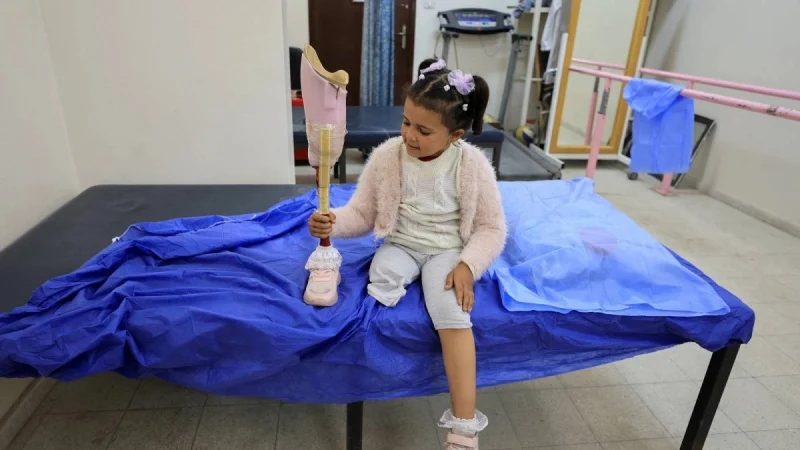
Nearly 8,000 people in Gaza are now reported to have undergone limb amputations during the war, highlighting the extraordinary scale of the long-term prosthetic and rehabilitation challenge facing the territory.
The figure was reported by Pars Today, citing Dr Hamad Naim, director of Hamad Rehabilitation and Prosthetics Hospital in Gaza, who said women and children are among those affected and that children account for a substantial proportion of amputation cases.
The figure should be understood as a reported local estimate rather than a fully independently verified count. Earlier United Nations and World Health Organization data have placed the number lower, although those assessments also show the number of amputees continuing to rise as injuries accumulate and more patients undergo delayed or secondary amputations.
For the prosthetics and orthotics profession, the distinction between 6,000, 7,000 or 8,000 amputees does not materially change the central reality: Gaza is facing a prosthetic rehabilitation requirement of exceptional scale with extremely limited local capacity to meet it.
WHO data confirms rapidly increasing demand
WHO’s May 2026 assessment provides one of the clearest independently documented snapshots of the situation.
Between September 2024 and May 2026, approximately 2,300 people with amputations had been clinically evaluated, but only around 500 had received permanent prostheses.
WHO’s detailed rehabilitation-needs assessment recorded 2,277 evaluated amputees as of May 2026, with 76% involving lower limbs and 18% of assessed amputees being children.
Those figures refer only to people who had been evaluated through available services and should therefore not be interpreted as the total number of amputees in Gaza.
By February 2026, the UN Office for the Coordination of Humanitarian Affairs was already reporting more than 6,000 amputation cases, while only around 300 prostheses had been brought into Gaza since December 2025.
The newer estimate approaching 8,000 would therefore represent a further escalation rather than an isolated or implausible jump.
A prosthetic backlog measured in thousands
The most immediate challenge is the gap between the number of people requiring prosthetic care and the number who can actually receive it.
WHO reported in 2025 that Gaza had only eight trained prosthetists available to manufacture and fit artificial limbs.
Even under normal conditions, thousands of amputees would create an enormous workload for such a small workforce.
Gaza’s conditions are anything but normal.
Prosthetic workshops have had to operate amid damaged healthcare infrastructure, disrupted electricity, limited materials, difficulties importing components and displacement of healthcare professionals.
OCHA reported in February that prosthetic and other assistive products continued to face severe access restrictions, while hundreds of new amputations were still being recorded after the October 2025 ceasefire. Between that ceasefire and 16 February 2026 alone, OCHA recorded 496 additional amputations among newly acquired disabilities.
This means services are attempting to reduce an existing backlog while simultaneously receiving new patients.
Children create a decades-long clinical responsibility
The high proportion of children among Gaza’s amputees is particularly significant for CPOs.
A child fitted with a prosthesis today is not a single prosthetic case.
As the child grows, sockets must be replaced repeatedly, alignment changes may be required, and componentry must evolve according to weight, activity, function and development.
Children with bilateral or proximal amputations may require particularly intensive rehabilitation and long-term clinical management.
WHO has described Gaza as having an exceptionally high burden of childhood amputation and has emphasised the importance of continuous rehabilitation and support for children with severe conflict-related injuries.
For the international O&P sector, this means the requirement should be measured not simply by how many prostheses are needed in 2026, but by the number of prosthetic interventions required over the coming decades.
One paediatric amputee could require many sockets and devices before reaching adulthood.
Initial prosthetic fitting is only the beginning
Amputation statistics can also understate the broader rehabilitation workload.
Many patients require revision surgery before they can be fitted. Others have complex soft-tissue injuries, burns, fractures or nerve damage.
WHO reported that nearly 14,000 patients were registered for limb reconstruction services between July 2025 and May 2026, and almost half of those assessed required further surgery.
Across Gaza more broadly, WHO estimates that tens of thousands of people now have life-changing injuries requiring long-term rehabilitation, including amputations, spinal cord injuries, traumatic brain injuries and severe burns.
The prosthetic pathway therefore begins long before a definitive limb is manufactured.
Patients may require wound management, surgery, contracture prevention, physiotherapy, pre-prosthetic rehabilitation, temporary devices and repeated socket adjustments before progressing towards long-term prosthetic use.
Material shortages remain a major barrier
Access to prosthetic materials continues to restrict production.
Reuters reported earlier in 2026 that Gaza’s prosthetic services were struggling to obtain essential materials used in traditional fabrication, with restrictions on the entry of some products making it difficult to maintain production.
The result has been extreme pressure on existing workshops and component stocks.
For the wider O&P industry, this highlights the importance of thinking beyond donations of finished limbs.
A sustainable prosthetic system requires regular supplies of socket materials, liners, feet, knees, pylons, adapters, resins, plaster or alternative casting technology, alignment equipment, workshop tools and spare parts.
It also requires the ability to repair what has already been supplied.
A sophisticated prosthetic component provides limited long-term benefit if no local clinician can maintain it or obtain replacement parts.
Regional programmes are becoming increasingly important
With local capacity overwhelmed, rehabilitation initiatives outside Gaza are playing a growing role.
Palestinian amputees have received prosthetic treatment through programmes in Egypt and Jordan, including the UAE-supported Step of Hope programme at the UAE Floating Hospital in Al Arish.
Other humanitarian organisations, rehabilitation centres and prosthetic teams across the region have also begun treating patients evacuated from Gaza.
These programmes provide essential support, but they cannot substitute indefinitely for a functioning prosthetic and rehabilitation system inside Gaza.
Travel itself is difficult, while long-term prosthetic care requires repeated access to clinicians.
A patient fitted in Cairo, Amman or elsewhere may require socket modifications or repairs months later. Unless continuity of care is planned from the beginning, even a successful initial fitting can become difficult to sustain.
Gaza may become one of the defining O&P challenges of this generation
For the IMEA CPO community, Gaza is increasingly becoming one of the region’s most significant long-term rehabilitation challenges.
The immediate humanitarian priority remains treating injuries and providing people with basic mobility.
But the O&P profession also needs to think much further ahead.
Thousands of amputees will require ongoing sockets, components, repairs and rehabilitation. Paediatric patients will require repeated replacement devices. Clinicians and technicians must be trained, workshops rebuilt and reliable supply chains restored.
The latest reported figure of nearly 8,000 amputees should therefore not be viewed simply as another casualty statistic.
It represents potentially tens of thousands of future prosthetic fittings and clinical interventions.
Whether the eventual verified total is somewhat lower or higher, the conclusion is unchanged: Gaza will require sustained investment in prosthetics and rehabilitation for many years.
For manufacturers, NGOs, universities, professional organisations and CPOs across India, the Middle East and Africa, the challenge now is how to move from individual humanitarian interventions towards a coordinated, locally sustainable rehabilitation system capable of supporting Gaza’s amputees throughout their lives.
- Pars Today – Nearly 8,000 people have lost limbs during Gaza war
- WHO – Estimating Trauma Rehabilitation Needs in Gaza
- WHO – One in four injuries in Gaza is life-changing
- OCHA – Gaza Humanitarian Response Situation Report No. 69
- IMEA CPO