

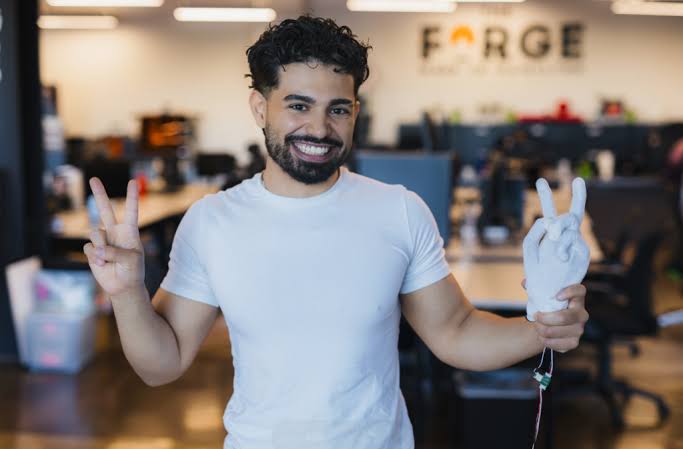
The Dream Weaver is a multi-finger prosthetic hand built by McMaster University student Ahmed Ibrahim, who first tried to make a hand for a friend who lost his in a bombing in Syria. CHCH News reports a pilot with Hamilton Health Sciences is planned for the end of 2026, pending Health Canada approval. The work is taking place in Canada, not the Middle East.
What is the Dream Weaver prosthetic hand?
Ibrahim runs Better Bionics. According to CHCH, the hand uses AI to learn signals from forearm muscles. The report describes it as having 20 movements, compared with five for high-end myoelectric hands. That comparison is made in the article and has not been independently verified.
Why did he build it?
At age 10, living in Syria, Ibrahim tried to build a robotic hand for his friend Ali using RC helicopter motors, LEGO and string. He calls the attempt a failure. He built the Dream Weaver in Niagara Falls, in a shared McMaster lab and in the 3D printing room at the Ron Joyce Children’s Health Centre. He plans to eventually build a hand for Ali. The article does not say where in Syria Ali was hurt.
What happens next?
The planned pilot with Hamilton Health Sciences would involve three adults and two children. Ibrahim is applying for Health Canada regulatory approval. Brad Haardeng of Hamilton Health Sciences says earlier prosthetics were mostly limited to a pinch grip. The report gives no information on funding or price.
What is still unknown?
Price, funding, durability and availability outside Canada are not covered. The device is not described as approved or clinically proven.
IMEA CPO Perspective
On the evidence of the report, the Dream Weaver is not available in the Middle East. Its relevance to CPOs in the region is as a signal of where upper-limb technology is heading: low-volume devices competing on dexterity, with open questions on regulation, cost, repair and clinician training. Readers in Syria will recognise the context from our coverage of 3D-printed prostheses in Syria, an Idlib clinic’s 3D-printed prosthetics and prosthetic rehabilitation in Raqqa. More is in O&P Middle East News.
FAQ
What is the Dream Weaver? A multi-finger prosthetic hand built by McMaster student Ahmed Ibrahim that uses AI to learn forearm muscle signals, according to CHCH News.
Is it approved or on sale? Not yet. Ibrahim is applying for Health Canada approval and a pilot is planned for the end of 2026.
Who is the pilot for? Three adults and two children at Hamilton Health Sciences.