

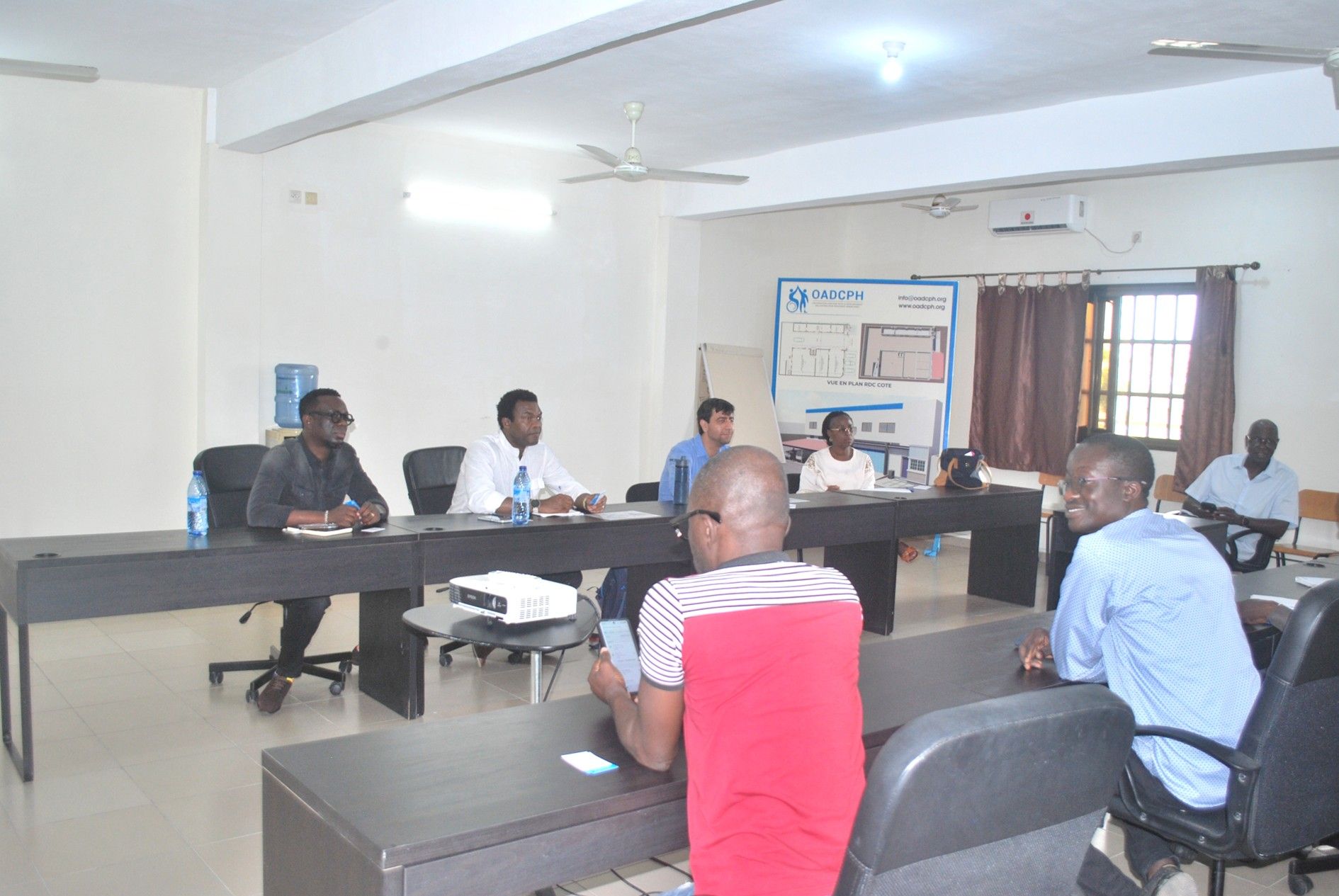
OADCPH in Togo has welcomed a delegation from the International Committee of the Red Cross (ICRC) for a visit focused on potential future areas of collaboration.
The delegation included the Head of the Logistics Sector in Geneva, the National Logistics Officer and the Logistics Officer for Togo.
During the visit, the ICRC representatives toured OADCPH’s facilities before taking part in a working meeting with the organisation’s team.
The discussions centred on possible future opportunities for cooperation, with the visit providing both organisations with an opportunity to better understand each other’s capabilities, operational requirements and areas where their work could potentially align.
Logistics plays a critical role in rehabilitation
For prosthetics, orthotics and physical rehabilitation programmes, logistics is often an underestimated part of service delivery.
A rehabilitation centre may have skilled clinicians and technicians, but those teams depend on reliable access to components, materials, tools and equipment.
For prosthetic services, that can include feet, knees, adapters, pylons, liners, resins, thermoplastics, socket materials and workshop equipment. Orthotic services may similarly depend on a regular supply of joints, uprights, straps, plastics, footwear materials and other specialised products.
In humanitarian environments, the challenge can become considerably more complex.
International procurement, customs clearance, warehousing, transportation and last-mile delivery can all determine whether rehabilitation professionals have the materials they need when patients arrive for treatment.
The presence of senior ICRC logistics representatives at the OADCPH visit therefore makes the meeting particularly relevant.
ICRC has a long history in physical rehabilitation
The ICRC has supported physical rehabilitation services internationally for decades, particularly in countries affected by conflict and other humanitarian emergencies.
Its rehabilitation work has included support for prosthetic and orthotic centres, wheelchair services, physiotherapy programmes, professional education and broader efforts to strengthen national rehabilitation capacity.
The organisation’s Physical Rehabilitation Programme focuses not only on providing assistive devices but also on helping people with physical disabilities regain mobility, independence and participation in their communities.
Across Africa, the Middle East and other parts of the IMEA region, ICRC-supported rehabilitation programmes have played an important role in maintaining access to services where health systems face significant operational pressures.
Local capacity remains essential
One of the broader lessons from rehabilitation programmes across the region is the importance of strong local institutions.
Long-term access to prosthetic and orthotic care cannot rely exclusively on periodic international interventions or donated equipment.
Patients require assessment, fitting, adjustment, repair and replacement over many years.
This means effective rehabilitation systems need local professionals, workshops, supply chains and organisational infrastructure capable of providing continuing care.
Meetings between organisations such as OADCPH and international humanitarian partners can therefore be important beyond any individual project.
They can create opportunities to examine how international expertise and logistical capacity might complement established local rehabilitation infrastructure.
Togo and the wider West African rehabilitation challenge
Access to assistive technology and rehabilitation remains uneven across much of West Africa.
People requiring prosthetic limbs, orthoses, wheelchairs and other mobility devices can face barriers including distance to specialist centres, cost, limited availability of trained personnel and difficulties maintaining reliable supplies of components.
These challenges make partnerships between local rehabilitation organisations and international humanitarian agencies particularly relevant.
Where collaboration is developed carefully, international partners can contribute procurement capability, technical knowledge and programme experience while local organisations provide clinical expertise, cultural understanding and continuity of care.
For patients, the objective should ultimately be a stronger and more sustainable rehabilitation system rather than a short-term supply intervention.
Supply-chain resilience is becoming more important for O&P
The O&P sector has also become increasingly aware of supply-chain vulnerability.
Many prosthetic and orthotic components used across Africa are imported. Disruption to shipping routes, international manufacturing or customs processes can therefore quickly affect individual clinics.
Humanitarian organisations have extensive experience managing these challenges.
Improved forecasting, consolidated procurement, regional warehousing and better inventory management can all help rehabilitation providers reduce the risk of essential components becoming unavailable.
For smaller rehabilitation centres, access to this level of logistics expertise can be particularly valuable.
Collaboration can extend beyond products
Potential cooperation between rehabilitation organisations and humanitarian agencies does not necessarily need to focus only on equipment or component supply.
Partnerships can also involve professional training, workshop development, service-quality improvement, data collection, patient pathways and the introduction of new rehabilitation technologies.
Digital manufacturing, 3D scanning and locally produced components may also become increasingly relevant as African rehabilitation systems look for ways to reduce dependence on long international supply chains.
Any future cooperation between OADCPH and the ICRC could therefore potentially have implications across several areas of rehabilitation delivery.
At this stage, however, the visit represents an exploratory discussion rather than a confirmed partnership.
Building connections before they are urgently needed
Perhaps the most important aspect of the meeting is that relationships between rehabilitation providers and humanitarian organisations are being developed proactively.
When an emergency occurs, building supply chains, clinical networks and institutional relationships from the beginning can be difficult.
Understanding local capabilities beforehand can make future responses faster and more effective.
The visit by the ICRC logistics delegation to OADCPH therefore provides an opportunity for both sides to examine where their respective strengths might complement each other.
For the wider O&P community in West Africa, such engagement is another example of how rehabilitation increasingly depends on cooperation between clinicians, local institutions, governments, humanitarian organisations and international supply networks.
If those relationships translate into stronger local capacity, the ultimate beneficiaries will be the people who depend on continued access to prosthetic, orthotic and rehabilitation services.
- International Committee of the Red Cross
- ICRC Physical Rehabilitation Programme
- ICRC – Togo
- World Health Organization – Rehabilitation
- International Society for Prosthetics and Orthotics
- IMEA CPO