

SwissABILITY has used its July 2026 mission to Tanzania to strengthen professional relationships, promote its MonoLimb prosthetic technology and open the door to a potentially important new education partnership with the Tanzania Training Centre for Orthopaedic Technologists (TATCOT).
The mission centred on the 2026 annual conference of the Association of Prosthetists and Orthotists in Tanzania (APOT), held in Morogoro and attended by rehabilitation professionals from across the country. SwissABILITY described the conference as an important national meeting point for sharing technological developments, exchanging experience and creating new professional collaborations.
For the wider African O&P sector, however, one of the most significant outcomes may be what happens next: SwissABILITY has been invited to develop a dedicated MonoLimb training module for second-year TATCOT students in 2027.
APOT brings Tanzania’s O&P profession together
APOT’s annual meeting plays an important role in Tanzania’s professional calendar.
According to SwissABILITY’s mission report, the 2026 edition brought together prosthetists, orthotists and other rehabilitation professionals from throughout Tanzania, combining formal sessions with exhibition and networking opportunities.
The event also highlighted the increasing importance of professional associations in strengthening national O&P communities.
In countries where practitioners may be geographically dispersed, conferences create rare opportunities for clinicians, technicians, educators, government representatives and suppliers to meet in one location.
That networking can be particularly valuable in prosthetics and orthotics, where successful service development depends not only on technology, but also on training, workshop capacity, supply chains and professional collaboration.
Four-person SwissABILITY delegation attends APOT 2026
SwissABILITY has participated regularly in the APOT conference since 2023. This year it was represented by a four-member national team: Bernardo Gomes, Claude Mushi, Nsengiyumva Magogwa and Tarik Khamis Ali.
Gomes joined SwissABILITY earlier in 2026 as Head of Field Operations after previously working with the International Committee of the Red Cross in several countries as an orthopaedic technician and project manager.
Mushi has previously led SwissABILITY training missions in Sierra Leone and Tanzania, while Magogwa has participated in previous Tanzania missions and manages prosthetic materials sent to local partners.
Khamis Ali works in prosthetics and orthotics in Zanzibar and also serves as APOT’s Deputy Secretary.
That composition is notable because SwissABILITY’s approach increasingly appears to rely on developing local and regional trainers rather than depending exclusively on visiting international teams.
MonoLimb presented to Tanzanian professionals
During two conference sessions, Bernardo Gomes presented SwissABILITY’s work and introduced the MonoLimb technology to delegates.
SwissABILITY described MonoLimb as a means of improving access to affordable, functional and high-performing prosthetic solutions in African settings.
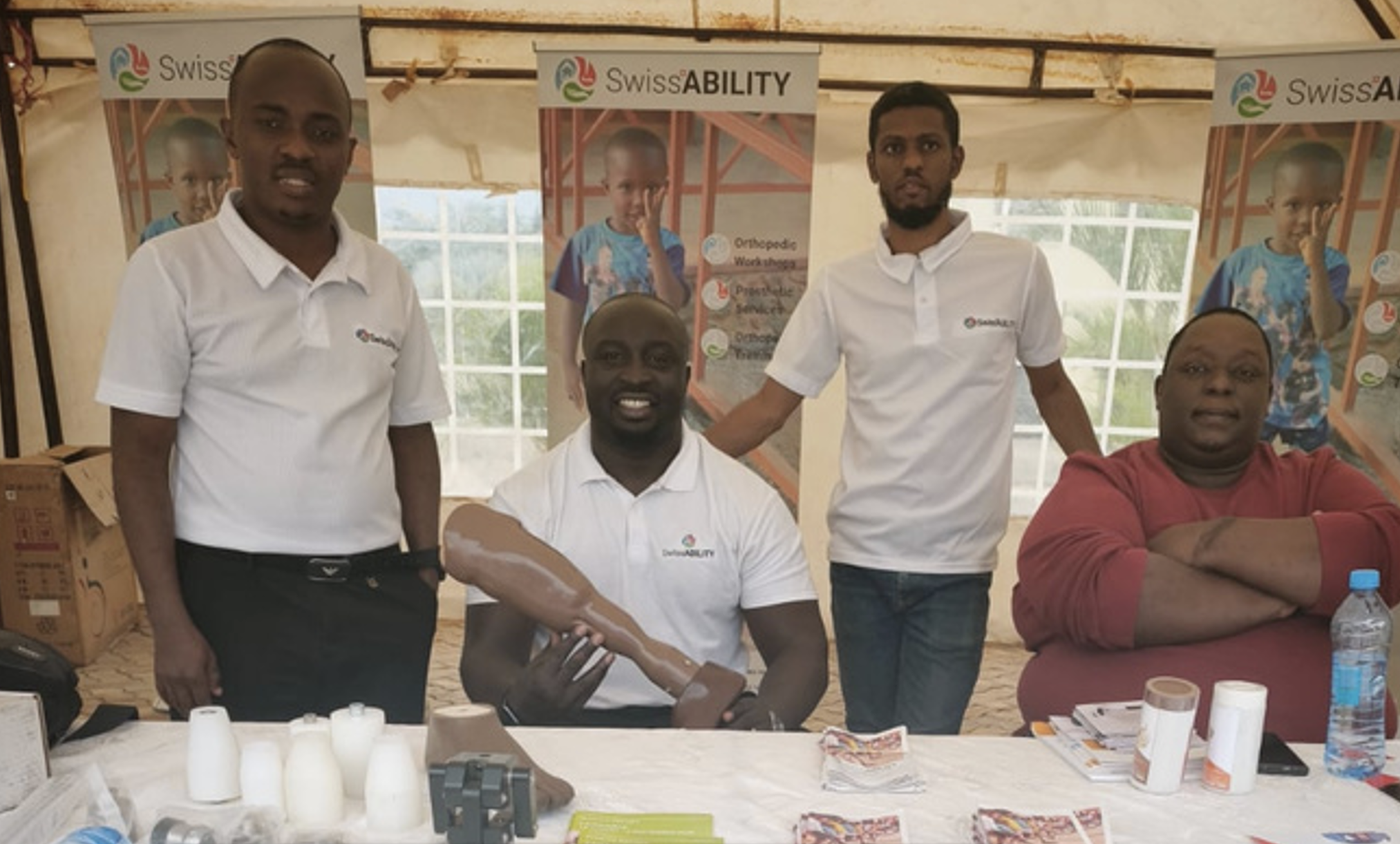
The organisation also operated an exhibition stand throughout the meeting, allowing rehabilitation centres, workshop managers and O&P professionals from across Tanzania to examine the technology and discuss SwissABILITY’s training programmes.
The photographs within the mission report show the SwissABILITY team actively engaging with conference participants around the exhibition stand and during the scientific sessions, reflecting the organisation’s emphasis on combining product demonstration with professional education.
TATCOT collaboration could be the biggest outcome
Perhaps the most important development emerging from the mission was a meeting between Gomes and representatives from TATCOT.
TATCOT is described in the SwissABILITY report as one of the relatively small number of African institutions providing a three-year professional training programme in prosthetics and orthotics, and as the continent’s largest training centre in its field.
SwissABILITY already has an indirect relationship with the institution: many participants in its previous MonoLimb courses are TATCOT graduates.
Following discussions during APOT 2026, SwissABILITY has now been invited to develop and submit a specific MonoLimb module for second-year students in 2027.
Under TATCOT’s programme structure described in the report, students later select a technology on which to develop a third-year case study.
Students choosing MonoLimb would therefore have the opportunity to gain more detailed experience with the system while still in professional education.
For SwissABILITY, integration into formal training could be considerably more influential than a standalone workshop.
Rather than reaching only practising clinicians through periodic training missions, the technology could become familiar to practitioners before they graduate.
Education can drive technology adoption
This illustrates a broader issue facing prosthetic technology in Africa.
Introducing a new prosthetic system requires more than supplying components.
Clinicians need to understand patient selection, manufacturing procedures, alignment, fitting and follow-up. Technicians need practical confidence with the fabrication process. Clinics also need reliable access to the required materials.
This is why partnerships with educational institutions can be particularly powerful.
If future prosthetists and orthotists encounter a technology during their formal training, the knowledge remains within the local professional workforce.
Over time, this can create a network of clinicians capable of delivering and teaching the system without depending continuously on outside specialists.
SwissABILITY’s own Tanzania strategy reflects this approach.
The organisation says MonoLimb technology has been taught to prosthetic and orthotic professionals across Tanzania for almost a decade, and its post-conference team meeting focused on assessing progress and planning how to further strengthen professional capacity in the country.
A three-level training strategy
A diagram within the mission report outlines SwissABILITY’s training model as a three-level progression.
The first level introduces interested technicians to the MonoLimb technology. The second develops selected technicians into advanced practitioners, creating a pool of local experts. The third level develops trainers, with the goal of establishing a reference technician within each country capable of delivering training independently.
This train-the-trainer model is particularly relevant for rehabilitation across Africa, where limited numbers of qualified O&P professionals mean education programmes must achieve more than short-term skills transfer.
Sustainable expansion depends on creating professionals who can subsequently train others.
Regional partnerships strengthened
The conference also allowed SwissABILITY to reconnect with partners from across East Africa.
The mission report highlights O. J. Ondiege, head of the Prosthetics and Orthotics Department at Kenya National Hospital in Nairobi, with whom SwissABILITY has previously collaborated on training missions.
The conference concluded with remarks from Nyembea Hamisi, Director of Curative Services at Tanzania’s Ministry of Health, who emphasised the importance of continued investment in rehabilitation services and access to prosthetic and orthotic care.
That government-level recognition is significant.
Expanding access to prosthetic services requires more than charitable or professional initiatives. Training institutions, government health systems, professional associations and service providers all need to be connected if technologies are to move from individual projects into routine care.
Building a Tanzanian O&P ecosystem
SwissABILITY’s 2026 Tanzania mission demonstrates how the organisation’s strategy is developing beyond individual prosthetic fittings.
The focus is increasingly on professional education, local trainers, institutional partnerships and national networks.
Its planned engagement with TATCOT could become particularly important if MonoLimb becomes incorporated into structured O&P education.
For Tanzania, that creates an opportunity to broaden the range of prosthetic technologies familiar to graduates entering the workforce.
For SwissABILITY, it offers a pathway towards a more sustainable model of technology transfer.
And for the wider African O&P profession, the mission provides another example of an important shift in international rehabilitation support: from delivering technology to building the professional capacity required to deliver it locally.
The SwissABILITY report concludes that events such as APOT demonstrate the value of collaboration in strengthening prosthetic and orthotic services and creating wider access to quality care across Africa.
- SwissABILITY
- Tanzania Training Centre for Orthopaedic Technologists (TATCOT)
- International Society for Prosthetics and Orthotics
- World Health Organization – Rehabilitation
- IMEA CPO