

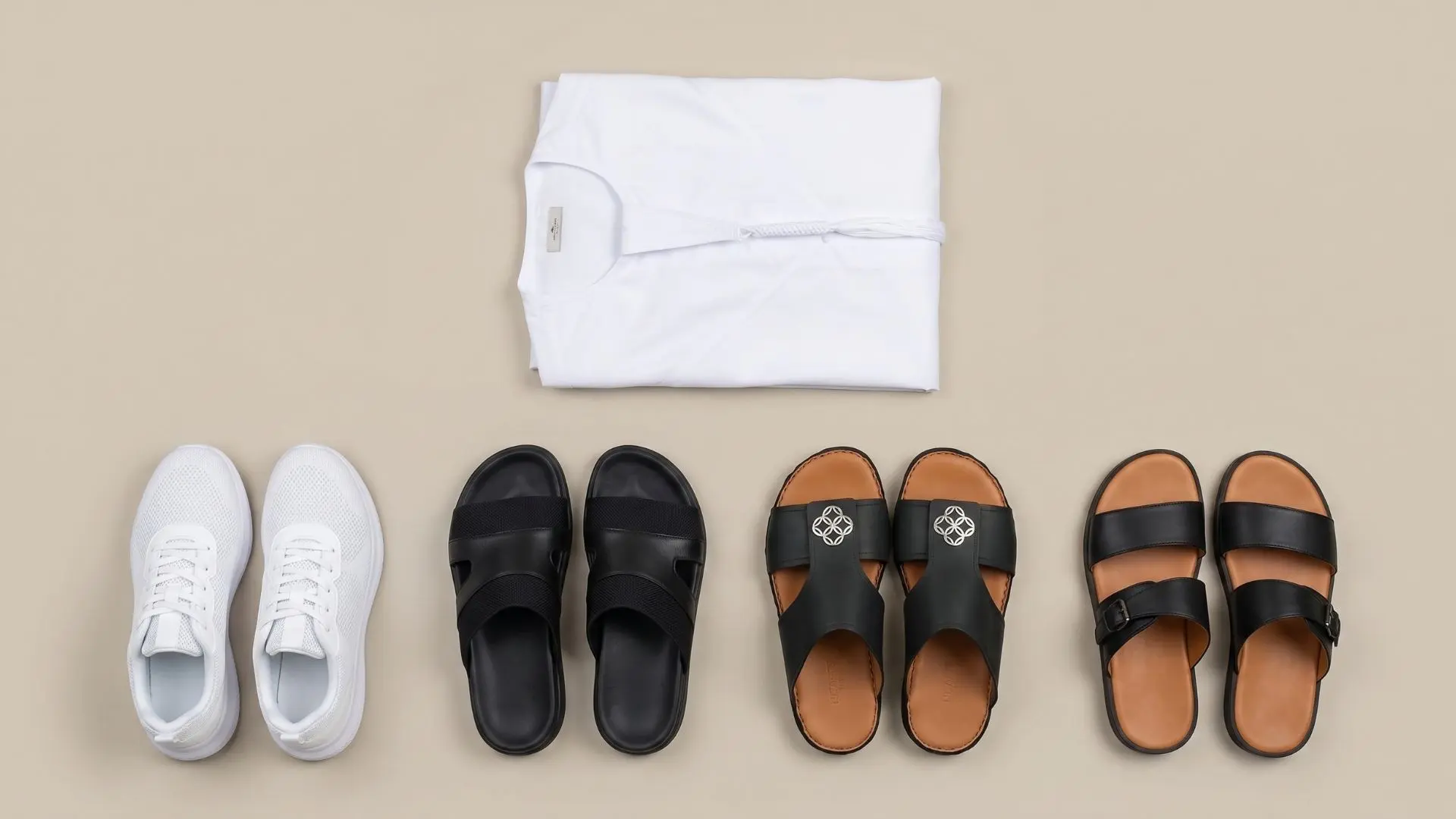
Arabic sandals—commonly known as na’al—are an important part of men’s daily and formal dress throughout the Gulf. For patients prescribed custom foot orthoses, however, finding an Arabic sandal that combines traditional styling with appropriate depth, stability and orthotic retention remains difficult.
Several brands now market Arabic sandals as “orthopedic,” “medicated” or fitted with arch-supporting footbeds. These terms do not necessarily mean that the sandal can accommodate a separately manufactured custom foot orthosis.
For orthotists, the distinction is important. A built-in comfort footbed is a standard component of the sandal. A custom foot orthosis is a prescribed medical device designed around the patient’s anatomy, symptoms, pressure distribution, biomechanics and treatment objectives.
The best solution may therefore be one of three different approaches:
- A ready-made Arabic sandal with suitable built-in support
- A custom Arabic sandal modified around the patient’s orthosis
- A purpose-designed orthotic na’al developed jointly by an orthotist and footwear manufacturer
Best Overall Retail Arabic Sandal Range: Raha Footwear
Raha Footwear is one of the most relevant UAE brands for orthotists looking for a traditional Arabic sandal with a more supportive footbed.
The company offers men’s Arabic sandals manufactured from premium leather and describes its products as incorporating orthopedic footbeds and arch support. Its collections include the Joud, Nafis, Shams, Kayan, Raa, Rabt, Wasl, Taurus and Vellar models.
Raha’s range is particularly relevant because the products maintain the appearance of a traditional Gulf na’al rather than resembling a conventional European walking sandal. The brand also has physical retail locations in Dubai and Abu Dhabi, allowing the orthotist and patient to inspect and trial the footwear before purchase.
However, Raha’s standard product pages do not clearly confirm that the complete footbed is removable. Its sandals should therefore be considered ready-made supportive footwear unless a specific model has been physically assessed and approved for custom orthotic integration.
An orthotist should not simply place a custom orthosis on top of Raha’s existing contoured footbed. Doing so could raise the foot excessively, reduce upper retention, alter the prescribed correction and create pressure around the arch or sandal margins.
Raha’s Custom Arabic Sandal Service
Raha becomes more interesting for orthotic practices through its Custom Arabic Sandals service.
Customers can choose the sandal model, leather colour, sole type and size or upload their own design. This creates a potential pathway for an orthotist to request an Arabic sandal manufactured around a prescribed device rather than attempting to adapt a finished retail product.
Before accepting a clinical order, the orthotist should confirm whether Raha can:
- Produce the sandal without its standard contoured footbed
- Create a recessed cavity matching the custom orthosis
- Increase the internal depth
- Modify the upper to accommodate the additional volume
- Incorporate a full-length orthosis during manufacture
- Add a discreet orthosis-retention system
- Adjust the outsole stiffness or rocker profile
- Manufacture different specifications for the left and right feet
Raha’s custom service currently focuses on style and material personalization rather than explicitly advertised medical customization. It should therefore be treated as a promising manufacturing route that requires direct technical discussion—not as confirmed evidence that every Raha sandal accepts custom orthotics.
For patients requiring only mild support, a standard Raha model may be sufficient after clinical assessment. For patients with a prescribed device, the more appropriate route would be a specially commissioned Raha sandal manufactured around the orthosis.
Best Local Development Partner: Italian Shoe Factory Dubai
Italian Shoe Factory in Dubai offers a different opportunity. Rather than being a medical footwear provider, it is a custom footwear manufacturer offering bespoke shoes, product development and private-label production.
The company provides prototyping, small-batch production and mould-development services. These capabilities could allow an orthotics clinic, distributor or O&P company to develop an orthotic-ready Arabic sandal rather than relying on an existing consumer model.
A collaboration could involve the orthotist supplying:
- The required internal dimensions
- A physical or digital orthotic model
- The preferred sandal last
- Minimum depth requirements
- Upper-volume specifications
- Heel and midfoot retention requirements
- Outsole stiffness and flex-line specifications
- Orthosis attachment or locating features
- Materials suitable for clinical cleaning and long-term use
Italian Shoe Factory could then develop the upper, sole tooling, last and finished sandal around those clinical requirements.
This route could be valuable for an O&P provider seeking to create a clinic-branded Arabic sandal in several sizes. A modular design could include a removable standard footbed for general customers, which an orthotist could replace with a full-length custom device.
The important limitation is that Italian Shoe Factory is a footwear manufacturer rather than a clinical orthotics service. The prescribing orthotist would remain responsible for the clinical design, patient assessment, orthosis specification, fitting and outcome review.
Any therapeutic claims would also require appropriate technical documentation and evidence rather than relying solely on descriptions such as “orthopedic” or “medicated.”
Best Regional Clinical Arabic Range: Edrees Medical
Edrees Medical offers one of the most clinically relevant Arabic sandal ranges in the region.
Its catalogue includes:
- Flat Foot Arabic Naal—EME-338
- Local Arabic Naal for Flat Foot—EME-339
- Ortho Flat Foot Arabic Sandals—EME-321 to EME-327
Because these products are supplied by an orthotics and prosthetics provider, Edrees may offer a more direct clinical pathway than a conventional sandal retailer.
Nevertheless, the publicly available information does not clearly state whether the footbeds are removable or whether the sandals can be supplied with a recess for an independently manufactured orthosis.
Before dispensing, the orthotist should ask Edrees to confirm:
- Whether the footbed can be removed
- The depth available after removal
- Whether the sandal can be manufactured around a cast or scan
- Whether it can accept a full-length custom device
- Whether bilateral modifications are possible
- How the orthosis is secured inside the sandal
Best Premium Ready-Made Alternative: Aetrex Arabic Sandals
Aetrex Middle East offers an extensive collection of men’s Arabic sandals with traditional styling, cushioning and built-in arch support.
The Aetrex Premium Comfort Arabic Sandal, for example, combines a leather upper with a cushioned supporting footbed. The range includes traditional, contemporary and formal designs.
These sandals may suit patients who want more support than a conventional flat na’al but do not require a custom orthosis.
As with Raha, the product information reviewed does not clearly confirm that the footbed is removable. Aetrex Arabic sandals should therefore be treated as supportive ready-made footwear unless the individual model has been physically evaluated for orthotic compatibility.
Best Medicated Comfort Options: Tucci and Mydan
Tucci Footwear offers several Arabic sandals described as orthopedic or medicated. The Tucci Joud, for example, is manufactured from leather and advertised with a medicated footbed providing cushioning and arch support.
Mydan also offers UAE-made medicated Arabic sandals with cushioning and supportive features.
These products can be considered for general comfort when their shape and built-in support suit the patient. However, the term “medicated” is not a standardized confirmation that a sandal can accommodate a prescription orthosis.
Unless a supplier confirms a removable footbed, adequate depth and secure retention, the product should not be described as custom-orthotic compatible.
Confirmed Orthotic-Friendly Alternatives
Where accommodating the custom orthosis is more important than maintaining an exact Arabic appearance, several international sandals provide clearer technical specifications.
Revere Montana 2
The Revere Montana 2 has a removable footbed, additional depth and three adjustable straps. It can accommodate custom orthoses and offers better foot retention than a backless na’al.
Revere Durban
The Revere Durban is a leather slide with a removable footbed. Its appearance is closer to a slip-on Arabic sandal, although its open heel limits rearfoot control.
Propét Hatcher
The Propét Hatcher combines adjustable straps with a removable footbed specifically intended to accommodate custom orthotics.
Finn Comfort Riad
Finn Comfort states that its footwear uses removable footbeds that can be replaced with individual orthopedic insoles. The Riad is a premium slide, although it does not reproduce the formal appearance of a Gulf na’al.
Comparison for Orthotists
| Option | Arabic appearance | Custom orthosis status | Best application |
|---|---|---|---|
| Raha standard range | Yes | Removable footbed not publicly confirmed | Ready-made comfort and built-in arch support |
| Raha custom service | Yes | Potentially possible; requires technical confirmation | Individually commissioned Arabic sandals |
| Italian Shoe Factory Dubai | Can be developed | Can be designed into a new product | Prototypes, clinic-branded products and small batches |
| Edrees Medical Arabic range | Yes | Requires supplier confirmation | Regional clinical and flat-foot pathway |
| Aetrex Arabic sandals | Yes | Removable footbed not publicly confirmed | Premium ready-made support |
| Tucci and Mydan | Yes | Not publicly confirmed | General comfort after assessment |
| Revere Montana 2 | No | Confirmed | Greater retention and custom-orthosis accommodation |
| Revere Durban | Partially similar | Confirmed | Slip-on sandal for less complex requirements |
| Propét Hatcher | No | Confirmed | Adjustable everyday orthotic sandal |
| Finn Comfort Riad | Partially similar | Confirmed removable footbed | Premium slide with replaceable footbed |
What Should an Orthotic-Ready Na’al Include?
A properly designed orthotic na’al should have more than an arch-shaped footbed.
Fully removable footbed
The complete factory footbed should lift out, leaving a stable and sufficiently deep base. Removing only a thin sock liner does not create adequate room.
Recessed orthotic cavity
The orthosis should sit inside the sole rather than on top of it. A recess improves stability and reduces the likelihood of the device moving or becoming visible.
Full-length orthosis
A full-length device is generally easier to retain in an open sandal than a three-quarter-length orthosis. A leather top cover can also be matched to the sandal.
Adjustable or custom upper
The upper must accommodate the volume created by the orthosis. Where an adjustable strap would compromise the traditional appearance, the vamp can be manufactured to the correct depth.
Stable outsole
The outsole should provide torsional stability, appropriate forefoot flexion and reliable traction. An excessively soft or flexible sole can reduce the effectiveness of the prescribed device.
Orthosis-retention system
A locating recess, hook-and-loop attachment or professional bonding method may be required. The device should not be left loose inside a backless sandal.
Appropriate width
The sandal last must accommodate both the foot and the orthosis. The device should not force the foot over the side of the sole or create pressure beneath the upper.
Recommended Dispensing Pathway
Orthotists considering an Arabic sandal should:
- Assess the patient’s symptoms, skin condition, sensation, circulation, balance and treatment objectives.
- Determine whether an open and potentially backless sandal is clinically appropriate.
- Decide whether the patient needs built-in comfort support or a prescribed custom orthosis.
- Obtain a physical sample or technical specification from the sandal supplier.
- Confirm whether the full footbed can be removed.
- Check the available depth and upper volume.
- Fit the orthosis and assess the patient during standing and walking.
- Confirm that the orthosis cannot migrate.
- Inspect the arch, forefoot, upper and sandal margins for pressure.
- Provide a gradual wearing schedule and arrange clinical review.
A low arch alone is not automatically an indication for orthotic treatment. The Royal College of Podiatry notes that arch height does not necessarily determine how well a foot functions and recommends basing management on symptoms and clinical findings.
Caution for Diabetes and Neuropathy
An open na’al may be inappropriate for patients with:
- Loss of protective sensation
- Active or recently healed ulceration
- Severe deformity
- Unstable Charcot arthropathy
- Significant peripheral vascular disease
- A history of recurrent skin breakdown
- Poor balance or frequent falls
These patients may require enclosed therapeutic footwear, pressure-relieving insoles and more secure foot retention. Cultural preference remains important, but it must be balanced against the need to protect the foot from impact, heat, debris and unnoticed injury.
The Verdict
Raha Footwear is one of the strongest current retail options for men seeking an Arabic sandal with a supportive or orthopedic-style footbed. Its custom sandal service may also offer a practical route for orthotists, provided the company confirms that it can manufacture the sandal around a prescribed orthosis.
Edrees Medical offers the clearest regional link with clinical orthotics, but individual product specifications still need to be verified. Aetrex, Tucci and Mydan provide supportive ready-made alternatives, although their built-in footbeds should not be confused with confirmed custom-orthotic accommodation.
For clinics and distributors interested in developing a genuine orthotic-ready na’al, Italian Shoe Factory Dubai offers valuable prototyping, small-batch and private-label capabilities. A partnership between a qualified orthotist, an Arabic sandal brand such as Raha and a specialist manufacturer could address a significant gap in the regional footwear market.
The ideal product would retain the appearance of a premium Arabic na’al while providing a removable full-length footbed, recessed orthotic cavity, adequate upper volume, stable outsole and secure device retention. This would allow orthotists to prescribe culturally acceptable footwear without compromising the clinical function of the orthosis.
- Raha Footwear
- Raha Custom Arabic Sandals
- Raha Signature Medicated Collection
- Raha Footwear Store Locations
- Italian Shoe Factory Dubai
- Italian Shoe Factory Private-Label Manufacturing
- Edrees Medical—Ortho Flat Foot Arabic Traditional Sandals
- Aetrex Middle East—Men’s Arabic Sandals
- Tucci Joud Orthopedic Arabic Sandal
- Mediclinic Middle East—Custom and Specialized Footwear
- Propét Men’s Orthotic-Friendly Sandals
- Finn Comfort Removable Footbeds
- Royal College of Podiatry—Flat-Foot Management