

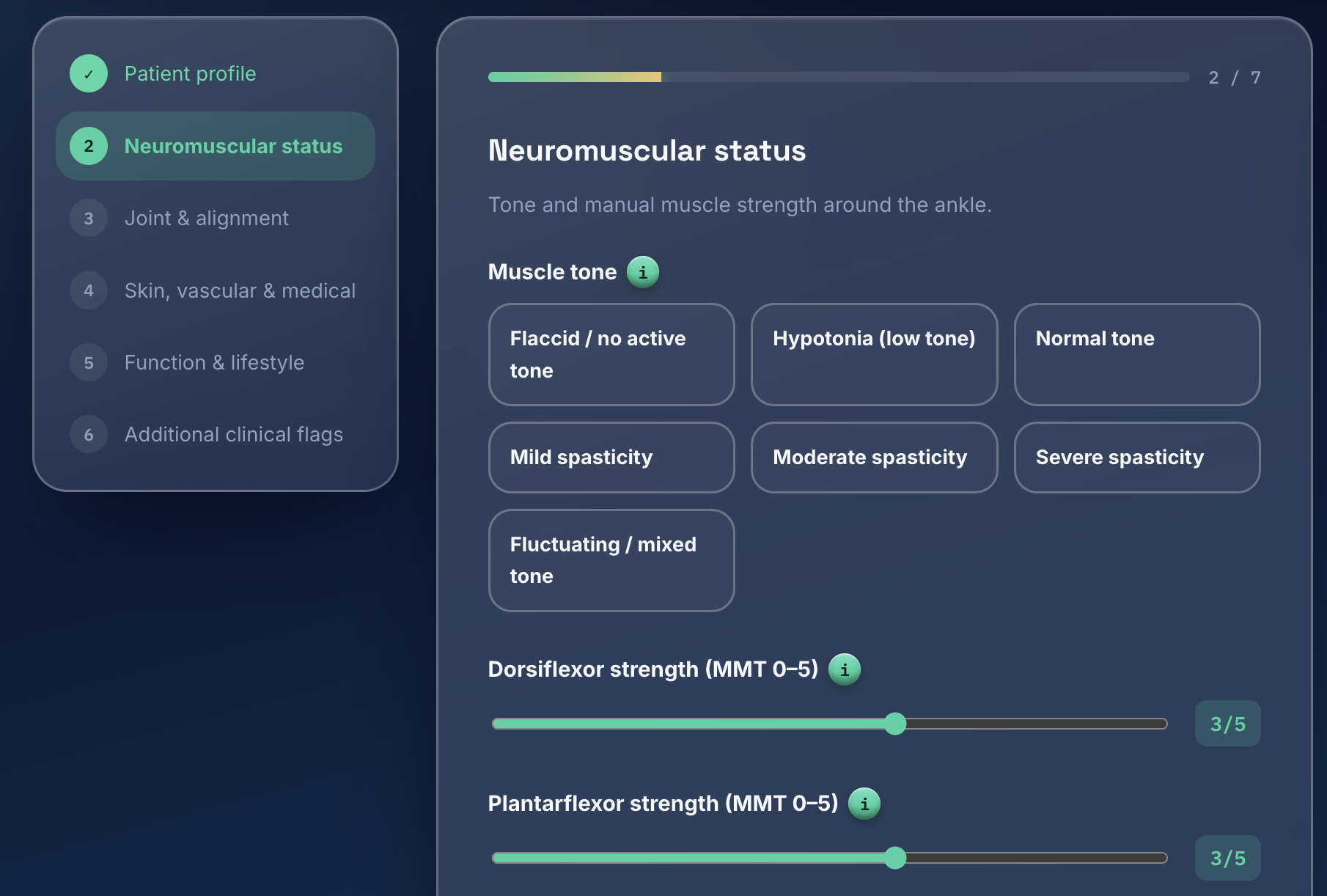
A new bilingual digital prototype aims to help clinicians and students structure the complex reasoning involved in selecting foot and ankle orthoses.
Developed by physiotherapist and orthotics and prosthetics specialist Mohamad Firas Wahbeh, Orthotica is an offline-capable English-Arabic clinical decision-support system. It uses a transparent set of weighted rules and exclusions to rank possible orthotic categories, designs and ankle-joint mechanisms.
Wahbeh, who reports more than 25 years of clinical and professional experience, has described the system’s design and preliminary evaluation in an openly accessible technical paper published on Zenodo on 1 September 2026.
The paper, “A Transparent Rule-Based Clinical Decision-Support System for Foot and Ankle Orthosis Selection: Design, Knowledge-Based Construction, and Software Architecture of a Pilot Prototype,” is available through its permanent Zenodo record and DOI.
Crucially, the author does not present Orthotica as a replacement for clinical examination or professional judgement. It is described as an engineering, organisational and educational prototype whose rules require further consensus development and prospective validation.
Structuring a complicated decision
Choosing an orthosis involves more than matching a diagnosis to a device.
The clinician may need to consider muscle strength, tone, joint stability, deformity flexibility, range of motion, skin and vascular status, gait, activity requirements and the functional objectives agreed with the user.
Even after deciding that an ankle-foot orthosis is appropriate, further choices remain. These can include the stiffness of the design, the need to control plantarflexion or dorsiflexion, whether articulation is suitable and which joint mechanism could support the required function.
Orthotica attempts to organise this process through a layered rule-based system.
Its knowledge base covers five principal orthosis categories:
- Foot orthosis
- Supramalleolar orthosis
- Dynamic ankle-foot orthosis
- Ground-reaction ankle-foot orthosis
- The wider ankle-foot orthosis family
When the AFO family receives the leading score, the software evaluates nine subtypes. These include solid, posterior leaf-spring, articulated free-motion, plantarflexion-stop, carbon dynamic-response, tone-reducing, dorsiflexion-assist or night-stretch, soft fabric-reinforced and patellar tendon-bearing designs.
Where an articulated solution may be relevant, a further layer compares 11 ankle-joint mechanisms.
Rules that can be inspected
Orthotica differs from a predictive machine-learning system because its reasoning is explicitly programmed and displayed.
Each candidate device is associated with indications, cautions and contraindications. A matched indication adds to its score, while a caution reduces it. A hard exclusion applies a substantial penalty and flags the option.
The system then presents a leading recommendation and ranked alternatives, accompanied by an itemised explanation of the rules that contributed to each result.
This traceability is a significant feature. Clinicians can inspect why a device was promoted or down-ranked rather than receiving an unexplained output from a “black-box” model.
However, transparency does not make the recommendation automatically correct. A clearly visible rule can still be based on incomplete evidence, an inappropriate weight or an unreliable clinical input. The value of transparency is that those assumptions can be identified, questioned and revised.
Dedicated foot-orthosis module
When a foot orthosis becomes the leading category, Orthotica opens a separate biomechanical refinement module.
This section uses four familiar assessment measures:
- Foot Posture Index
- Navicular drop test
- Jack’s test
- Silfverskiöld test
The additional results are used to compare four types of foot orthosis: a rigid corrective shell, a semi-rigid design with a deep heel cup and medial posting, a soft accommodative design, and a cushioned option incorporating a lateral forefoot wedge for a high-arched foot.
A rigid result during Jack’s test is treated as an exclusion for rigid and semi-rigid corrective options. A Silfverskiöld result suggesting isolated gastrocnemius tightness produces an explanatory note because an insole alone would not address the underlying restriction.
The manuscript also acknowledges limitations in the clinical measures themselves. Reliability can differ between tests, examiners and settings, meaning that structured digital inputs should not be mistaken for perfectly objective data.
Designed for offline and Arabic use
Orthotica is built as a Progressive Web Application using standard browser technologies. Its principal version is contained in a single HTML file, allowing the interface and rule base to operate locally without a continuous internet connection.
According to the paper, all processing takes place on the user’s device. The system has no server-side component and does not transmit or persistently store entered clinical information.
The interface supports English and Arabic, including right-to-left formatting. Each assessment field includes a plain-language explanation covering what is being measured, why it matters and how it influences the decision process.
A working version of the Orthotica application is freely accessible without registration. The paper states that the application collects neither analytics nor personal information.
Offline capability and Arabic localisation could make the concept particularly relevant to education and clinical services across the Middle East and other settings where connectivity, software cost and language remain barriers.
Preliminary evaluation
The prototype was retrospectively applied to data from 30 adult and paediatric cases. The reported presentations included drop foot, flexible and rigid flatfoot, cerebral palsy, gastrocnemius tightness and poliomyelitis.
Displayed suitability matches ranged from 76% to 97%, with a mean of approximately 89.5%.
These figures must be interpreted carefully. They are bounded scores generated by the programmed rules—not probabilities that a prescribed orthosis will produce a successful clinical outcome. The evaluation did not measure prospective changes in gait, pain, participation, skin condition, device use or quality of life.
The system was also reviewed by a multidisciplinary panel of ten people, including certified orthotists, rehabilitation physicians, physical therapists, researchers and clinical educators. Reviewers gave an average overall rating of 8.8 out of ten, with positive responses to the traceable logic, conservative exclusions and Arabic interface.
This review supports the system’s preliminary face validity and perceived educational usefulness. It does not establish diagnostic accuracy, comparative effectiveness or patient safety in routine practice.
Important limitations and next steps
The manuscript is unusually direct about the prototype’s present limitations.
Its numerical weights were developed by the author using published literature, manufacturer guidance and informal clinician input. They have not been established through a formal Delphi consensus exercise or calibrated against prospective clinical outcomes.
The evidence supporting different orthotic designs is itself variable, particularly across heterogeneous patient groups. There is also a risk of automation bias if users interpret a prominently displayed score as more authoritative than their own examination.
The paper identifies several necessary next steps:
- Formal multidisciplinary consensus development to review the rules and weights
- Prospective comparison with independent recommendations from qualified orthotists
- Evaluation involving new patients and blinded clinical decision-making
- Longitudinal research measuring functional and patient-reported outcomes
- Continued refinement of safety warnings and referral triggers
Independent, multi-institutional participation will be important because Wahbeh is both the sole author and the system’s developer. The paper declares this interest, states that no commercial organisation was involved and reports that the work received no external funding.
Potential value for IMEA education
In its present form, Orthotica may be most useful as an educational and clinical-reasoning aid.
Students could use its explanations to examine how assessment findings change the ranking of orthotic options. Educators could challenge particular recommendations and ask learners to identify missing considerations. Practising clinicians could use the system as a structured checklist while retaining responsibility for the final decision.
Its open publication also enables the P&O community to inspect the underlying approach rather than evaluating only a finished interface.
Orthotica is not yet a validated prescription system, and its percentage-style scores should not be used as evidence that a device will succeed for an individual patient. Its more immediate contribution is demonstrating how orthotic reasoning might be organised digitally without concealing the rules behind an opaque algorithm.
For the IMEA region, the combination of Arabic support, offline operation and visible decision logic offers a promising foundation. Whether that foundation can become a dependable clinical instrument will now require formal consensus, independent scrutiny and prospective evidence.
- Orthotica paper on Zenodo
- Permanent DOI for the Orthotica paper
- Open Orthotica prototype
- International Society for Prosthetics and Orthotics
- Overview of clinical decision-support benefits and risks
- WHO standards for prosthetics and orthotics