

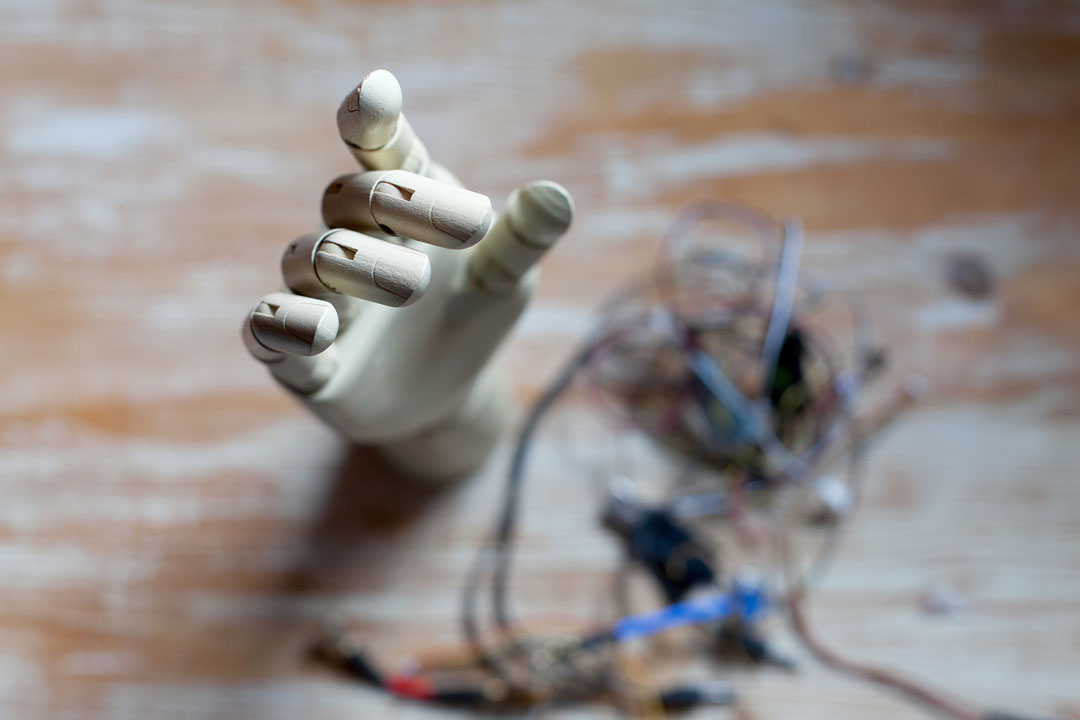
Researchers from the Rochester Institute of Technology’s campuses in Dubai and the United States have developed a prosthetic finger prototype combining multi-material additive manufacturing, flexible silicone and embedded tactile sensing.
The collaborative project brings together four areas that are often investigated separately: material behaviour, mechanical design, 3D printing and smart sensors. By integrating them into a single prototype, the researchers hope to establish a pathway towards prosthetic fingers and hands that are customisable, flexible, sensitive and more economical to manufacture.
The research has particular relevance to the IMEA region through the involvement of RIT Dubai, demonstrating how engineering expertise within the UAE can contribute to international advances in RIT Dubai prosthetics technology.
The findings were published in the open-access Journal of Manufacturing and Materials Processing under the title “Foundations for Future Prosthetics: Combining Rheology, 3D Printing, and Sensors.”
One prototype, three manufacturing technologies
Human fingers combine rigid bones, flexible joints, compliant skin and highly sensitive touch receptors within a very small structure. Reproducing even part of this combination in a prosthesis presents a considerable engineering challenge.
A rigid printed finger may be relatively easy to manufacture but lack natural flexibility. A soft structure may move more naturally but provide insufficient strength. Sensors can detect contact, but incorporating them into a durable, patient-specific device introduces further complexity.
The RIT team sought to address these competing requirements through a hybrid structure produced using three additive-manufacturing processes:
- Fused deposition modelling for structural PLA components
- Stereolithography for additional detailed parts
- Extrusion-based bioprinting for flexible silicone-based material and sensors
This allowed the researchers to select different materials and manufacturing methods for different functions rather than printing the complete finger from one rigid polymer.

What “bioprinting” means in this study
The term bioprinting can suggest that researchers are printing living cells or biological tissue. That is not what occurred in this project.
Here, extrusion-based bioprinting refers to equipment and processes used to deposit a carefully controlled flexible, biocompatible silicone material. The research focused on polydimethylsiloxane, commonly known as PDMS, and examined how its flow properties changed across temperatures between 30°C and 70°C.
Understanding these rheological properties is essential because the material must flow through a printing nozzle but retain the intended shape after deposition. If it is too viscous, extrusion becomes inconsistent. If it flows too freely, the printed geometry may deform.
The study therefore contributes not only a prototype but also information about how flexible silicone materials can be characterised and prepared for additive manufacturing.
Creating a sensor that recognises touch
To give the prototype a basic capacity to detect contact, the researchers incorporated barium titanate particles into the PDMS silicone.
Barium titanate has piezoelectric properties, meaning that mechanical force can generate an electrical signal. When pressure is applied to the flexible sensor, the material produces a measurable open-circuit voltage.
This allows the prosthetic prototype to register tactile stimulation rather than functioning only as a passive mechanical structure.
However, detecting contact is not the same as restoring the user’s sense of touch. The current prototype generates an electrical signal, but the study does not demonstrate that this information is transmitted back to an amputee through nerves, skin stimulation or another feedback interface.
Future development would need to determine how sensor data is processed and communicated to the user. Possible pathways could include vibration, electrical stimulation, visual feedback or integration with more advanced neural interfaces.
The research should therefore be understood as an early foundation for sensory prosthetics—not a clinically available finger that already recreates human sensation.
Optimising the rigid structure
The team also examined how printing parameters affected the strength of the PLA components.
A Taguchi design-of-experiments method was used to study the effects of infill density, infill pattern and print speed on tensile performance. The researchers found that a 90 per cent infill density and hexagonal internal pattern improved yield strength, ultimate tensile strength and stiffness.
This type of process optimisation matters in prosthetics because a visually successful print is not necessarily a mechanically reliable component. Print orientation, internal geometry, layer adhesion and production speed can all influence how a part responds to repeated loading.
The research indicates that strength can be improved through controlled print architecture, although PLA itself has limited impact resistance compared with materials used in established commercial terminal devices.
Collaboration between Rochester and Dubai
The project was completed by Salman Pervaiz of RIT Dubai together with Krittika Goyal, Jun Han Bae and Ahasan Habib from RIT’s Rochester campus.
Each researcher contributed expertise in an area including hybrid materials, electromechanical systems, mechanical properties and bioprinting. This multidisciplinary structure allowed the project to examine the complete manufacturing chain rather than treating the sensor, printed structure and flexible material as unrelated experiments.
Pervaiz is an engineering professor at RIT Dubai and director of its materials and advanced manufacturing research activities. His participation connects the project to the UAE’s expanding research base in additive manufacturing, materials science and medical engineering.
For the regional P&O community, this is an important connection. Universities and engineering laboratories across the Gulf increasingly possess equipment and knowledge that could support prosthetic research, but successful clinical translation requires structured collaboration with prosthetists, occupational therapists, surgeons and prosthetic users.
A proof of concept, not a finished prosthesis
Reports on emerging technology can sometimes move too quickly from a laboratory prototype to claims of an imminent clinical product. The 3D Printing Industry report makes clear that important limitations remain.
The prototype has not been presented as a clinically validated prosthesis. The sensors have not yet been tested for real-time monitoring of joint movement, and the current material model covers the silicone’s behaviour before curing rather than the complete curing and gelation process.
The long-term bond between the PDMS material and the stereolithography components also requires testing under repeated mechanical loading. Other unanswered questions include water and sweat resistance, sensor drift, repairability, power requirements, manufacturing repeatability and safe performance during daily use.
Most importantly, published reports do not describe trials involving prosthetic users. Clinical testing would be needed to determine comfort, control, functional usefulness and whether the sensor information improves performance in meaningful daily tasks.
Potential relevance across IMEA
If the technology progresses successfully, multi-material printing could support more localised production of individualised finger and partial-hand prostheses.
Partial-hand presentations are highly variable. The position and length of remaining digits, available joint movement, scar condition, sensitivity and functional goals differ considerably between users. Digital design and flexible manufacturing may offer advantages where standard components cannot easily accommodate an individual anatomy.
For IMEA countries with limited access to imported upper-limb systems, a validated digital workflow could eventually enable regional production and reduce dependence on complex international supply chains.
Affordability, however, must be assessed across the complete service. Printer cost, sensor fabrication, electronics, finishing, clinical fitting, user training and maintenance all contribute to the real cost of provision.
The RIT prototype is promising because it attempts to integrate these technologies from the beginning. Its next challenge is to move from manufacturing feasibility to dependable clinical function.
By combining research capabilities in Dubai and Rochester, the project also offers a useful model for the region: advanced prosthetic innovation is most likely to succeed when materials scientists, engineers, clinicians and users work on the same problem together.
- 3D Printing Industry: RIT prosthetic prototype
- Original research paper
- RIT report on the prosthetic research
- Rochester Institute of Technology
- RIT Dubai
- RIT Dubai materials and advanced manufacturing research
- Journal of Manufacturing and Materials Processing