

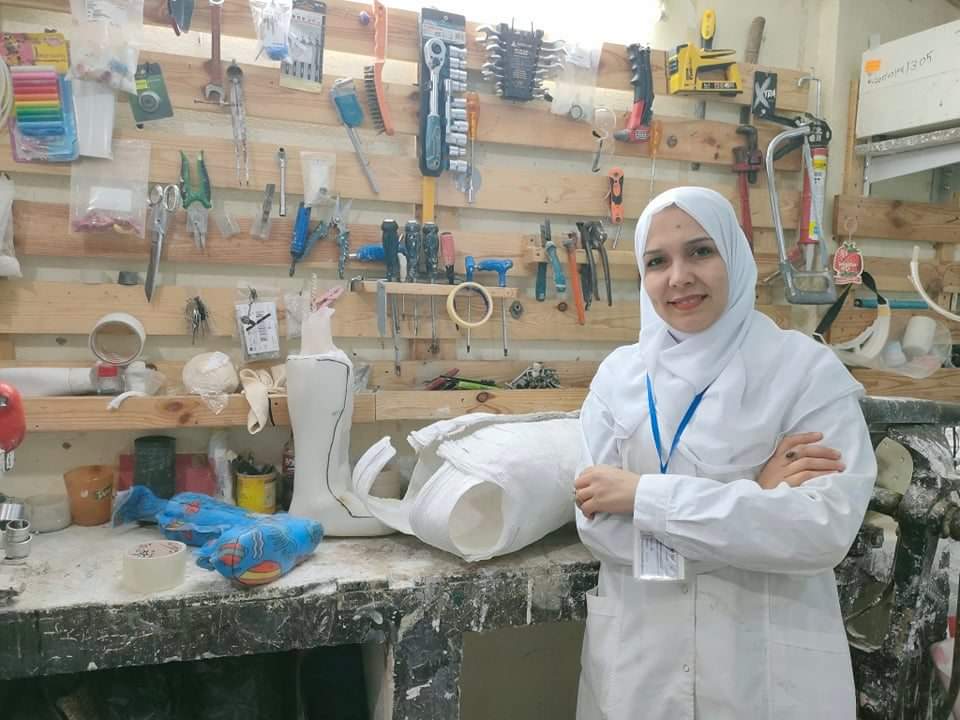
An Algerian orthoprosthetist has developed a structured clinical protocol intended to improve understanding, participation and treatment adherence among adolescents receiving conservative care for idiopathic scoliosis.
Programme 4D was developed by Soumaya Foughali, an orthoprosthetist specialising in conservative scoliosis management in Annaba, with scientific supervision from Abdelkader Bentenfif.
The protocol is organised around four actions: Décoder, Dynamiser, Documenter and Définir—or Decode, Activate, Document and Define. It aims to change the patient’s experience from passively enduring a brace prescription to understanding and participating actively in the treatment programme.
The complete French-language guide is available through Zenodo under DOI 10.5281/zenodo.22730407. The authors also report that a related manuscript is currently under consideration by the International Journal for Research Trends and Innovation under paper ID IJRTI_300535.

Addressing adherence to scoliosis bracing
Conservative treatment for adolescent idiopathic scoliosis may involve observation, physiotherapeutic scoliosis-specific exercises, bracing or a combination of interventions. The appropriate pathway depends on factors including curve magnitude, skeletal maturity, progression risk and the individual patient’s clinical circumstances.
A technically well-designed spinal orthosis can only deliver its intended corrective effect when it is worn according to the agreed treatment plan. Adolescents may struggle with brace wear because of discomfort, heat, appearance, clothing, school life, social pressure, emotional distress or a limited understanding of why the treatment is necessary.
Programme 4D starts from the premise that these human factors must be addressed alongside orthotic design.
Foughali writes that many adolescents in Algeria experience the brace as something imposed on them without sufficient explanation. The protocol therefore introduces a longer, visually supported consultation intended to help the patient understand the deformity, see the purpose of treatment and establish personally meaningful goals.
The four components of Programme 4D
1. Décoder – Decode
The first stage helps the patient and family understand the scoliosis.
The clinician reviews the radiograph, explains the curve pattern and discusses the three-dimensional nature of the deformity. The guide refers to thoracic, lumbar and double-major patterns and encourages clinicians to use drawings and accessible explanations rather than relying exclusively on medical terminology.
A suggested initial consultation lasts approximately 30 minutes. Its purpose is not merely to communicate an angle or diagnosis, but to reduce fear and make the treatment rationale understandable.
2. Dynamiser – Activate
The second stage introduces active participation through a small number of individually selected exercises.
Programme 4D proposes teaching three manageable exercises rather than overwhelming the patient with a lengthy programme. The guide draws on principles associated with the Scientific Exercise Approach to Scoliosis, known as SEAS, and the Schroth method.
The exercises are intended to promote active three-dimensional self-correction, muscular engagement and the integration of corrected posture into everyday activities. The document includes a photographic example comparing spontaneous posture with active self-correction following instruction during one session.
The guide does not propose that exercise should replace an indicated brace. Instead, it presents active correction as part of a broader conservative programme supporting the orthosis and the patient’s engagement.
3. Documenter – Document
The third stage uses clinical records and visual feedback to make progress more visible.
Suggested documentation includes photographs in spontaneous and actively corrected postures, clinical observations, treatment records and appropriately scheduled radiographic assessment. A patient diary may also record brace wear, exercises, questions and personal achievements.
Documentation can help the clinical team review changes and adjust treatment. For patients, it may make gradual progress easier to recognise and provide a sense of continuity during a programme that can extend over several years.
Any photographic or clinical documentation involving children must be managed with appropriate consent, privacy protection and secure data storage. Radiographic follow-up should also be determined by the responsible medical team and follow radiation-protection principles.
4. Définir – Define
The final component establishes shared objectives for the short, medium and longer term.
These may include curve stabilisation, agreed brace-wearing targets, preparation for weaning or improvements in posture and function. Programme 4D also encourages clinicians to ask about goals that matter personally to the adolescent—such as participating in a family event, returning to an activity or feeling more confident at school.
This approach connects clinical objectives with the patient’s daily life. It also creates an opportunity to review barriers and revise the plan when an initial target proves unrealistic.
Alignment with SOSORT principles
The authors describe Programme 4D as being informed by the SOSORT guidelines and contemporary scoliosis-specific exercise approaches.
The document commonly referred to as the “SOSORT 2018 guidelines” is formally titled the 2016 SOSORT Guidelines: Orthopaedic and Rehabilitation Treatment of Idiopathic Scoliosis During Growth and was published in 2018.
The open-access guidelines address assessment, bracing, physiotherapeutic scoliosis-specific exercises, multidisciplinary care and the importance of patient involvement. They support a treatment model in which the orthosis is part of a coordinated clinical programme rather than an isolated product.
Programme 4D attempts to translate these principles into a simple framework that can be incorporated into routine Algerian practice.
Current evidence and limitations
The submitted guide is best understood as a practice-based clinical framework rather than a validated clinical standard.
It is informed by approximately ten years of the lead author’s experience, but the current paper does not report a defined prospective patient cohort, a control group or quantified results for brace-wearing time, quality of life, curve progression or treatment completion.
The immediate postural change illustrated in the guide demonstrates that a patient can learn an active correction strategy during one session. It does not, by itself, establish longer-term radiographic or clinical effectiveness.
Further evaluation could include:
- Prospective recruitment with defined inclusion criteria
- Baseline and follow-up Cobb-angle reporting
- Objective brace-wear monitoring
- Patient-reported quality-of-life measures
- Validated adherence and self-efficacy measures
- Documentation of adverse effects and brace modifications
- Comparison with standard counselling
- Multicentre testing across different Algerian regions
- Independent ethical and statistical review
Such research could determine whether the 4D structure produces measurable benefits beyond existing good-practice education and shared decision-making.
Relevance for the IMEA P&O community
Programme 4D addresses a problem encountered far beyond Algeria. Across India, the Middle East and Africa, access to advanced spinal-orthosis design is expanding, but patient education and continuing support may remain inconsistent.
Digital scanning, computer-aided rectification and modern fabrication can improve technical workflows. They cannot replace the conversations that help an adolescent understand the condition, tolerate treatment and remain engaged during growth.
The protocol’s strength lies in making those conversations visible and repeatable. Its four headings provide clinicians with a straightforward reminder to explain, activate, record and agree on goals.
IMEA CPO welcomes the submission as a contribution to professional discussion and encourages constructive review from orthotists, physicians, physiotherapists, researchers, patients and families.
Publication or editorial review by IMEA CPO should not be interpreted as certification, clinical validation or regulatory approval. Any future endorsement would require an independent, transparent review process with defined criteria and appropriate scoliosis expertise.
Programme 4D nevertheless raises an important point: the success of conservative scoliosis care depends not only on what is fabricated in the workshop, but also on whether the young person understands the treatment and feels able to sustain it.
- Programme 4D Full Guide on Zenodo
- 2016 SOSORT Guidelines Published in 2018
- International Society on Scoliosis Orthopaedic and Rehabilitation Treatment
- ISICO – Italian Scientific Spine Institute
- International Journal for Research Trends and Innovation
Merci l’equipe IMEA CPO,
Ce guide s’adresse aux orthoprothésistes et aux patients atteints de scoliose idiopathique en Algérie.
L’objectif est d’améliorer l’adhésion au traitement conservateur par corset et exercices.
Un bon corset ne vaut rien s’il n’est pas porté correctement.
Ce programme de 4 étapes vise à intégrer le patient dans sa prise en charge :
1. DÉCODER : Comprendre la maladie
2. DYNAMISER : Créer la motivation et l’alliance thérapeutique
3. DOCUMENTER : Suivre avec des fiches claires
4. DÉFINIR : Fixer des objectifs avec le patient
Basé sur les recommandations ISICO-SOSORT 2018, ce guide a été adapté au contexte algérien.