 By
By
For decades, foot orthoses have often been designed as rigid corrective devices. While these traditional approaches can provide predictable support, they sometimes treat the foot as a simple mechanical lever rather than the dynamic biomechanical structure it truly is.
Advances in digital manufacturing are beginning to change that perspective. New technologies in 3D printing and lattice design are enabling orthotic devices that better reflect the complex biomechanics of the human foot.
Moving Beyond the “Rigid Orthotic” Model
Many traditional orthotics rely on solid plastic shells designed to control motion through stiffness. These devices often function as corrective wedges that influence foot alignment and redistribute pressure.
However, the human foot is far from rigid. One of its most sophisticated features is the heel fat pad, which acts as a natural shock absorber.
Rather than being simple adipose tissue, the heel pad contains a chambered structure that dissipates impact forces during walking and running. When orthotics are made from solid materials with little flexibility, this natural cushioning mechanism can be partially bypassed.
Modern orthotic design is increasingly focused on working with this biological system rather than overriding it.
Biomimicry in Modern Orthotic Design
Recent developments in additive manufacturing have opened the door to biomimetic orthotic structures. Technologies such as Selective Laser Sintering (SLS) and Multi Jet Fusion (MJF) allow designers to control not only the shape of an orthotic but also its mechanical behaviour.
This shift enables orthoses to replicate aspects of natural foot mechanics.
Key developments include:
Variable stiffness zones
Different areas of the orthotic can be designed with varying levels of flexibility. For example, the midfoot region may provide firm arch support, while the forefoot remains more flexible to support natural gait mechanics.
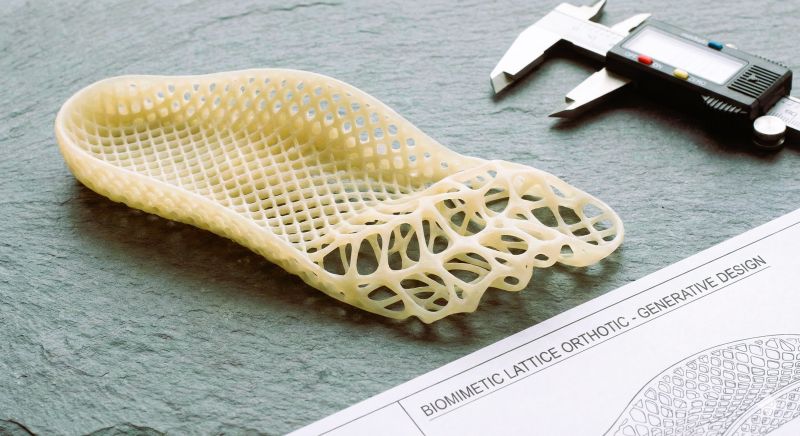
Lattice structures
Advanced printing methods allow orthotics to incorporate internal lattice designs. These structures can mimic the energy absorption properties of the heel pad and other biological tissues.
Energy storage and return
Instead of acting as a rigid barrier, lattice structures can store and release mechanical energy during gait. This behaviour more closely reflects the natural recoil of structures such as the plantar fascia.
Understanding the Biomechanics of Foot Motion
In gait analysis, clinicians often study how the ground reaction force (GRF) interacts with the foot during walking.
Traditional orthotics can sometimes shift the centre of pressure abruptly. This can alter foot motion but may also create sudden mechanical transitions during gait.
With digitally designed orthoses, clinicians can control how forces are distributed across the device. By adjusting lattice density or structural geometry, the orthotic can guide motion gradually rather than blocking it entirely.
This approach allows orthoses to function as a mechanical interface between the foot and the ground, rather than simply acting as a corrective wedge.
Technology Is Not a Substitute for Clinical Expertise
Despite the excitement surrounding digital orthotics, technology alone cannot guarantee better outcomes.
A poorly prescribed orthotic design will still perform poorly, regardless of the manufacturing method. Clinical assessment, gait analysis and patient-specific considerations remain essential.
However, additive manufacturing removes many of the technical limitations that previously restricted orthotic design.
For the first time, clinicians have tools that allow them to design devices whose internal structure can more closely match the biomechanics of the human foot.
The Future of Biomechanically Tuned Orthotics
As additive manufacturing technologies continue to advance, orthotic devices are likely to become increasingly sophisticated.
Future developments may include:
- fully personalised lattice structures
- AI-assisted orthotic design
- dynamic stiffness tuning based on patient activity levels
- integrated sensor feedback for gait monitoring
These innovations could allow orthotics to function not just as passive supports, but as carefully engineered biomechanical systems designed to work in harmony with the foot.
The shift toward digitally designed orthoses represents an important step forward in biomechanics-driven foot care—where technology finally begins to match the complexity of human anatomy.