 By
By
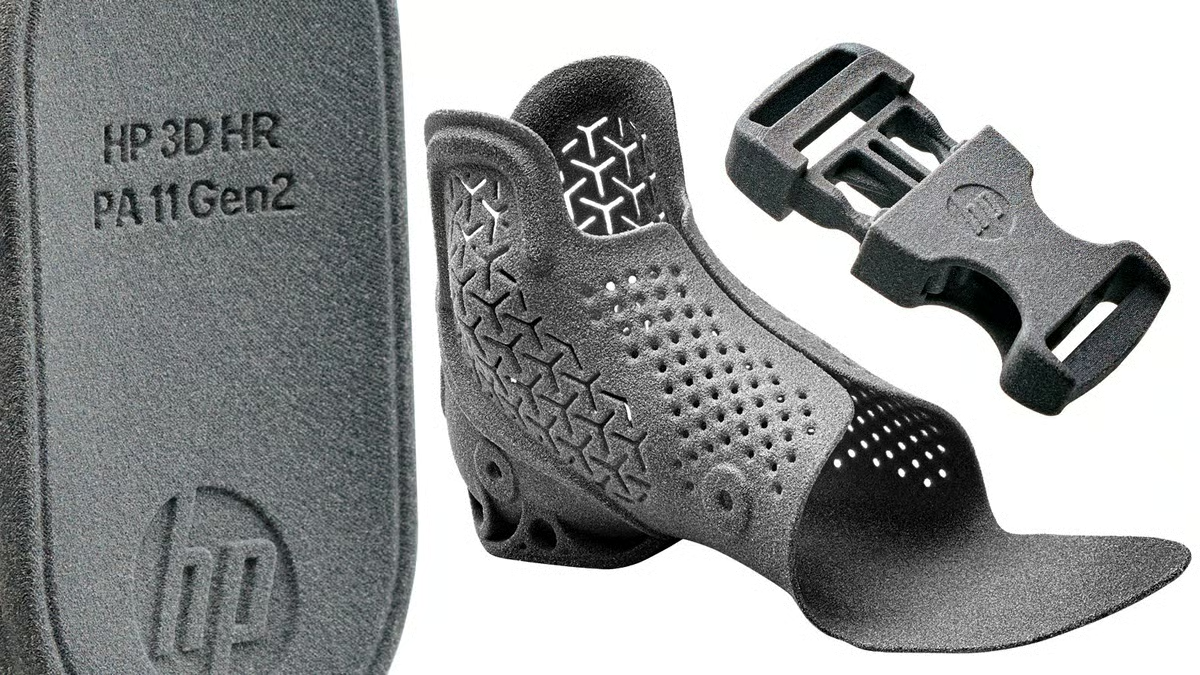
After seven years of leading HP’s 3D Printing business across India & RoAPJ, one troubling trend has become impossible to ignore: counterfeit parts being marketed as genuine HP Multi Jet Fusion (MJF) components.
While additive manufacturing has unlocked extraordinary design freedom and production efficiency, it has also created space for misrepresentation, material substitution, and false process claims — risks that can lead to premature failure, safety hazards, and catastrophic warranty exposure.
In mission-critical applications, “looks similar” is not the same as performs reliably.
The Growing Risk of Counterfeit MJF Claims
Across multiple industries — including medical devices, orthotics & prosthetics, automotive, aerospace, and industrial engineering — buyers are encountering suppliers advertising:
❌ “MJF-equivalent parts”
❌ “Printed using MJF technology” (without HP systems)
❌ Unverified PA12 materials
❌ Pricing that seems too good to be true
The consequences can include:
⚠ Unexpected mechanical failure
⚠ Poor isotropy and weak Z-axis strength
⚠ Porosity and leakage in fluid-tight parts
⚠ Dimensional inaccuracies
⚠ No material traceability
⚠ Legal and liability risks
Why HP Certification Matters
Sourcing from HP Certified Partners ensures that parts are produced using validated equipment, genuine materials, and controlled processes.
✅ Certified Production Standards Typically Include:
⚙ Genuine HP Jet Fusion Systems
• HP Jet Fusion 5600 / 5200 / 5210 platforms
🧪 Genuine HP PA12 Material
• ~48 MPa tensile strength
• Strong, near-isotropic mechanical properties
💧 Fluid-Tight Performance
• ~4.2 MPa pressure resistance
• Up to ~42 bar with no leaks (application dependent)
📏 Dimensional Accuracy
• ±0.2% typical accuracy
📑 ASTM-Validated Properties
• Tested mechanical behaviour
🔍 Material Traceability
• Batch documentation & certification
Certification protects not just part quality — but engineering reliability, regulatory compliance, and brand integrity.
HP Certified MJF Service Bureaus in India
📍 North Region
• Adroitec (NCR)
• Proto Fusion 3D (NCR)
📍 West Region
• Imaginarium (Mumbai)
• Vexma (Vadodara)
• Immaculate 3D (Mumbai)
📍 South Region
• Pranava Fusion (Hyderabad)
• Amuse3D (Chennai)
• Primaeam (Chennai)
• Proto Hubs (Bengaluru)
These partners support national and international supply capability, serving industries where precision and performance are non-negotiable.
How to Verify Your 3D Printing Supplier
Before placing production or prototype orders, perform due diligence:
✅ Ask for HP Certification
Request documented proof of HP Partner / Certified status.
✅ Demand Material Certificates
Genuine HP PA12 includes batch-level documentation.
✅ Inspect Equipment Credentials
Confirm operation of:
• HP Jet Fusion 5600
• HP Jet Fusion 5200 / 5210
✅ Request Mechanical Test Reports
Look for ASTM validation such as:
• ASTM D638 (Tensile)
• ASTM D790 (Flexural)
• ASTM D648 (Heat deflection)
✅ Check Client References
Certified partners typically have track records with Tier-1 OEMs.
Red Flags — Proceed With Caution
⚠ 40–50% cheaper pricing
⚠ No HP certification evidence
⚠ “MJF-equivalent” language
⚠ No ASTM test data
⚠ No traceability documentation
Short-term savings can translate into long-term losses.
₹50K saved on a prototype can become ₹50L in warranty claims, recalls, or liability exposure.
Certification = Risk Mitigation
For medical, structural, load-bearing, fluid-handling, and safety-critical applications, supplier validation is not optional — it is a risk management necessity.
Counterfeit or misrepresented additive parts can compromise:
• Mechanical integrity
• Patient safety
• Regulatory compliance
• Product warranties
• Brand reputation
Final Thought
As additive manufacturing matures, procurement discipline must evolve alongside it.
Mission-critical applications demand certified processes, certified materials, and certified partners.
Always verify your supplier against the HP Ecosystem / Partner Map and insist on documentation that supports performance claims.
Because in advanced manufacturing:
Authenticity is not a label — it is a measurable engineering outcome.