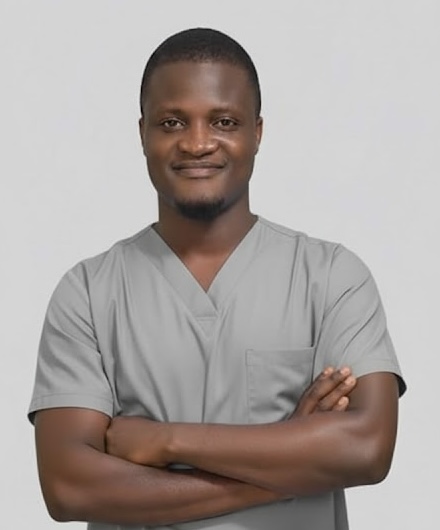
My name is Olojede Sodiq Ayinde and I live in Lagos, Nigeria, where I actively practice and contribute to rehabilitation services.
I studied Prosthetics and Orthotics as my foundational clinical
training, and I am currently advancing my expertise through an MPhil
in Exercise and Sport Science, integrating rehabilitation science with
movement and performance. I graduated in 2018.
I am the founder and practitioner at Orthosolution Prosthetics and
Orthotics Clinic, where I provide clinical care, rehabilitation
support, and device innovation tailored to local needs.
What do you claim is your speciality – your O&P passion?
My specialty lies in functional rehabilitation of lower limb
conditions, particularly:
Gait restoration in prosthetic users
Orthotic management of neurological conditions (e.g., cerebral palsy)
Integration of exercise science into prosthetic rehabilitation
I am especially passionate about bridging biomechanics, orthotic
design, and structured exercise therapy to improve real-life mobility
outcomes.
What do you like most about practicing O&P?
What I value most is the transformational impact,seeing a patient move
from dependency to functional independence.
O&P is unique because it combines:
Engineering (device design)
Clinical reasoning
Human connection
The moment a patient takes confident steps again is deeply rewarding.
What frustrates you about O&P?
The biggest frustrations are systemic, especially in low-resource
settings like Nigeria:
Limited access to quality materials and components
Financial barriers for patients
Low awareness and late referrals
Lack of structured rehabilitation systems
These challenges often limit the full potential of what O&P
interventions can achieve.
What is your greatest patient story in O&P?
One of my most impactful experiences has been working with patients
who initially had severely compromised gait or mobility, and through a
combination of:
Proper prosthetic/orthotic prescription
Structured rehabilitation
Patient education
…were able to regain functional independence and confidence.
For me, the “greatest” stories are not just about walking again—but
about patients returning to work, school, or sport, reclaiming their
identity and purpose.
How do you build rapport with patients in your care?
I build rapport through a patient-centered and education-driven approach:
Active listening – understanding their fears, expectations, and lifestyle
Clear communication – simplifying clinical concepts so they feel involved
Empathy and trust – treating each patient as a partner, not just a case
Goal alignment – focusing on what matters most to them (not just
clinical outcomes)
I also ensure that patients see progress, even in small steps, which
strengthens trust and motivation.
 By
The Editor
By
The Editor