 By
By
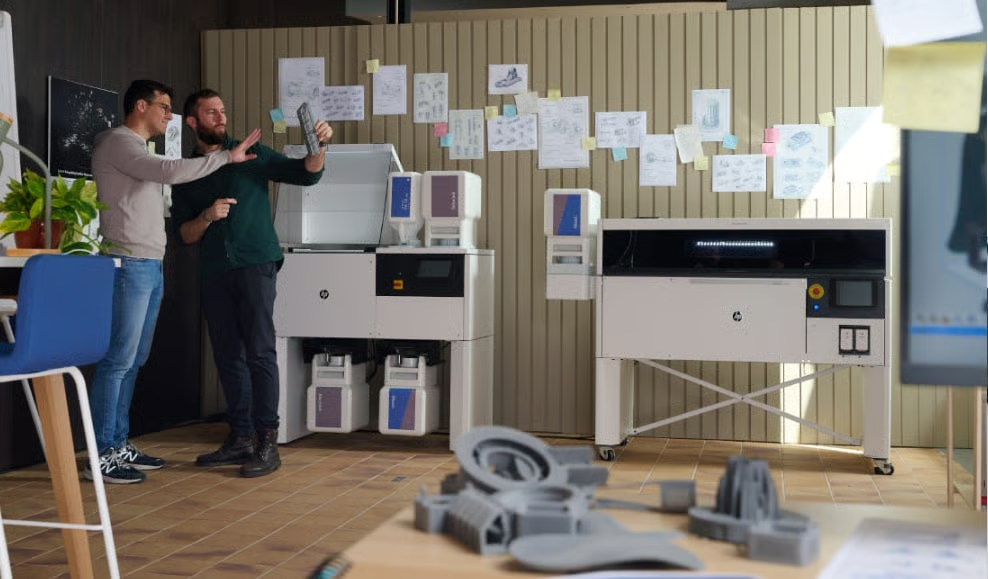
HP has introduced the HP Multi Jet Fusion 1200 3D Printer Solution, a new compact system designed to bring the company’s industrial Multi Jet Fusion (MJF) technology into smaller workshops, engineering teams, and design environments. The launch was highlighted by All3DP on April 14, 2026, and confirmed in HP’s own announcement, which describes the machine as a more compact and affordable entry point into the MJF ecosystem.
According to HP, the new system is intended to deliver the same core MJF process used across its wider additive manufacturing portfolio, but in a footprint and price range better suited to smaller spaces and earlier-stage adoption. HP says the printer has a 12-litre build volume, a sub-12-hour print time, and launches at under $60,000, with HP 3D HR PA 12 by Evonik as its initial material offering and up to 80% reusability.
That combination matters because HP is clearly trying to reposition MJF as something more accessible than a large industrial production platform alone. All3DP described the MJF 1200 as smaller, faster, and cheaper, while HP’s own messaging frames it as a way to bring industrial-grade polymer printing into “every workspace.” This suggests a deliberate move toward design studios, prototyping labs, education-linked workshops, and small manufacturing teams that may have wanted MJF capability before but found existing systems too large or too expensive.
A broader push, not just one new machine
The launch is also part of a wider HP additive manufacturing push. In the same announcement, HP said it was marking 10 years of additive manufacturing innovation, while also unveiling productivity improvements for the Jet Fusion 5600 series and broader availability for its Industrial Filament 3D Printer 600 High Temperature in the U.S. and Canada. That makes the MJF 1200 look less like a standalone experiment and more like a deliberate expansion of HP’s additive portfolio downwards into more compact, adoption-oriented environments.
All3DP also noted that HP is pairing the hardware story with a new 3D printing portal powered by Craftcloud, aimed at giving users access to MJF parts even if they do not yet own a machine. That is an important commercial signal. It suggests HP is trying to lower the barrier to entry in two ways at once: through a lower-cost printer for buyers who want in-house capability, and through an on-demand route for those who want to test the workflow first.
Why this matters for O&P and healthcare-focused fabrication
For IMEA CPO readers, the most relevant question is not whether HP has made MJF smaller. It is what a compact MJF system could mean for orthotics, prosthetics, insoles, and other customized medical fabrication workflows.
HP’s press release says the company is already collaborating with innovators in several segments, including healthcare, to explore how the new printer could strengthen existing workflows. HP specifically quotes Mecuris, which says it is excited to bring the technology into the medical industry as a beta tester. That matters because MJF has already established a reputation in healthcare-adjacent applications for strong polymer parts, consistent surface quality, and a cleaner production feel than many entry-level filament workflows.
This does not automatically mean the MJF 1200 will become an O&P clinic printer. Powder-bed polymer systems still come with material-handling, post-processing, and workflow requirements that are different from simpler desktop systems. But a smaller-format, lower-cost MJF machine could be relevant for service bureaus, central fabrication labs, university-based rehab engineering teams, and better-equipped specialist workshops looking for more industrial consistency without stepping into the largest HP systems. That is an inference, but it is well supported by HP’s own effort to position the MJF 1200 as a compact industrial solution rather than a hobby or consumer machine.
Where it may fit best
The strongest immediate fit for the MJF 1200 appears to be in functional prototyping, short-run production, engineering validation, and small-batch end-use parts. HP says the solution is intended to help teams produce strong, functional polymer parts suitable for real-world applications, while alpha and beta users cited by HP emphasize validating designs without changing existing workflows.
For O&P and rehab technology markets, that could make the machine most interesting for:
- component development and iterative prototyping
- custom tooling and jigs
- selected orthotic or prosthetic accessories
- trial parts where strength and repeatability matter
- research and innovation environments exploring patient-specific applications
That final application list is an inference, but it follows from HP’s stated target users, the material platform, and the historical use cases of MJF in healthcare and engineering contexts.
The bigger strategic takeaway
The launch of the MJF 1200 signals that industrial polymer additive manufacturing is continuing to move downstream from large centralized production settings into more compact and adoption-friendly environments. That shift matters because it narrows the gap between high-end industrial additive manufacturing and the kinds of spaces where smaller teams actually work. HP is not presenting this as a consumer device. It is still clearly an industrial tool. But it is one aimed at making industrial capability more reachable.
For IMEA CPO readers, that makes the MJF 1200 worth watching. The machine may not be the right fit for every clinic or workshop, but it adds another option to the growing middle ground between basic desktop printing and large production-scale additive systems. In digital fabrication, that middle ground is becoming increasingly important.