 By
By
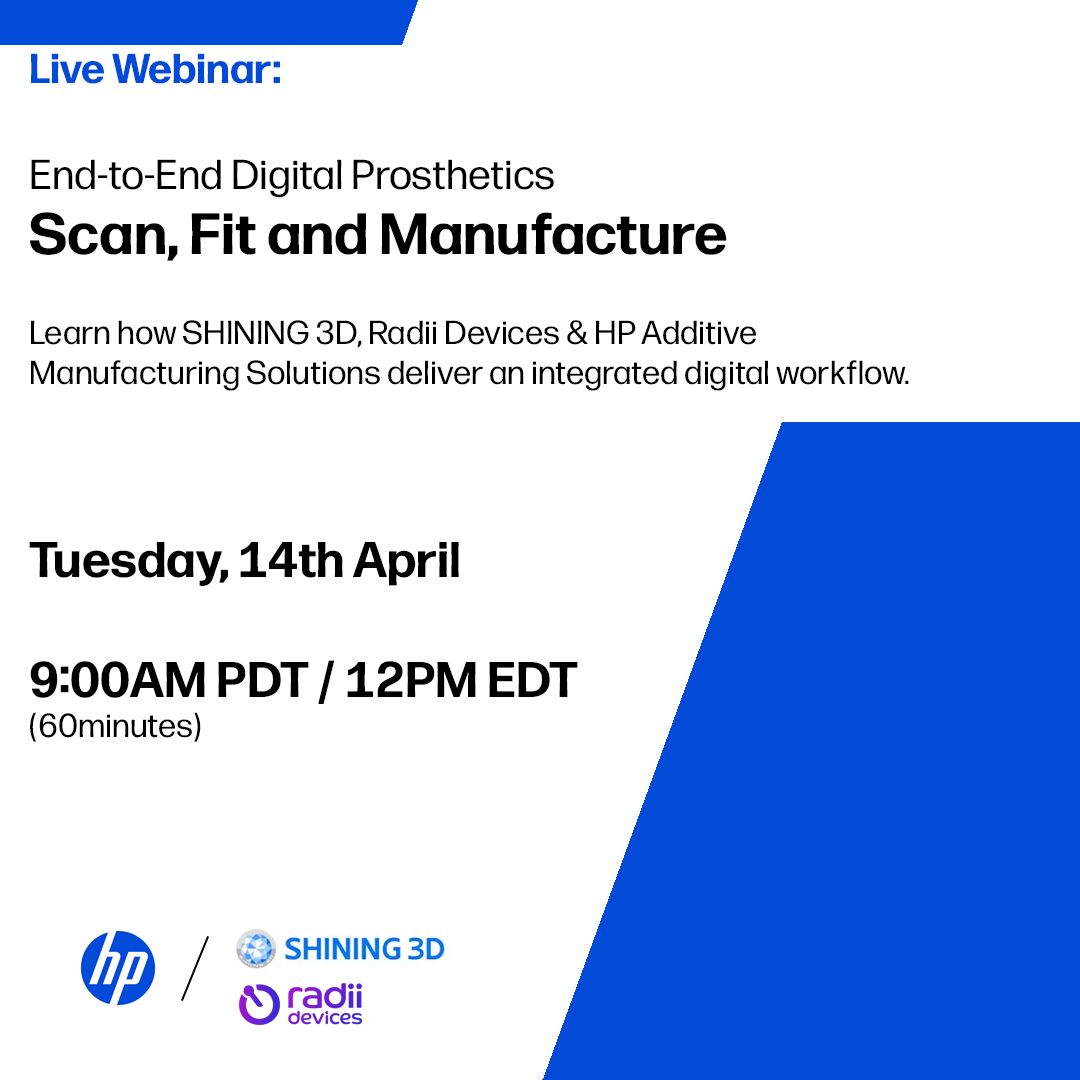
A new live webinar on 14 April will examine how clinics and laboratories can build a more connected digital prosthetics workflow, bringing together 3D scanning, digital socket modification, and additive manufacturing into one practical process.
Hosted with Radii Devices and SHINING 3D, the session will focus on what an end-to-end digital prosthetics workflow looks like in real-world use, rather than as a purely theoretical digital concept. For many orthotics and prosthetics providers, digital tools are already entering daily practice. However, in many settings those tools still operate as isolated steps rather than as part of one consistent system.
That disconnect can have a direct impact on workflow efficiency, reproducibility, and the overall patient experience.
The webinar aims to show how clinicians and technical teams can move beyond separate digital stages and toward a more integrated model, where data capture, digital modification, and manufacturing are aligned from the start of the process through to final delivery.
According to the event outline, the session will cover:
- 3D scanning for precise data capture
- digital socket modification using riiForm
- additive manufacturing for accurate, scalable production
The broader value of the session lies in how these technologies are presented together. Rather than looking at scanning, design, and manufacturing as separate innovations, the webinar will highlight how they can function as one connected workflow, helping clinics and labs improve consistency while creating a more practical route to scale.
For O&P providers across the IMEA region, that question is becoming increasingly important. Many clinics have already begun exploring digital shape capture, CAD-based rectification, and 3D printing. The next challenge is not simply adopting more technology, but connecting those technologies in a way that is repeatable, clinically useful, and commercially realistic.
A workflow that moves smoothly from scan to fit to final part has the potential to reduce inefficiencies, improve reproducibility, and support better service delivery across both established clinics and growing laboratories. In markets where workforce time, production consistency, and access to specialist expertise can all be under pressure, a more integrated digital pathway may offer meaningful advantages.
The webinar will also look at examples of how professionals are already using connected digital systems to improve day-to-day prosthetics workflows.
The session takes place on 14 April at 9:00 am PDT / 12:00 pm EDT.
Registration is open, although places are limited.
Register here: Secure your place
Event date and time:
14 April
9:00 am PDT | 12:00 pm EDT
Suggested hyperlinks: