 By
By
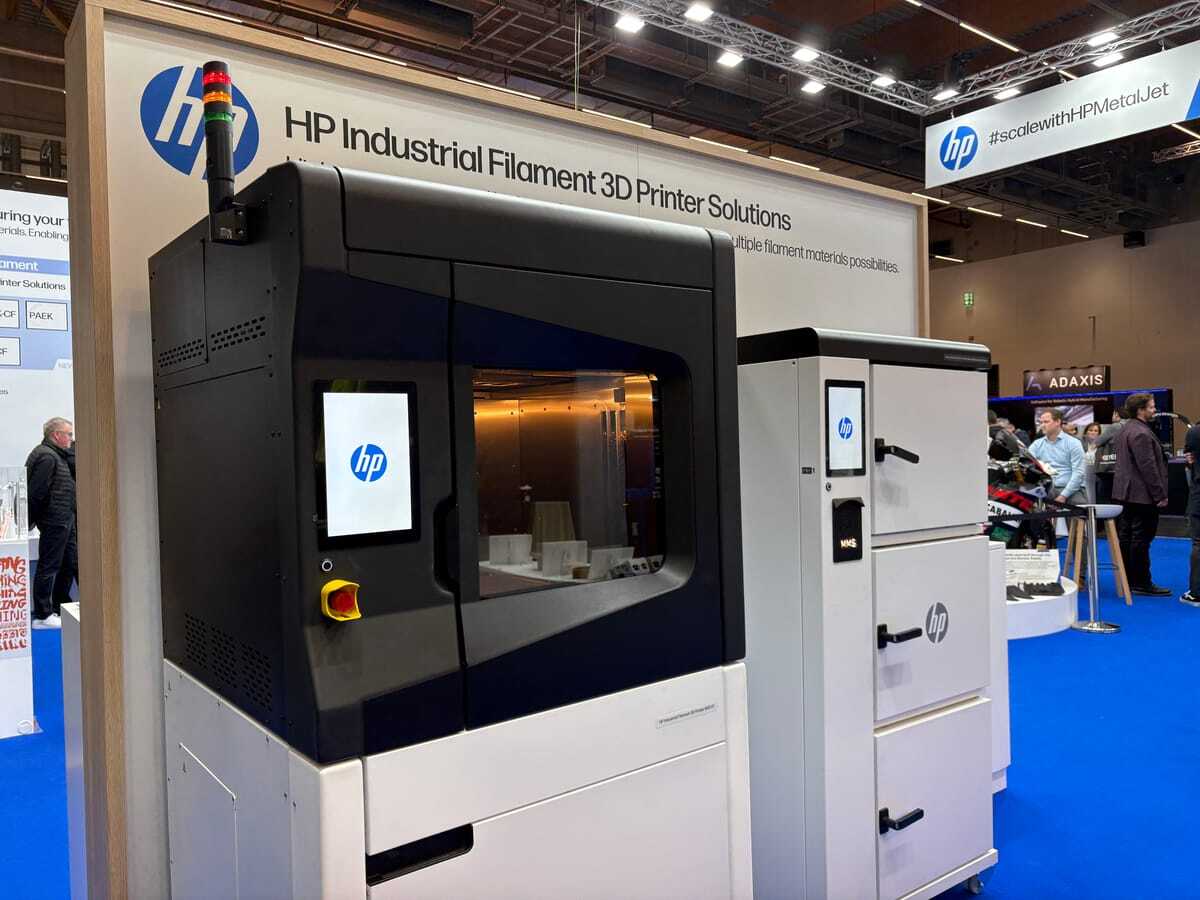
HP used AMUG 2026 in Reno, Nevada, to give North American audiences a closer look at its new HP Industrial Filament 600 High Temperature (HP IF 600HT), a platform that signals a broader push beyond HP’s established Multi Jet Fusion ecosystem and into high-performance industrial filament printing. HP first introduced the system at Formnext 2025 and positioned it as part of a wider portfolio expansion into applications that need tougher materials, more flexibility, and a lower barrier to entry than some powder-based systems.
What makes this machine notable is not simply that HP has launched another printer. It is that the company is entering the industrial filament segment with an open materials platform, a modular printhead approach, and a focus on engineering-grade and high-temperature polymers. According to HP, the IF 600HT is designed for continuous industrial use and supports interchangeable modules for different material families, with temperature capability scaling from 280°C to 360°C and up to 500°C for advanced polymers such as PEEK and PAEK. HP also highlights support for materials including ABS, PC, PEI, PA-CF, PEEK, and PEEK-CF.
That combination matters because it pushes filament printing further into territory that has traditionally been associated with more specialised and more expensive industrial systems. HP says the platform is intended for sectors such as aerospace, oil and gas, medical, automotive, railway, and education, where users are looking for validated, production-capable workflows rather than basic prototyping. 3DPrint.com reported that HP is also pairing the system with a Material Management System designed to automate drying and conditioning, support traceability, and provide post-annealing for high-performance materials. HP’s own product page says that system is intended to improve consistency and strengthen part properties for materials such as PEEK and PAEK.
For the orthotics and prosthetics sector, the most interesting takeaway is the potential expansion of viable material choices. HP’s Multi Jet Fusion systems have been highly relevant in O&P for selected applications, but the material set has always shaped what can realistically be produced. The new filament platform appears aimed at opening access to a wider range of engineering and high-temperature polymers, which could be significant for components or devices where strength, thermal performance, chemical resistance, or fibre reinforcement matter. 3DPrint.com’s report from AMUG noted HP’s interest in medical applications and referenced work with medical companies exploring uses such as spinal implants and ankle wedges. The article also suggested HP sees further potential in prosthetics because of the broader material range now available.
That does not automatically mean the platform will become a mainstream O&P production tool overnight. High-temperature filament systems still need to prove themselves on repeatability, validation, workflow simplicity, and total cost of ownership in clinical manufacturing settings. But HP’s move is important because it gives the industrial filament category a much larger commercial profile. It also reflects a wider trend across additive manufacturing: more users want production-ready filament systems that offer open material access without giving up traceability, reliability, or service support. HP explicitly says the new industrial filament line is meant to help customers lower cost per part and accelerate time to market, while still benefiting from HP’s broader service network.
Another point worth watching is HP’s market positioning. 3DPrint.com reported that HP sees the platform as differentiated by a relatively lower acquisition cost, lower filament cost, and its open-system approach. The publication also reported that the platform is powered by a 3DGence engine but has been further modified by HP. If that positioning holds up in real-world adoption, HP could appeal to manufacturers who want industrial-grade performance without locking themselves into a closed materials environment.
The timing is also notable. HP said at Formnext 2025 that the HP IF 600HT would be available in H1 2026, with a second system, the HP IF 1000 XL, planned for H2 2026 and aimed at larger parts. That suggests HP is not treating this as a one-off product launch, but as the beginning of a larger industrial filament portfolio. For manufacturers in O&P and adjacent medical sectors, that could mean a broader future ecosystem that spans high-temperature parts, larger-format production, and more application-specific material development.
The bigger story, then, is not just that HP showed a new machine at AMUG. It is that one of the biggest names in industrial additive manufacturing is now putting serious weight behind open, high-temperature filament printing. For clinicians, technicians, and digital fabrication teams in orthotics and prosthetics, that is worth watching closely. If the platform delivers the reliability and workflow control HP is promising, it could help expand the range of patient-specific and production-grade applications that are practical to manufacture in-house or through specialist partners.
Suggested hyperlinks: