 By
By
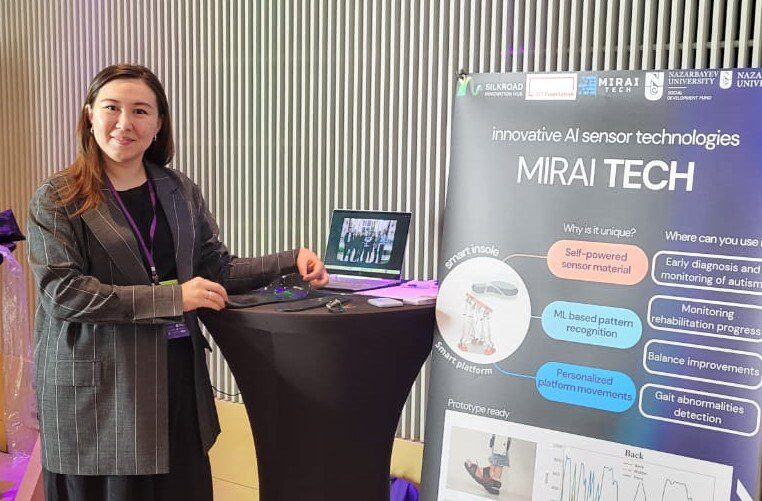
A Kazakhstan-based startup is developing smart sensor insoles designed to analyse movement biomechanics in real time, with potential applications across sport, rehabilitation, and patient monitoring. According to El.kz, the company, Mirai Tech, was co-founded by scientist and entrepreneur Gulnur Kalimuldina and is working on sensor-based insoles and wearable systems that can detect movement patterns and flag injury risks before they become more serious.
The story is notable not just because it involves another wearable device, but because it reflects a broader push to turn advanced academic research in biomechanics and sensing into practical healthcare and performance tools. El.kz reported that Mirai Tech received two awards at Digital Bridge 2025 in Astana, including the AI Sana Generative Nation Award for best scientific AI project and the MA7 Award at the Astana Hub Battle.
According to Astana Hub, the technology grew out of research into materials capable of generating electricity through motion. That work evolved into “smart” nano-insoles built around sensor systems that respond to movement, pressure, and load distribution. Astana Hub says the insoles are being tested by football clubs in Kazakhstan and that the startup has already secured its first $90,000 in investment.
What makes the concept especially interesting for rehabilitation and orthotic audiences is its potential to generate useful movement data quickly. In Astana Hub’s interview, Kalimuldina said the insole can collect more than 20,000 data points in two minutes, producing a digital profile of how a person walks, runs, or loads the foot. The company says this kind of data can help reveal asymmetry, overload, and abnormal weight transfer patterns that may otherwise be missed until injury risk becomes more obvious.
That direction also appears to be supported by related academic work connected to Nazarbayev University. A published research summary from the Institute of Smart Systems and Artificial Intelligence describes an AI-enhanced gait analysis insole using self-powered triboelectric sensors to help detect flatfoot. The study used 100 participants and reported 82% overall accuracy, suggesting that insole-based sensing may have practical value not only in sport but also in orthopaedic screening and rehabilitation pathways.
For the orthotics and prosthetics sector, the real significance lies in where these systems could go next. Smart insoles are not new as a category, but combining gait data, sensor-based monitoring, and machine learning in a form factor that can potentially be used in clinics, rehab settings, or high-performance sport could open up new options for assessment and follow-up. That is especially relevant in areas such as gait asymmetry monitoring, post-injury rehabilitation, diabetic foot risk tracking, paediatric movement analysis, and orthotic outcome measurement. This is an inference based on the capabilities described by Mirai Tech and the related flatfoot-detection research, rather than a claim that the company has already validated all of these applications.
Mirai Tech now appears to be positioning the product less as a single gadget and more as part of a broader sports analytics platform. El.kz says the team is aiming to build a system for deeper biomechanical analysis that could be useful for doctors, coaches, and sports federations. That kind of positioning matters because the long-term value in smart wearable systems often lies not just in the sensor itself, but in the software layer, workflow integration, and usefulness of the resulting data.
For IMEA CPO readers, the story is worth watching because it shows how sensor-based wearables are continuing to move closer to practical clinical and performance use. Whether this kind of technology ultimately finds its strongest foothold in elite sport, rehabilitation, orthopaedic screening, or broader patient monitoring, it points to a future in which insoles are not only passive interfaces inside footwear, but active sources of movement intelligence. That final point is an inference, but it is consistent with both the startup’s stated direction and the linked academic research.