 By
By
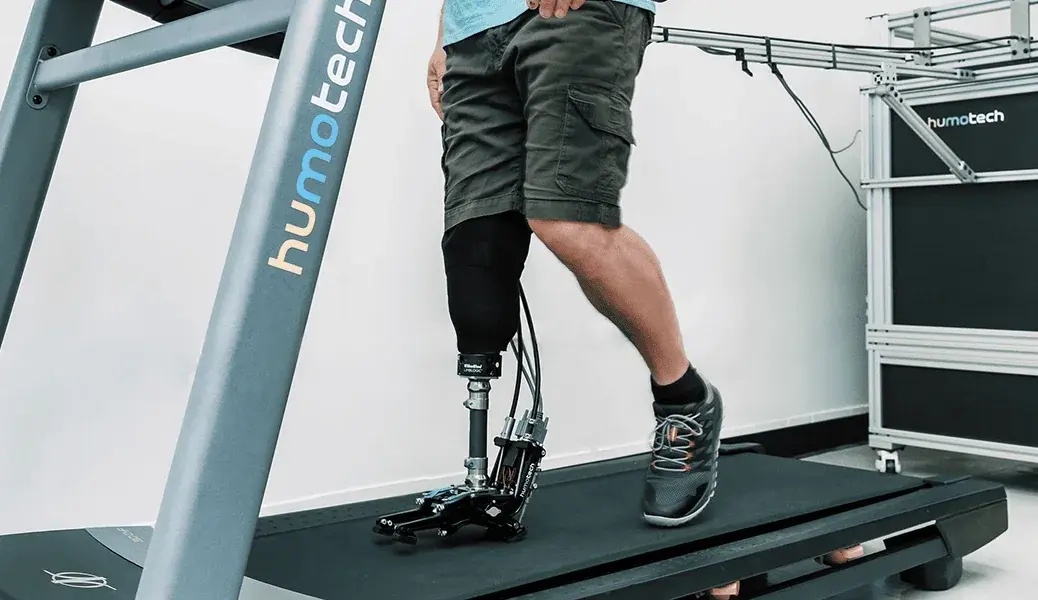
Pittsburgh-based medtech company Humotech is preparing to bring a new prosthetic foot selection model into clinical care, one that lets patients walk on a device that emulates different commercial feet in real time before making a final choice. Local station WTAE reported on April 6 that the company plans to launch its first mobile clinic this summer, following years of research and clinical studies.
The core idea is simple but potentially significant. Instead of selecting a prosthetic foot largely on the basis of clinician experience, product literature, and limited trial opportunities, Humotech’s system allows users to test-drive multiple foot behaviors during one session. Founder Josh Caputo told WTAE that the goal is not to build yet another prosthetic foot, but to create “technologies, solutions, workflows” that improve data-driven decision-making in prosthetic prescription.
Humotech compares the experience to getting prescription glasses. On its clinical page, the company says its Caplex® System lets providers emulate selected prosthetic feet on site, while the patient walks and the team records experiential data and patient preference across foot models. The company says the process is intended to support personalized selection, data-driven justification, and clearer evidence for medical necessity and reimbursement.
That matters because prosthetic foot selection remains one of the most difficult and expensive parts of lower-limb care. WTAE highlighted the experience of amputee Christina Kenney, who said she has gone through around 10 different prosthetic setups over the years and described how difficult it can be to access or compare different component options. In many systems, trying multiple feet in a meaningful way is slow, costly, and limited by what can actually be ordered, fit, and tested.
Humotech’s own case-study material argues that emulation can reduce that bottleneck by allowing rapid comparison without ordering and fitting every possible physical foot. The company says Caplex is programmed to mimic the mechanics of clinically available prosthetic feet, so patients can trial options more quickly and economically than if each actual foot had to be supplied for testing. That company material also says the system is currently available for investigational use only, which is an important qualifier at this stage.
The concept is not entirely new inside research settings. Humotech has long positioned itself as a wearable robotics company building prosthesis and exoskeleton emulator systems for research and development, and Ansys previously described the company as developing clinical applications of the prosthetic foot emulator in partnership with VA and DoD researchers. WTAE likewise reported that the company’s clinical preparation includes work with Veterans Affairs and that it is now in its fourth clinical study.
There is also a growing research base behind the broader “test-drive” approach. Humotech’s research library points to a 2025 Archives of Physical Medicine and Rehabilitation paper titled “A Novel ‘Test-Drive’ Strategy for Prosthetic Foot Prescription Using a Robotic Prosthetic Foot Emulator,” along with a 2025 PLOS One trial protocol on prosthetic foot stiffness, preference, stability, and satisfaction. Those references suggest the company is trying to move the idea from engineering demonstration toward clinically defensible prescription workflows.
For IMEA CPO readers, the most interesting part is not the robotics itself but the prescription model. In many prosthetic markets, the process of choosing a foot still depends heavily on clinician judgement, limited inventory, reimbursement constraints, and incomplete patient trialing. A system that allows structured comparison of different foot behaviors could help make prescription more transparent, more personalized, and potentially easier to justify to payors. That is an inference, but it is strongly supported by Humotech’s own clinical positioning and the way the company describes its value proposition.
That said, the bigger question is adoption. The idea will need to prove that it fits real clinic workflows, produces actionable information, and improves outcomes enough to justify the extra step. It will also need to show whether providers and payors accept emulator-generated trial data as meaningful evidence in prescription and reimbursement decisions. WTAE’s report suggests Humotech believes that moment is getting closer, but the company is still moving from research into clinical translation rather than operating at full routine scale today.
Why this matters
Humotech’s approach is worth watching because it shifts the conversation from which prosthetic foot is best in general to which prosthetic foot is best for this specific patient. If that model works in practice, it could help move prosthetic foot selection toward a more patient-centered and evidence-based process, closer to a guided fitting experience than a one-shot prescription decision.