

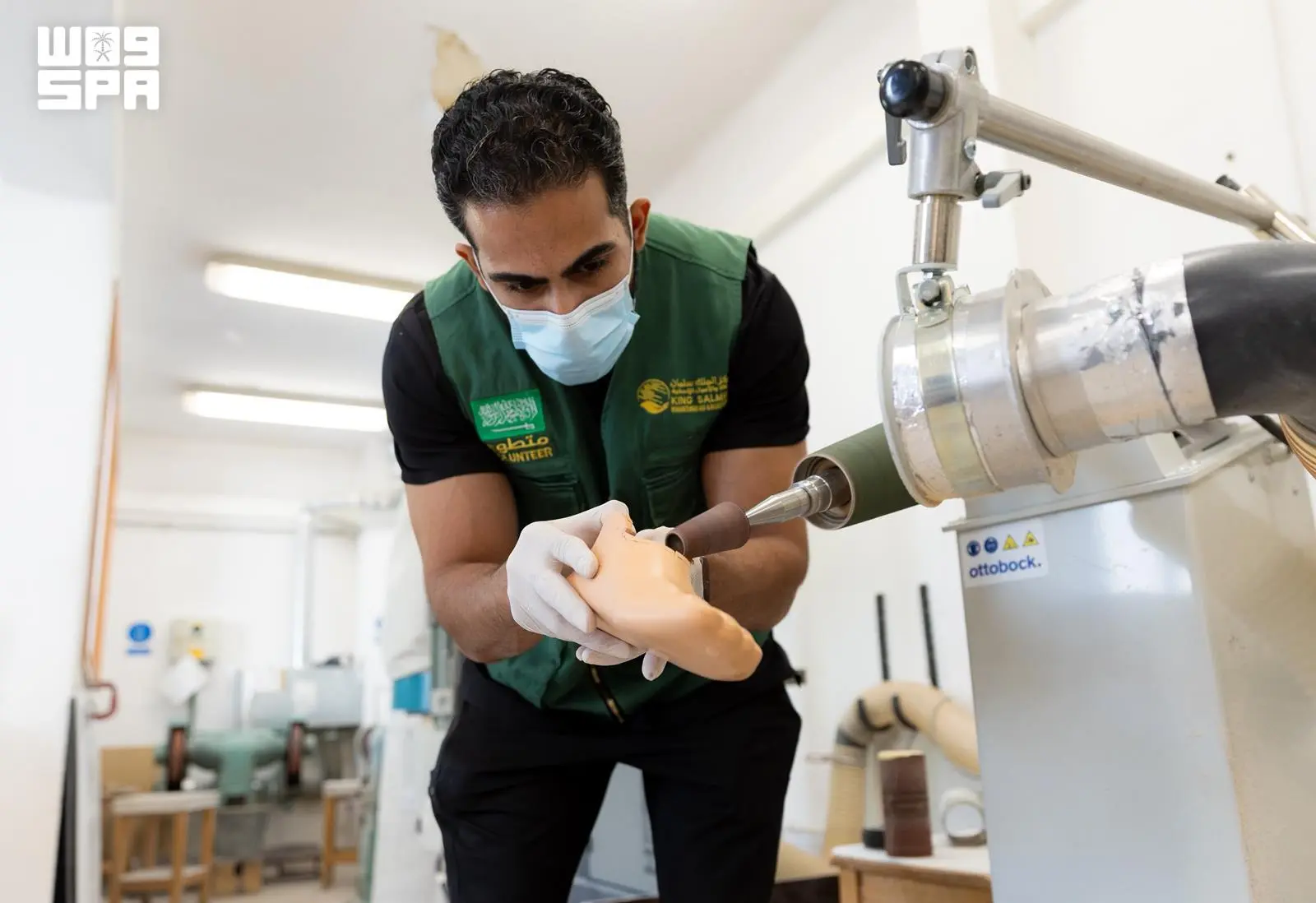
The King Salman Humanitarian Aid and Relief Centre has launched a new volunteer medical project providing prosthetic limbs to people receiving rehabilitation in Budapest, Hungary.
The project is taking place from July 20 to 26, 2026, with a team of seven volunteers participating in the assessment, fitting and rehabilitation process. It forms part of Saudi Arabia’s growing international programme of medical volunteering and prosthetic support for people affected by conflict and limb loss.
The Budapest initiative follows an earlier KSrelief mission held in the Hungarian capital from June 22 to 29. During that campaign, the organisation’s medical team fitted prosthetic limbs for 20 people.
Hungarian reporting indicates that the wider cooperation between KSrelief and Budapest-based rehabilitation provider GYSGY REHA is intended to serve Ukrainian patients waiting for artificial limbs. The programme reportedly aims to support as many as 100 patients, with approximately 20 included in its initial phase.
Supporting Ukrainians displaced by war
The war in Ukraine has created a substantial population requiring complex trauma surgery, prosthetic limbs and long-term rehabilitation.
Some patients have been treated inside Ukraine, while others have travelled through international medical evacuation and humanitarian referral programmes to specialist facilities elsewhere in Europe.
For people with amputations, crossing a border for treatment can provide access to:
- Residual-limb assessment
- Revision or reconstructive surgery
- Prosthetic socket fabrication
- Component selection and assembly
- Gait and mobility training
- Physiotherapy
- Pain management
- Psychological support
However, overseas treatment also creates challenges involving language, clinical records, component maintenance and continuity of care when the person returns home.
The Budapest project therefore needs to be understood not simply as the delivery of artificial limbs, but as one stage in a much longer rehabilitation pathway.
A second mission suggests continuing demand
The new July mission follows only weeks after the completion of KSrelief’s June programme in Budapest.
That rapid return suggests both sustained demand and an intention to develop the work beyond a one-off fitting camp.
High-volume international missions can reduce waiting lists, particularly when receiving clinics already have patients assessed and prepared before the visiting team arrives.
Effective planning may involve:
- Confirming that wounds are healed
- Reviewing surgical and medical records
- Identifying amputation levels
- Ordering suitable components
- Preparing workshop materials
- Coordinating interpreters
- Scheduling fittings and therapy
- Arranging future reviews
Without this preparation, much of a short mission can be lost to administrative or logistical delays.
The involvement of an established Hungarian rehabilitation partner provides local infrastructure and creates a possible route for adjustments after KSrelief’s volunteers leave.
Prosthetic fitting requires more than supplying a limb
A prosthesis must be individually prescribed and fitted.
The socket—the part connecting the person’s residual limb to the device—is especially important. Poor socket fit can cause pain, skin damage, instability and reduced wearing time even when advanced components are used.
A complete fitting pathway should include:
- Clinical and functional assessment
- Measurement or digital shape capture
- Socket manufacture
- Trial fitting
- Static and dynamic alignment
- Gait or functional training
- Patient education
- Follow-up and adjustment
Patients may also require treatment for phantom-limb pain, contractures, weakness or psychological trauma.
The success of the Budapest programme should therefore be measured through comfort, mobility and sustained use rather than the number of limbs delivered alone.
Conflict-related amputations can be clinically complex
People injured by explosions, missiles and other weapons may present with more complex residual limbs than patients undergoing planned amputations.
Possible complications include:
- Extensive scar tissue
- Nerve damage
- Bone prominence
- Infection
- Soft-tissue loss
- Burns
- Multiple injuries
- Bilateral amputation
- Damage to vision or hearing
- Post-traumatic stress
Some patients require further surgery before a durable prosthetic fitting is possible.
Others may initially need a preparatory prosthesis while their residual limb continues to change in shape and volume.
Visiting teams must therefore work closely with local surgeons, physiotherapists and rehabilitation physicians rather than approaching every patient through a standardised fitting process.
Saudi Arabia expands its international prosthetic activity
KSrelief has become increasingly active in prosthetic and rehabilitation programmes both within the Middle East and internationally.
The organisation operates or supports artificial-limb centres in Yemen, where conflict, landmines and explosive remnants have created sustained demand for prosthetic services.
Its artificial-limb programme describes the provision of prosthetic devices and rehabilitative care to people who have experienced amputations, particularly within conflict-affected populations.
In May 2026, a KSrelief-supported centre in Marib delivered 1,559 prosthetic, physiotherapy and specialist services to 497 beneficiaries. Eighty per cent of those receiving care were displaced people.
The organisation has also extended its volunteer fitting model into Europe. In July, a KSrelief team fitted prostheses for 21 Ukrainian beneficiaries during a mission in Rzeszów, Poland.
These projects indicate that Saudi humanitarian rehabilitation is expanding beyond permanent centres in conflict-affected Arab countries towards mobile and international partnerships.
Hungary can provide a stable rehabilitation base
Budapest offers a comparatively stable clinical environment in which Ukrainian patients can receive assessment, fitting and therapy away from active hostilities.
A specialist rehabilitation facility can provide advantages that are difficult to maintain in an emergency setting, including:
- Reliable electricity and workshop access
- Safe accommodation
- Component inventory
- Experienced clinical personnel
- Physiotherapy facilities
- Repeated fitting appointments
- Structured documentation
- Access to medical referral
Yet overseas fitting should be planned around the patient’s eventual living environment.
A prosthesis used successfully in a Budapest clinic must also function in Ukraine, where the user may encounter damaged pavements, stairs, winter weather, disrupted transport and limited access to repairs.
Component selection should therefore consider durability and future availability as well as clinical performance.
Continuity must extend across borders
When a patient receives a prosthesis in another country, complete information should accompany the device.
This should include:
- Amputation level and clinical history
- Socket design and materials
- Liner type and size
- Knee, foot or upper-limb component details
- Alignment records
- Warranty information
- Maintenance instructions
- Recommended review dates
- Contact information for the fitting centre
Digital copies can be valuable if paper records are lost during travel or displacement.
The Budapest provider and KSrelief should also identify who will manage repairs and replacements after the beneficiary leaves Hungary.
A proprietary component may become unusable if the patient cannot locate a compatible technician or replacement part at home.
Training can increase the programme’s legacy
The presence of international volunteers provides an opportunity for professional exchange as well as direct service delivery.
Saudi, Hungarian and Ukrainian clinicians could share experience in:
- Blast-related amputation
- Complex socket fitting
- Bilateral prosthetic rehabilitation
- Paediatric care
- Digital shape capture
- Psychological support
- Outcome measurement
- Humanitarian service coordination
Including Ukrainian prosthetists and therapists wherever possible would strengthen continuity when patients return.
The most sustainable humanitarian programmes do not merely deliver devices. They transfer knowledge, build clinical relationships and improve the capacity of professionals who remain with the patient.
Patient choice should remain central
Humanitarian urgency should not reduce the role of the patient in clinical decisions.
Each person should understand:
- What type of prosthesis is being proposed
- What activities it is designed to support
- Its limitations
- How to use and maintain it
- Whether alternatives are available
- Where future care can be obtained
Some patients may prioritise stability, while others require water resistance, workplace durability or the ability to cover longer distances.
A young, active trauma survivor may have very different goals from an older person with other health conditions.
The correct prescription is the one suited to the individual—not necessarily the most advanced or expensive option available.
Outcomes should be followed after the mission
A short fitting mission can record how many people received devices, but that figure does not show whether the prostheses remained comfortable or useful.
Longer-term evaluation should examine:
- Daily wearing time
- Socket comfort
- Skin condition
- Walking ability
- Falls and confidence
- Return to work or education
- Frequency of repairs
- Patient satisfaction
- Access to follow-up
- Need for replacement sockets
These data can help KSrelief and its partners improve future missions in Hungary, Poland and other countries.
They may also demonstrate whether temporary international programmes can create sustained mobility rather than only immediate device delivery.
A growing Saudi role in global rehabilitation
The Budapest project reflects the increasingly international character of Saudi Arabia’s humanitarian rehabilitation work.
KSrelief’s experience in Yemen has shown the need for sustained prosthetic provision, physiotherapy and follow-up in countries affected by war. Its newer missions in Hungary and Poland apply elements of that experience to Ukrainian patients receiving care in Europe.
The model offers considerable potential, but its long-term value will depend on continuity.
A prosthesis can be fitted within days. The patient may require clinical support for decades.
By connecting volunteer missions with permanent rehabilitation providers, complete patient records and cross-border follow-up, KSrelief can ensure that its assistance extends beyond the fitting appointment.
For Ukrainians receiving care in Budapest, the objective is not simply to leave with an artificial limb. It is to regain safe, comfortable and sustainable mobility.
- Saudi Press Agency – KSrelief implements prosthetics medical project in Hungary
- KSrelief – Prosthetic-limb project in Budapest
- KSrelief Artificial Limbs Programme
- KSrelief
- World Health Organization – Rehabilitation
- International Society for Prosthetics and Orthotics
- International Committee of the Red Cross – Physical rehabilitation