

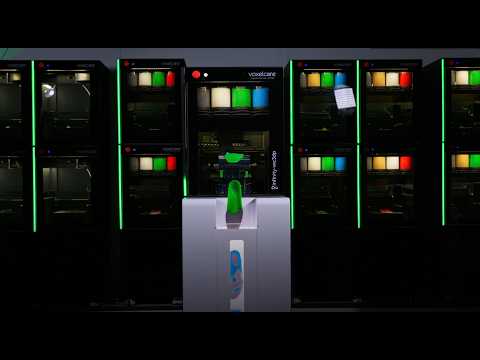
Slovakian orthopaedic and prosthetic equipment provider Reha-Care has expanded its custom-insole operation from manual manufacturing to an increasingly automated digital production system developed with Voxelcare.
The company began its partnership with Voxelcare in 2022, initially introducing four filament-based 3D-printing units and a connected workflow covering patient measurement, foot scanning, digital design, order management and insole production.
Reha-Care has now upgraded three of its printers with Voxelcare’s Automation Module, allowing production to continue between printing cycles with less operator intervention and creating the possibility of operating for up to 24 hours a day.
Moving directly from manual production to 3D printing
Reha-Care has manufactured and distributed orthopaedic, prosthetic and mobility equipment across Slovakia for more than 15 years.
Its portfolio includes wheelchairs, beds and lifting equipment, alongside individually manufactured products such as orthopaedic footwear and custom insoles.
Before beginning its work with Voxelcare, the company was not using CAD/CAM technology in its production process. Rather than introducing a conventional milling system as its first digital manufacturing investment, Reha-Care decided to move directly into 3D printing.
The company said its objective was to introduce a new manufacturing approach to the Slovakian market while creating a more connected and scalable production model.
Integrated workflow supports multiple locations
A key factor in Reha-Care’s selection of Voxelcare was the availability of an end-to-end digital system rather than a standalone printer.
The workflow connects:
- Patient measurement
- Digital foot scanning
- Custom insole design
- Order and production management
- 3D printing
- Production tracking and delivery
Once a patient’s foot has been scanned, the data can be uploaded to Voxelcare’s cloud-based platform. Reha-Care’s production specialists can then access and process the order from another location.
This has been particularly relevant for the company because its clinical and production teams work across different parts of Slovakia.
The connected system also allows staff to monitor each order from the initial scan and design stages through manufacturing and final delivery.
Shorter production and delivery times
According to the case study published by Voxelcare, the digital workflow has reduced the time required to manufacture individual products and shortened delivery times by several days.
Digitising the process allows production work to begin soon after the patient assessment, without requiring physical casts, impression boxes or paper-based order information to be transported between locations.
Reha-Care also reported improvements in the quality and level of customisation available within its finished insoles.
Voxelcare’s design software includes different modules that can be applied according to the patient’s foot condition, diagnosis and prescription requirements. This gives production specialists greater flexibility when modifying the geometry and functional characteristics of an orthosis.
Production growth created a capacity challenge
As Reha-Care’s digital insole activity expanded, its original 3D-printing set-up began to approach its production limits.
The workflow itself was functioning effectively, but the company needed to increase output without creating additional repetitive manual work or requiring operators to remain beside the printers between each production cycle.
Reha-Care therefore upgraded three of its filament printers with Voxelcare’s Automation Module.
The aim was to increase the utilisation of the company’s existing equipment while allowing staff to focus on design, quality control and other higher-value production activities.
Automation reduces interruptions between print cycles
Before the automation upgrade, an operator needed to intervene after every completed print before the next production cycle could begin.
Although each interruption was relatively short, the accumulated idle time reduced the number of insoles that could be manufactured each day.
With the automated system, the printers can continue operating between jobs without waiting for an employee to restart the production process.
According to Reha-Care, the upgrade has enabled the company to:
- Reduce downtime between printing cycles
- Increase daily insole output
- Improve utilisation of existing printers
- Consider continuous production for up to 24 hours
- Reallocate staff to higher-value activities
- Expand capacity without immediately purchasing a completely new production system
The company described the Automation Module as an effective investment when the cost of the upgrade was compared with the increase in output and operational efficiency.
Training supports transition to automation
Voxelcare provided training to Reha-Care’s production team during implementation of the new automated workflow.
Reha-Care said the upgraded process remained familiar to employees already working with the company’s existing Voxelcare printers and software.
This reduced the complexity of introducing automation because operators did not need to adopt an entirely separate production platform.
The system increased the level of automation behind the manufacturing process while retaining a similar user experience for the production team.
Three stages of manufacturing development
Reha-Care described its production transformation as progressing through three principal stages:
Manual manufacturing → Digital production → Automated production
The automation project represents the first production automation system introduced by the company.
For a medium-sized healthcare manufacturer operating in a relatively small market, the development demonstrates how digital tools can be introduced progressively rather than through a single large-scale factory investment.
Reha-Care initially established the scanning, design and 3D-printing workflow. It then increased order volumes and only introduced automation once existing capacity began to restrict further growth.
This phased approach may be relevant to orthotic businesses that want to digitise production but are not yet ready to invest in a high-volume industrial manufacturing facility.
Potential benefits for orthotic providers in IMEA markets
The Reha-Care project has potential relevance for orthotic providers across the Middle East, Africa and South Asia.
Many facilities in these regions operate from several clinics while relying on a central workshop for custom manufacturing. Physical impressions, prescriptions and order documents may need to be transported considerable distances before production can begin.
A cloud-connected workflow can allow patient measurements to be collected in one city or country while design and manufacturing take place at a central production centre.
This could support hub-and-spoke service models in which smaller clinics perform assessment and scanning while specialist technicians manage digital design and production remotely.
Potential advantages include:
- Reduced transport of physical casts and impressions
- Faster communication between clinics and workshops
- Centralised specialist design expertise
- Consistent digital order records
- Greater production visibility
- Easier replication of previous prescriptions
- Scalable manufacturing across multiple clinical locations
For providers serving geographically dispersed populations, the ability to separate scanning from production could increase access to custom foot orthoses without requiring a complete manufacturing workshop at every clinic.
Automation does not remove the clinical role
Although automation can improve production capacity, the clinical quality of a custom foot orthosis still depends on appropriate assessment and prescription.
Scanning technology captures foot shape and related data, but it does not independently determine the patient’s diagnosis, biomechanical needs or treatment objectives.
Clinicians remain responsible for deciding issues such as:
- Orthosis stiffness
- Arch contour
- Posting and wedging
- Pressure-relief areas
- Heel-cup depth
- Top-cover materials
- Footwear compatibility
- Follow-up and adjustment requirements
The effectiveness of a digital workflow therefore depends on close communication between the assessing clinician, digital designer and production team.
Automation should be viewed as a tool for reducing repetitive manufacturing work and increasing consistency, rather than replacing professional judgement.
Scalability depends on demand and workflow design
Automated 3D printing may be particularly valuable when an orthotic provider has sufficient order volume to keep its printers operating consistently.
Facilities with lower production demand will need to assess whether automation produces a meaningful return compared with standard printing, milling or traditional manufacturing.
The business case may depend on daily order volumes, labour costs, material consumption, printer utilisation, maintenance requirements and the value placed on faster delivery.
Quality-control procedures also remain essential. Every finished insole must be checked against the prescription before being supplied to the patient, regardless of whether the production process is manual or automated.
Reha-Care’s development illustrates how an orthotic manufacturer can combine digital patient information, cloud software, 3D printing and automation to build a more scalable custom-insole operation.
Its experience also shows that digital transformation is not necessarily a single technology purchase. It is a staged process involving clinical workflow, staff training, software integration, manufacturing capacity and ongoing evaluation of patient and business needs.
- Original Voxelcare case study on LinkedIn
- Voxelcare
- Reha-Care Slovakia
- International Society for Prosthetics and Orthotics
- World Health Organization assistive technology resources
- WHO and UNICEF Global Report on Assistive Technology