

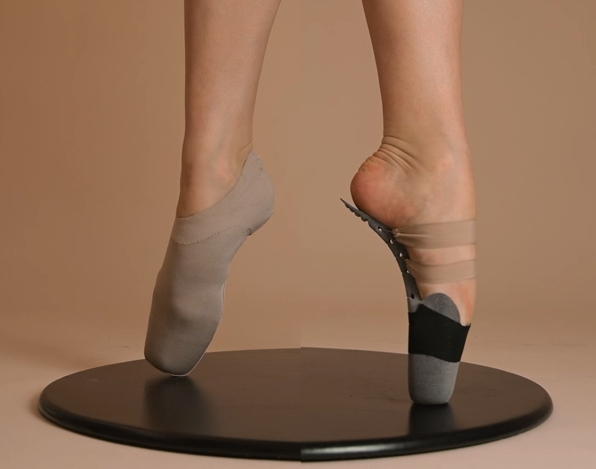
German dancewear company Act’ble has partnered with Barcelona-based additive-manufacturing specialist Something Added to produce a modular pointe shoe featuring a flexible 3D-printed inner sole.
The design seeks to address several longstanding problems associated with traditional pointe shoes, including short service life, lengthy break-in periods, pressure on the toes and limited accommodation of different foot shapes.
According to Act’ble, the shoe can last up to five times longer than a conventional pointe shoe because its individual parts can be replaced separately rather than requiring the dancer to discard the entire product when one component wears out.
Traditional pointe shoes may last only 10 to 20 hours
Conventional pointe shoes typically combine a rigid toe box made from layers of paper, fabric and adhesive with a stiff internal shank, leather sole and satin outer covering.
Although the construction enables dancers to perform on the tips of their toes, known as dancing en pointe, the shoes can deteriorate quickly under the repeated loading, moisture and movement associated with professional ballet.
A pair may remain usable for only 10 to 20 hours of dancing, after which the toe box, shank or other supporting structures may no longer provide sufficient stability.
Once one structural element fails, the complete shoe is normally replaced. This creates significant recurring costs for dancers and ballet companies while generating waste from materials that may not all have reached the end of their usable life.
Three-part modular design
Act’ble’s pointe shoe is divided into three primary replaceable elements:
- A 3D-printed inner sole
- A compression-fit knitted outer skin
- Adjustable laces
Each component can be selected or replaced according to the dancer’s size, performance requirements and wear pattern.
This modular approach means that a worn knitted upper or lace system can be exchanged without automatically replacing the printed sole. Similarly, the inner sole can be replaced while other usable parts are retained.
The company says the design can reduce unnecessary disposal while allowing dancers to maintain a more consistent fit between replacements.
Flexible TPU sole locks during pointe work
The central functional component is an inner sole produced from thermoplastic polyurethane, or TPU.
Rather than using a conventional rigid shank, the printed sole incorporates a series of engineered incisions and separate segments. These allow the foot to flex and articulate during ordinary movement.
When the dancer rises onto the toes, the segments close and lock together, creating the stability needed to support body weight in the pointe position.
Act’ble says this geometry is intended to resolve the traditional compromise between flexibility and support. The sole can move with the foot when flexibility is required but becomes more stable under the loading conditions of pointe work.
Because the TPU structure is flexible from the outset, the company says the shoe does not require the extensive breaking-in process commonly used to soften traditional pointe shoes.
Produced using HP Multi Jet Fusion
Something Added manufactures the soles in Barcelona using HP Multi Jet Fusion additive-manufacturing technology.
The partnership was established because Act’ble required a production process capable of reliably reproducing the sole’s complex geometry while maintaining material consistency and dimensional precision.
Additive manufacturing also allows the design team to modify and refine the internal structures without investing in new moulds for every development cycle.
Act’ble founder and former ballet dancer Sophia Lindner said the sole had to provide substantial support when the dancer was on the toes while still allowing the foot to articulate naturally during movement.
This combination of structural control and design flexibility illustrates how additive manufacturing can be used for more than producing visually distinctive footwear. It can create mechanical characteristics that would be difficult to achieve using a single traditionally manufactured component.
Toe box adapts to different foot widths
The toe box has also been designed to accommodate variation in forefoot width.
As the dancer inserts the foot, the box can widen to match its shape. An external tape can then be used to secure the chosen width.
Traditional pointe shoes are offered in different lasts, box profiles and widths, but achieving a precise fit can still require dancers to try several models or manually modify a shoe.
Act’ble’s adjustable structure is intended to reduce concentrated pressure by allowing the forefoot to occupy a width that more closely reflects the dancer’s anatomy.
The company reports that the design aims to reduce pressure on the toes and limit strain around the Achilles tendon. These remain manufacturer claims and would require independent clinical and biomechanical research to establish their effect on pain or injury rates.
Lace widths provide different levels of arch support
The shoe’s lace system can also be configured according to the dancer’s arch.
Narrower laces are intended for dancers with lower arches, while wider laces provide additional support for higher arches. Different widths can be combined for dancers whose requirements fall between those configurations.
Together with the adaptable toe box, compression upper and segmented sole, the laces are designed to distribute forces across a larger area of the foot rather than concentrating loading primarily at the toes.
The knitted skin includes compression zones intended to support the foot and control how pressure is transferred during movement. It functions as a close-fitting interface between the dancer and the printed structure.
Footwear fitting remains critical
Although digital manufacturing can provide new forms of adjustability, correct fitting remains essential.
Pointe work generates high forces through a relatively small supporting area. A shoe that is too narrow, too wide, too soft or incorrectly aligned may affect balance, control and comfort.
The modular design therefore does not remove the need for assessment by an experienced pointe-shoe fitter or dance-health professional.
Factors that may need to be considered include:
- Foot length and forefoot width
- Toe length and alignment
- Arch height and flexibility
- Ankle strength and range of motion
- Dancer experience and technique
- Training intensity
- Previous pain or injury
- Changes in fit during prolonged use
A design that works effectively for one dancer may not provide the same outcome for another, particularly where foot anatomy, strength and movement patterns differ.
Potential lessons for orthotic and prosthetic footwear
Although the Act’ble shoe was developed for ballet rather than medical use, its construction has relevance to the wider orthotic, prosthetic and customised-footwear sectors.
The project demonstrates how additive manufacturing can combine controlled flexibility, localised stiffness and replaceable components within one product.
Similar principles could potentially be applied to:
- Custom foot orthoses
- Ankle-foot orthoses
- Prosthetic-foot covers and footwear
- Therapeutic footwear
- Partial-foot prosthetic systems
- Sports braces
- Pressure-relieving insoles
A printed structure can be engineered to flex in selected areas while remaining rigid elsewhere. This allows designers to control mechanical behaviour through geometry rather than relying entirely on material thickness or separate reinforcement components.
For orthotic providers, this could support devices with more gradual stiffness transitions, improved ventilation or replaceable high-wear areas.
Modular design could reduce replacement costs
Modularity may also offer lessons for assistive-product services in the Middle East, Africa and South Asia.
Many customised devices must currently be replaced in full when one part becomes damaged or worn, even if the remainder is still functional.
Designing footwear or orthoses with replaceable interfaces, straps, covers or structural inserts could reduce lifecycle costs and simplify repair.
This may be particularly important in markets where imported products are expensive, supply chains are lengthy or patients have limited access to specialist workshops.
However, the economic benefit depends on replacement components remaining available and being easy to install. A modular product can only remain useful if manufacturers maintain consistent specifications and long-term supply.
Longer lifespan may reduce material waste
Act’ble positions the pointe shoe as a more sustainable alternative to conventional products because individual components can be retained until they are genuinely worn out.
The company says the printed sole’s TPU material and segmented geometry allow it to remain usable for up to five times longer than a conventional pointe-shoe structure.
A longer lifespan could reduce the number of complete shoes consumed by professional dancers, although the total environmental impact would also depend on manufacturing energy, material sourcing, transport and the recyclability of worn components.
Independent lifecycle assessment would be needed to determine whether the modular shoe produces a lower overall environmental footprint than established alternatives.
Ballet sector has traditionally been cautious about change
Pointe-shoe design has evolved relatively slowly because performance, appearance and tradition remain closely connected within classical ballet.
Newer designs using polymers, foam and additive manufacturing have promised longer life and improved comfort, but acceptance among dancers, teachers and artistic directors has varied.
Some professionals value the consistency and durability of modern materials, while others prefer the appearance, responsiveness and established fitting practices associated with handmade shoes.
Act’ble’s challenge will therefore involve more than technical performance. The company will also need to demonstrate that the shoe meets the aesthetic, artistic and practical expectations of professional dancers and ballet companies.
Additive manufacturing moves closer to functional footwear
The project reflects a wider trend towards using 3D printing to manufacture functional footwear components rather than prototypes alone.
Additive manufacturing allows product developers to produce complex lattices, flexible zones and personalised geometries that would be difficult to manufacture using conventional moulding or cutting techniques.
For clinicians and technicians working in orthotics and prosthetics, the most relevant aspect is the ability to design a product around the movement and anatomy of the individual user.
Act’ble’s modular pointe shoe remains a specialist dance product, and its reported durability and comfort benefits require wider independent evaluation. Nevertheless, it provides a useful example of how digital design, flexible materials and replaceable components can be combined to rethink footwear that has remained largely unchanged for generations.
- Original 3D Printing Industry report
- Act’ble 3D-printed pointe-shoe soles
- Act’ble
- Something Added
- HP Multi Jet Fusion technology
- International Association for Dance Medicine and Science
- International Society for Prosthetics and Orthotics
- World Health Organization assistive technology resources