

Artificial intelligence can generate highly realistic landscapes, products and people within seconds. Yet when asked to depict someone with limb loss or a prosthesis, the results are often inaccurate, stereotyped or completely absent.
People may appear with additional limbs, incomplete anatomy, incorrectly positioned prostheses or bodies that resemble science-fiction cyborgs rather than real prosthetic users. In some cases, image-generation systems refuse to create the requested picture at all.
Ottobock and Microsoft are seeking to address this gap through DearAI, a community-led initiative designed to give AI systems a more accurate understanding of people with limb loss and limb difference.
At the centre of the initiative is an open-source Community Library developed with people who use upper- and lower-limb prostheses. Rather than allowing technology companies or advertising teams to decide how disability should be portrayed, community members selected, reviewed and annotated the material themselves.
AI reflects the information it has been shown
Generative AI systems learn patterns from large collections of existing images and written descriptions.
When people with disabilities are absent or poorly represented in those datasets, the systems have little reliable information from which to generate accurate results.
The problem is therefore not necessarily that an AI model has been intentionally programmed to exclude people with limb differences. It is that the source material used to train and evaluate the model may not sufficiently reflect their lives.
Ottobock describes this as an issue of absence. Prostheses, mobility aids and realistic depictions of disability remain underrepresented in much of the imagery available online.
That absence can influence more than social-media images.
AI-generated content is increasingly used in advertising, education, publishing, healthcare communication and recruitment. If people with disabilities remain invisible or inaccurately represented, those systems may reinforce narrow public assumptions about what disability looks like and how people with limb differences live.
Andreas Onea describes being “digitally disabled”
Paralympian, television presenter and DearAI ambassador Andreas Onea has experienced these limitations directly.
Onea underwent a left-arm amputation at the shoulder following a car accident when he was six years old. When he attempted to use AI tools to generate an action-figure version of himself, the systems repeatedly produced incorrect results.
Some images showed him with two arms. Others depicted only part of an arm or an anatomically inaccurate residual limb. In some cases, the system reportedly refused to generate the image because it interpreted the requested depiction of amputation as inappropriate content.
Onea described the experience as being “digitally disabled”—excluded from participating in a widely shared online trend because the technology could not accurately represent his body.
For Onea, digital visibility is linked to social participation. If AI systems are unable to represent people with disabilities accurately, they may also exclude them from the visual culture increasingly being created through generative technology.
Community members decide what accurate representation means
The DearAI Community Library was designed around the principle that people with limb differences should define how they are portrayed.
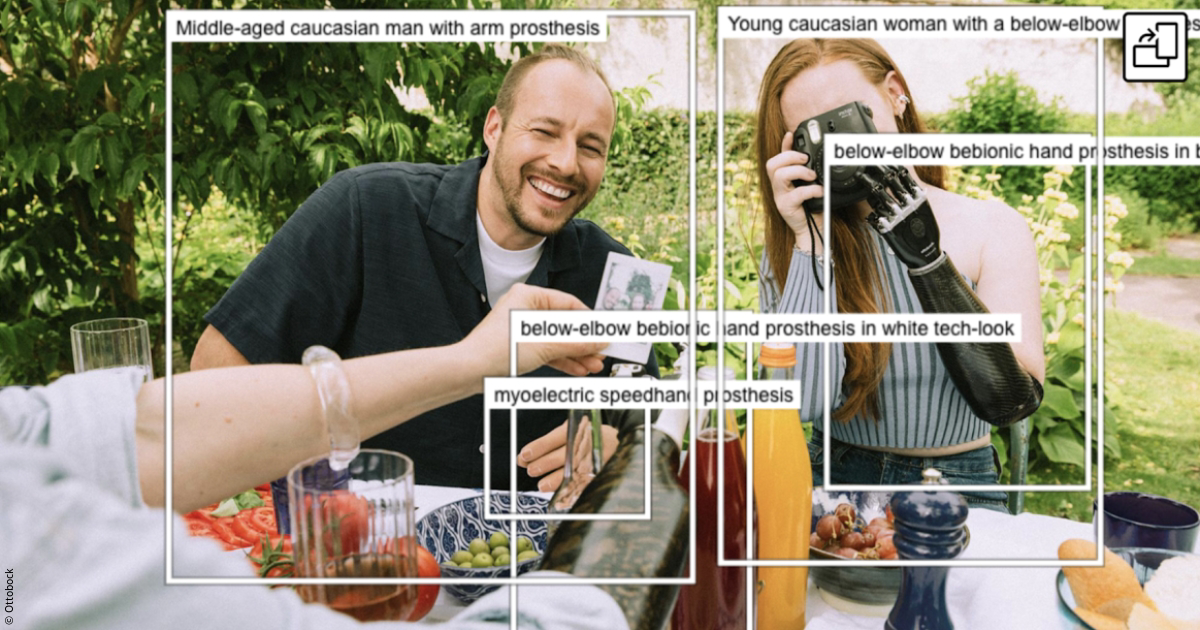
Community members reviewed images depicting people with arm and leg amputations in everyday settings. They selected suitable material, rejected inaccurate or stereotyped representations and added detailed annotations explaining what each image showed.
The project was divided into upper- and lower-limb groups.
The upper-limb group included people with differences or amputations affecting the hand, forearm, upper arm and shoulder. The lower-limb group included people with differences or amputations affecting the foot, lower leg and thigh.
Onea helped lead the upper-limb community.
The resulting datasets include people parenting, gardening, working, exercising and carrying out other daily activities—not only receiving medical treatment or competing in elite sport.
This matters because people with limb loss are frequently depicted in limited contexts: as patients, inspirational athletes or futuristic users of robotic technology. The library instead aims to show ordinary life in its full variety.
Open-source datasets released on Hugging Face
Ottobock released the DearAI Community Library publicly in July 2026.
The initiative includes separate limb-difference and prosthetic-representation datasets for upper- and lower-limb communities. Both are available through Hugging Face, a widely used platform for sharing AI models and training datasets.
At launch, each dataset contained approximately 400 images and up to 100 videos. More than 60 people from different countries contributed material that was subsequently reviewed and annotated by community members.
Microsoft researcher Anja Thieme said carefully selected, high-quality information may help improve AI models without requiring the extremely large quantities of poorly curated data often associated with model training.
The datasets are freely available, meaning developers, researchers and AI companies can use them to train and evaluate future models.
However, publication alone does not guarantee that every major AI system will adopt the material. Its impact will depend on whether developers incorporate the datasets into training, testing and model-evaluation processes.
Not made with AI—but made for AI
Ottobock has described DearAI as a campaign that was not created with AI but was deliberately made for AI.
The distinction reflects the purpose of the initiative.
Instead of using existing generative systems to produce campaign imagery—risking the same inaccuracies the project is attempting to address—Ottobock worked with real prosthetic users and created data that future systems can learn from.
Martin Böhm, Chief Experience Officer at Ottobock, said AI has not adequately seen the real lives of people with amputations and limb differences.
He also emphasised that neither Ottobock nor Microsoft should determine what constitutes appropriate representation. That authority should remain with the people directly affected.
This community ownership distinguishes the project from conventional corporate diversity campaigns.
The objective is not simply to display more inclusive advertising. It is to influence the underlying information from which future AI systems learn.
Avoiding both invisibility and cyborg stereotypes
Inaccurate AI representation can appear in several forms.
The most obvious is anatomical error, such as generating an additional hand, placing a prosthesis on the wrong side or showing a device that does not connect realistically to the body.
Another problem is complete omission. A prompt may describe a person with limb loss, but the generated image depicts someone without a disability.
A third issue is exaggeration.
People who use advanced prostheses are frequently represented as futuristic cyborgs with metallic limbs, illuminated components or superhuman abilities. While this may create dramatic imagery, it can separate prosthetic users from everyday human experience.
This framing can also create unrealistic expectations about available technology.
Modern prostheses can provide substantial functional benefits, but they do not restore natural sensation and movement in every situation. Depicting all users as technologically enhanced risks overlooking socket discomfort, access barriers, rehabilitation needs and the ordinary realities of living with limb loss.
The DearAI initiative instead asks AI systems to portray people as parents, professionals, students, friends and community members who happen to have limb differences or use prostheses.
Representation has particular relevance across IMEA
More accurate AI representation is especially important across India, the Middle East and Africa.
People with disabilities in the region may already face limited visibility in media, education and employment. Images used in public-health campaigns or corporate communication may rely heavily on Western stock photography that does not reflect local clothing, cultures, environments or assistive technologies.
An inclusive dataset should eventually represent diversity across:
- Skin tones and ethnic backgrounds
- Religious and cultural clothing
- Urban and rural settings
- Different levels and causes of limb loss
- Locally available prosthetic technologies
- Children, adults and older people
- Humanitarian and non-humanitarian contexts
- People who use prostheses and those who do not
- Different occupations and family roles
A person with limb loss in Lagos, Mumbai, Amman or Riyadh should not be represented only through imagery based on European or North American clinical settings.
The project’s global contribution model provides an opportunity to expand representation, but continued participation from IMEA communities will be important if the datasets are to reflect the full diversity of prosthetic users.
AI is already influencing modern prosthetic control
The Microsoft interview also highlights a second relationship between AI and limb loss: AI is not only creating images of prosthetic users but is increasingly supporting the function and delivery of prosthetic devices.
Ottobock uses pattern-recognition technology in upper-limb prosthetics to interpret muscle signals from the residual limb.
Electrodes within the socket detect electrical activity generated when the user attempts a movement. Machine-learning systems can identify patterns within those signals and associate them with intended prosthetic-hand actions.
This allows the system to learn from the individual user rather than requiring the person to reproduce a small number of rigid muscle commands.
Onea now uses an updated Michelangelo hand system with six electrodes and personalised myoelectric control.
Through Ottobock’s connectgrip application, he can adjust how the prosthesis interprets signals and disable movements that could be triggered unintentionally in particular situations.
For example, he can adapt the device before presenting on television so that an accidental signal does not cause the prosthetic hand to release his cue cards.
Learning occurs within regulated limits
The idea of a prosthesis that “learns” can create the impression that the device independently changes its behaviour without restriction.
Medical-device regulation places limits on this process.
According to Christoph Schlotterbach, who leads development of Ottobock’s myosmart control system and connectgrip app, machine learning is used within the smartphone application to recognise movement patterns.
The processor inside the prosthesis itself continues to operate using fixed, pre-programmed algorithms.
This distinction is important for safety.
A lower-limb prosthesis, for example, cannot be allowed to independently learn an incorrect movement pattern that increases the risk of a fall. Any adaptive functionality must remain within validated and controlled parameters.
AI could improve prosthetic socket design
Ottobock is also exploring the use of AI to improve prosthetic socket design.
The socket is the interface between the user’s residual limb and the prosthesis. Even the most advanced knee, foot or hand will provide limited benefit if the socket causes pain, instability or skin damage.
Traditional socket design combines clinical assessment, casting or scanning, model modification and the experience of the prosthetist. Outcomes can vary according to the complexity of the residual limb and the practitioner’s skill.
Ottobock’s Perfect Socket project aims to use historical fitting data and AI-supported modelling to generate more consistent digital socket designs.
Paul Peyer, who leads global product management for prosthetics at Ottobock, said AI-created models could eventually help providers achieve successful fittings more quickly and reliably.
Potential benefits could include:
- Fewer repeated fitting appointments
- Reduced pressure injury
- Greater socket stability
- Faster digital modification
- More consistent manufacturing
- Better access in regions with limited specialist expertise
However, AI-generated designs would still require clinical oversight.
Residual-limb tolerance, tissue condition, sensation, activity level and patient feedback cannot be fully understood from geometry alone. The prosthetist’s judgement will remain central to assessing whether a socket is safe and appropriate.
Digital technology can support the complete patient journey
Ottobock says AI and digital tools are increasingly being used throughout the prosthetic-care pathway.
Potential applications include:
- Patient registration
- Three-dimensional body scanning
- Digital socket design
- Rehabilitation support
- Device configuration
- Reimbursement administration
- Remote monitoring
- Workshop and production management
The company already offers a digitally connected fitting process that can move from residual-limb scanning to CAD modification and computer-assisted fabrication.
Böhm described AI as a strategic pillar for Ottobock and said Microsoft technology supports several of the company’s digital systems.
The longer-term ambition includes connected prostheses that can receive secure software improvements during their service life, although any changes would remain subject to medical-device regulations and safety controls.
Better data could expand access—but also raises questions
AI-supported prosthetic design has potential relevance for countries with limited numbers of experienced prosthetists and technicians.
A digital platform could help a local clinician scan a patient and collaborate remotely with specialist designers or fabrication centres.
Historical fitting data may also help less experienced teams identify design options more consistently.
However, the use of patient data raises important questions:
- Who owns the residual-limb scans?
- Can data be used to train commercial systems?
- Is consent fully informed?
- Can a patient withdraw their information later?
- Where is the information stored?
- Are models trained on diverse populations?
- Can independent clinics access the technology fairly?
- Does the system support or replace local professional development?
Inclusive AI requires more than adding representative images.
It also requires transparent governance, appropriate consent and meaningful involvement from the communities whose bodies and clinical information are being used.
Community-led AI offers a model for rehabilitation technology
The DearAI Community Library demonstrates an alternative to developing technology first and consulting users afterwards.
People with limb differences were involved in defining the problem, selecting the material and describing what accurate representation should look like.
This principle could be applied more broadly across rehabilitation technology.
People who use prostheses and orthoses could help shape:
- Clinical outcome measures
- Socket-comfort evaluations
- Device-control interfaces
- Mobile applications
- Remote-care platforms
- Educational resources
- Product photography
- AI safety testing
The phrase commonly used by disability advocates—“nothing about us without us”—is particularly relevant when technology is trained on personal images, movement patterns and medical data.
Accurate visibility is only one part of inclusion
Improving AI imagery will not by itself solve barriers in prosthetic access, employment, education or public infrastructure.
A person can be represented accurately in an advertisement while still being unable to obtain an appropriate prosthesis or enter an inaccessible building.
Nevertheless, digital representation matters because images influence public expectations.
They help determine who is seen as employable, independent, fashionable, athletic, professional or part of family and community life.
As AI-generated content becomes more common, the datasets underlying that content will shape how disability is understood.
DearAI addresses that challenge at an early stage by giving people with limb loss and limb difference a direct role in teaching AI how they want to be seen.
The initiative also shows the two contrasting faces of AI in prosthetics.
Used poorly, it can erase people, distort their bodies and reinforce stereotypes.
Used responsibly, it can improve prosthetic control, assist clinicians, personalise digital services and help people participate more fully in daily life.
The difference lies not only in the technology, but in whose experience and knowledge are included when it is created.
- Microsoft: Dear AI, here’s how to portray amputees correctly
- Microsoft: Why better AI starts with the people it often misses
- Ottobock DearAI campaign
- Ottobock DearAI Community Library announcement
- DearAI datasets on Hugging Face
- Ottobock digitalisation and AI in prosthetic care
- Ottobock intelligent hand-prosthesis technology
- World Health Organization disability information
- International Society for Prosthetics and Orthotics