

Researchers have developed and prospectively validated a wearable sensor system designed to provide an objective measure of walking quality among people with lower-limb amputations.
The technology combines inertial measurement unit sensors with machine-learning software to produce a continuous result known as the gait goodness score, or GGS. The score is intended to help clinicians identify gait deviations and evaluate functional mobility without relying exclusively on laboratory-based motion analysis equipment.
The research, published in the journal Sensors, could support more accessible and data-driven gait assessment within prosthetic clinics, rehabilitation centres and outpatient physiotherapy departments.
Addressing the limitations of conventional gait assessment
Detailed prosthetic gait analysis has traditionally required specialist laboratories equipped with infrared cameras, force plates and trained biomechanics personnel.
Although these systems can provide highly accurate measurements, their cost, space requirements and operational complexity make them unsuitable for many routine clinical environments.
As a result, prosthetists and rehabilitation professionals often rely on visual observation, video analysis and established functional tests when assessing a patient’s walking pattern.
These approaches remain clinically important, but wearable sensors could provide an additional layer of objective information that helps practitioners quantify changes following prosthetic alignment, socket or component adjustments.
Four sensors capture movement above and below the knees
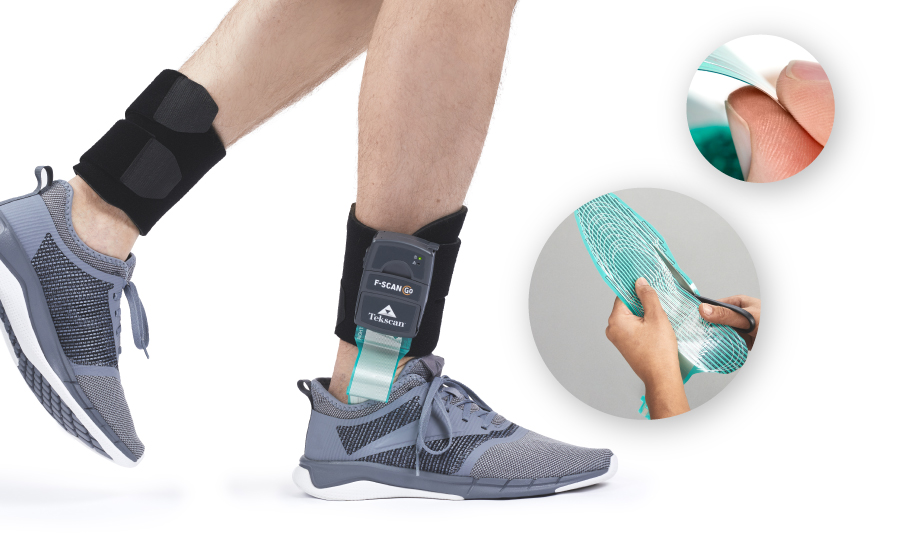
The newly validated system uses four inertial measurement units positioned above and below both knees, including sensors attached to the prosthetic side.
Each sensor records angular velocity and linear acceleration. The information is transmitted using Bluetooth Low Energy to custom software operating on an iPad.
The system identifies heel strikes and calculates a series of gait characteristics, including:
- Walking speed
- Step length
- Gait-cycle duration
- Single-limb support time
- Double-limb support time
- Peak knee flexion
Machine-learning models then analyse these characteristics and classify several possible gait patterns, including non-deviated walking, reduced balance over the prosthetic limb, reduced prosthetic toe loading and reduced prosthetic knee flexion.
The resulting gait goodness score ranges from zero to one, with a higher score representing better overall gait quality.
Validated across military and veterans’ clinics
The machine-learning model was originally trained using data from 71 people with unilateral lower-limb amputations and seven participants without disabilities.
Nearly 3,000 pairs of strides were assessed, with five licensed physical therapists providing reference classifications after reviewing video recordings of ten-metre walking tests.
The system was then prospectively evaluated among 120 participants attending military and Veterans Affairs outpatient facilities, including Walter Reed National Military Medical Center and the Miami VA Healthcare System.
Of the 120 participants, 83 provided valid sensor-based walking data that could be used to calculate the gait goodness score. Importantly, the machine-learning model was used without being retrained for the validation population.
Scores reflected differences in functional mobility
The wearable system successfully differentiated participants according to their Medicare Functional Classification Level, commonly known as the prosthetic K-level system.
People with greater ambulatory capabilities generally achieved higher gait goodness scores.
Participants with transtibial amputations recorded an average score of approximately 0.50, compared with approximately 0.47 among participants with transfemoral amputations. Researchers also observed a modest reduction in gait scores as participant age increased.
The gait goodness score correlated with a number of established clinical outcome measures. Higher scores were associated with faster walking speeds and stronger results on the Amputee Mobility Predictor, while lower scores were associated with longer Timed Up and Go test times.
The score also showed a moderate positive relationship with results from the Prosthetic Limb Users Survey of Mobility.
Potential applications in prosthetic practice
For prosthetists, one of the system’s most significant potential applications is the ability to evaluate how clinical interventions affect a patient’s walking pattern.
For example, a clinician could compare gait scores before and after changing:
- Prosthetic alignment
- Socket fit
- Knee resistance or damping
- Foot selection or stiffness
- Suspension settings
- Rehabilitation exercises
Because the software can operate on a standard mobile device without requiring cloud-based processing, the results could potentially be generated during a routine appointment.
The system may therefore help practitioners determine whether an adjustment has produced a meaningful improvement rather than relying solely on visual observation or patient feedback.
However, the researchers emphasised that further longitudinal studies are required before the gait goodness score can be widely adopted as a clinical decision-making tool.
Opportunities for IMEA rehabilitation services
Portable gait-analysis systems may be particularly relevant across the Middle East, Africa and South Asia, where many prosthetic and rehabilitation facilities have limited access to dedicated motion-analysis laboratories.
A sensor-based system operating through a tablet could make objective gait assessment more accessible to smaller rehabilitation centres, mobile clinics and outreach programmes.
Such technology could also help standardise assessments across clinical networks. The same testing protocol could potentially be used by different prosthetists, therapists or rehabilitation centres to monitor patient progress over time.
In humanitarian and conflict-affected settings, where large numbers of people may require rehabilitation following traumatic amputation, portable gait-analysis tools could support more consistent follow-up while reducing dependence on complex laboratory infrastructure.
Their clinical value would still depend on affordability, practitioner training, reliable sensor placement and validation across more diverse populations, including people using different prosthetic knees, feet, sockets and suspension systems.
Moving towards continuous mobility monitoring
The researchers believe wearable gait systems could eventually move beyond short walking tests conducted inside clinics.
Future versions may allow patients to wear sensors during everyday activities, enabling rehabilitation professionals to monitor mobility and detect changes that may not appear during a controlled assessment.
Continuous monitoring could help identify developing gait asymmetries, deterioration in socket fit, reduced prosthetic confidence or changes in functional ability.
The technology could also be integrated with auditory or haptic biofeedback systems. A prosthetic user might receive an immediate signal when the system detects reduced loading, limited knee flexion or another gait deviation.
This could create a closed-loop rehabilitation system in which movement is measured, interpreted and corrected in real time.
Wearable sensors are unlikely to replace the clinical judgement of prosthetists and rehabilitation professionals. However, by converting complex movement information into a practical and repeatable score, they could make objective gait analysis more accessible and strengthen evidence-based prosthetic care.
- Original AZoSensors report
- Research article in Sensors
- Amputee Mobility Predictor information
- PLUS-M mobility assessment
- International Society for Prosthetics and Orthotics
- World Health Organization rehabilitation resources