

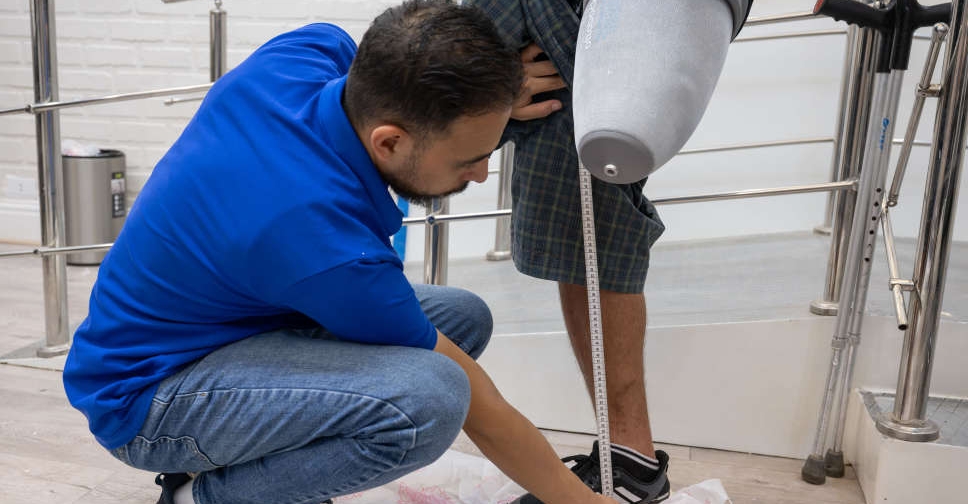
The UAE Floating Hospital in Al Arish, Egypt, has provided prosthetic limbs to a further 21 Palestinian amputees, continuing a rehabilitation programme aimed at restoring mobility and independence to people injured during the conflict in Gaza.
According to ARN News Centre, the patients undergo both medical and technical assessments before being fitted with prosthetic limbs according to their individual measurements. Physiotherapy and mobility rehabilitation are also incorporated into the programme.
The latest group brings the total number of Palestinians supported through the UAE’s Step of Hope programme to 72. The initiative was launched in June 2026 as part of Operation Chivalrous Knight 3, the UAE’s wider humanitarian response for Palestinians affected by the conflict.
Prosthetics combined with rehabilitation
The programme is notable for going beyond simply supplying prosthetic devices.
Each patient is assessed before prosthetic fitting and subsequently receives physiotherapy and mobility rehabilitation, creating a more complete pathway towards functional recovery.
For prosthetists and orthotists, this multidisciplinary approach is particularly important in conflict-related amputations, where injuries can be complex and patients may also be recovering from multiple surgeries, trauma, prolonged hospitalisation and periods of limited mobility.
Prosthetic provision in these circumstances often needs to evolve over time. Residual limb volume can change substantially during recovery, while muscle weakness, contractures and altered gait patterns may all affect the eventual prosthetic prescription.
The involvement of rehabilitation professionals alongside prosthetic fitting therefore gives patients a better opportunity to learn to use their devices safely and progressively regain mobility.
Step of Hope programme continues to expand
The UAE launched the Step of Hope initiative in June with the stated aim of helping Palestinians who had undergone amputations during the Gaza conflict regain mobility and rebuild their lives. (Dubai Eye 103.8)
By late July, the UAE Floating Hospital had already reported fitting prosthetic limbs for 51 Palestinians through the initiative.
The additional 21 fittings announced on 13 August bring the cumulative total to 72 beneficiaries, demonstrating that the programme is continuing rather than operating as a one-off prosthetic mission.
That continuity matters.
IMEA CPO previously reported on the first 51 fittings, and the latest update shows how the programme is developing into an ongoing rehabilitation pathway for Palestinians receiving treatment in Egypt.
Enormous unmet need remains
While programmes such as Step of Hope can have a profound impact on individual patients, the scale of amputations associated with the Gaza conflict means that demand for prosthetic and rehabilitation services remains exceptionally high.
The United Nations reported in May 2026 that thousands of people had undergone amputations since October 2023 and highlighted severe shortages of prosthetic specialists and materials. UN partners estimated that one in five amputees was a child and warned that, without a significant expansion in capacity, meeting existing prosthetic needs could take years.
Reuters has similarly reported that approximately 5,000 amputees in Gaza face major difficulties accessing prostheses because of shortages of materials, limited clinical capacity and restrictions affecting supplies used in prosthetic fabrication.
This creates a rehabilitation challenge extending well beyond initial prosthetic fitting.
Children require repeated socket replacements as they grow. Adults may require multiple sockets as residual limbs stabilise, while components will need maintenance, replacement and adjustment over many years.
Long-term prosthetic care will therefore require sustained investment in clinicians, technicians, rehabilitation professionals, workshops, components and supply chains.
A wider challenge for the regional O&P community
The Gaza crisis is increasingly becoming one of the largest conflict-related rehabilitation challenges facing the prosthetics and orthotics sector across the IMEA region.
Patients are receiving treatment not only within Palestinian territories but also through hospitals and rehabilitation organisations in countries including Egypt, Jordan and the UAE-supported humanitarian network.
This means regional cooperation between governments, hospitals, NGOs, prosthetic providers and manufacturers is likely to become increasingly important.
For the O&P profession, the requirement extends beyond donating components or manufacturing an initial limb. Sustainable programmes need clinical assessment, socket fabrication and modification, gait training, physiotherapy, follow-up, maintenance and eventual replacement.
The UAE Floating Hospital’s latest 21 fittings are therefore another important contribution to a much larger rehabilitation effort.
For the 72 people supported so far through Step of Hope, the programme represents an opportunity to regain mobility and independence. For the wider IMEA prosthetics community, it is also another reminder of the enormous long-term requirement for qualified prosthetic and rehabilitation capacity created by the conflict.
- ARN News Centre – UAE Floating Hospital fits prosthetic limbs for 21 Palestinian amputees
- Dubai Eye 103.8 – UAE launches Step of Hope programme
- IMEA CPO – UAE Floating Hospital Provides 51 Prosthetic Limbs to Palestinian Amputees
- United Nations – Humanitarian update on amputees and prosthetic needs
- IMEA CPO